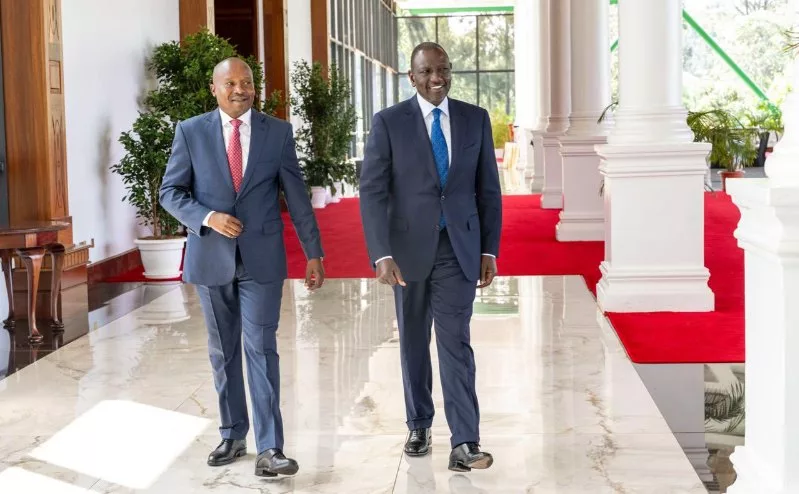
 Deputy President Kithure Kindiki and President William Ruto at State House, Nairobi. /FILE
Call it the deputy president or the vice president — Kenya’s number two position in the political hierarchy appears to be cursed, at least as far as succession politics are concerned.
The apparent curse traces its roots to April 1966, when Jaramogi Oginga Odinga resigned as Kenya’s first vice president.
Once bosom buddies with President Jomo Kenyatta, the two fell out two years into their political bromance, leading to Odinga’s resignation on April 14, 1966.
Their fallout was ideological. In his autobiography 'Not Yet Uhuru', Odinga referenced his belief that even after independence from Britain, the oppression of opposition politics persisted, meaning Kenya had still not attained real freedom.
Although he had never been officially designated as Mzee’s definitive successor, Kenyatta’s inner circle and conservative elite never intended for Odinga — a self-declared socialist with ties to Eastern Bloc nations — to inherit the presidency.
In the lead-up to his shock resignation, KANU changed its party structures to dilute Odinga’s national authority, replacing a single powerful party vice-chairmanship with eight provincial vice presidents.
Realising he was being systematically blocked and targeted by the same regime he served as its second-in-command, Odinga threw in the towel, resigned and formed the Kenya People’s Union (KPU).
Joseph Murumbi, Kenya’s second vice president, was in office for just six months before resigning on November 30, 1966, citing the government’s departure from the principles so many had suffered for.
But it was not until Daniel Moi was appointed Kenya’s third vice president that the troubles surrounding the VP seat became more pronounced.
Moi held the vice presidency for more than 11 years, making him the country’s longest-serving vice president.
While constitutionally designated as Kenyatta’s successor in the event that the President could not finish his term, influential politicians in Kenyatta’s inner circle, often referred to as the Kiambu Mafia, tried to change the law in 1976 to block the vice president from automatically taking over for 90 days if the President died.
Kenyatta reportedly tacitly turned a blind eye to the plots to sideline his long-serving confidant and ally, with Attorney General Charles Njonjo strongly defending the constitutional succession.
Njonjo warned that imagining the death of the President was treason, which stopped the push for change and allowed Moi to take office as interim president when Kenyatta died in 1978.
Backed by key figures such as Njonjo and Mwai Kibaki, Moi quickly unified support, moved past his rivals and was declared the sole candidate of the ruling party, KANU, officially taking power following the November 8, 1979 General Election.
Moi picked Kibaki as his vice president on October 14, 1978. They would gradually fall out over the next 10 years.
It started with demotions and loss of influence.
In 1983, Moi reshuffled the Cabinet, stripped Kibaki of the powerful Ministry of Finance and reassigned him to the less influential Ministry of Home Affairs.
After the 1988 General Election, Moi dropped Kibaki as vice president altogether and demoted him to the Ministry of Health.
Josephat Karanja was appointed the new vice president.
As pressure mounted to end single-party rule in KANU, Kibaki chose to dissociate himself from the establishment.
In December 1991, he resigned from the Cabinet, quit KANU and formed the Democratic Party (DP).
Exit Kibaki, enter George Saitoti.
Moi appointed Saitoti as the sixth vice president on May 1, 1989, after Kibaki’s successor, Josephat Karanja, resigned in March 1989 following a vote of no confidence and pressure from political opponents.
Saitoti’s hold on the vice presidency ended when Moi fired him on August 30, 2002, after a bitter succession dispute.
Moi stripped Saitoti of his positions as vice president and Minister for Home Affairs in a radio broadcast announcement on KBC, leaving the vice presidency vacant for the remainder of his term.
The two fell out after Moi chose Uhuru Kenyatta as his preferred successor for the 2002 presidential election, bypassing Saitoti, who had long expected to inherit the position.
The fallout happened in full view of the media during the KANU National Delegates Conference at Kasarani Stadium on March 18, 2002.
Moi dissolved the single national vice chairman post held by Saitoti and replaced it with four regional vice chairman positions, omitting Saitoti from the line-up in favour of Uhuru.
With the cameras rolling, Saitoti approached Moi to question why his name was missing, but Moi bluntly dismissed him in public.
Saitoti stepped aside from the immediate contest with these immortalised words: “I know there are many of you who wanted me to contest, is that not so? There comes a time when a nation is more important than an individual, one day I will be proved right.”
Following the promulgation of the 2010 constitution, Kenya shifted the title from vice president to deputy president to align the office with the new supreme law, which introduced joint presidential-deputy tickets and removed the old VP’s separate ministerial duties.
Despite the enhanced job security that came with the new arrangement, the first three occupants of the seat under the new dispensation have not had it easy.
William Ruto, the first deputy president, faced intense political fallout with his boss, Uhuru Kenyatta, soon after their re-election in 2017.
He was sidelined, his office and allies targeted by state machinery and, following the March 2018 handshake, Uhuru eventually backed his former rival-turned-ally Raila Odinga for the 2022 presidential election.
Ruto would eventually beat Raila in the election, making history as only the second second-in-command in Kenya’s history to ascend to power as President.
His running mate, Rigathi Gachagua, became the country’s second deputy president.
A supremacy battle between the two would later lead to Gachagua’s impeachment in October 2024.
Their political fallout stemmed from policy disagreements, differences over governance style and alleged insubordination.
Ruto accused Gachagua of defying the government manifesto, alienating other leaders and fighting with senior state officials rather than focusing on development.
Gachagua claimed the Mount Kenya region was sidelined and betrayed by the Kenya Kwanza administration, leading to his dramatic removal and replacement by Kithure Kindiki.
Kindiki, the man of the moment, now also appears destined for turbulent times as succession politics gather momentum.
Following ODM’s inclusion in the broad-based government, the Orange party is angling for the deputy president slot, with pressure mounting on Ruto to pick Wycliffe Oparanya as his running mate in the 2027 General Election.
If ODM’s demands are ignored, there are implicit threats that the party could pull out of its arrangement with Ruto, making Kindiki a target for removal to preserve the broad coalition.
Speculation that Kindiki was being systematically isolated from within the administration to make room for fresh political alignments gained traction after a directive from the Head of Public Service stripped Kindiki of his role in intergovernmental coordination and devolution, reassigning it to Prime Cabinet Secretary Musalia Mudavadi.
Although Kindiki and government operatives dismissed this as “fake news”, observers viewed it as a ploy by Ruto’s inner circle to force his resignation.
Other reports suggested Ruto may have promised Mudavadi the 2027 running mate ticket following the dissolution of the Amani National Congress (ANC) into UDA.
Besides the alleged internal friction, Kindiki is facing immense pressure from Gachagua, who is running an aggressive grassroots campaign that has shadowed Kindiki’s development tours.
Gachagua has labelled Kindiki, a native of Mt Kenya East, a freeloader who cannot consolidate control over the larger, populous Kikuyu electorate in Mt Kenya West.
The recent crushing defeat UDA suffered at the hands of Gachagua’s Democracy for the Citizens Party (DCP) in the Ol Kalou parliamentary by-election has also compounded Kindiki’s troubles.
The loss triggered panic within Kenya Kwanza, leading allies to suggest that Kindiki cannot deliver the crucial Mt Kenya vote in the 2027 election.
Amid the mounting speculation and the apparent dilemma he finds himself in, Kindiki has tried to direct focus towards securing Ruto’s 2027 re-election while simultaneously walking a fine line by hinting at his own potential 2032 bid.
“Next year is the last time we will be voting for Ruto as President then he will go on retirement like Uhuru Kenyatta. And then what?” Kindiki said during an event in Meru on July 25.
In an apparent response to reports that Mudavadi could be picked as running mate, he said: “This person they want to bring us here has been in power for decades but the road to his own home is not even tarmacked, tarmac road is 300 kilometers from his home.”
His allies have equally dismissed assertions that the DP’s seat is under threat.
“The seat of Deputy President is not vacant, we have Prof Kithure Kindiki, a man who has performed well in being principal assistant to the President. He has actually outperformed himself; he’s a nationalist,” Public Service CS Geoffrey Ruku said during an interview on Citizen TV on July 27.
He said Ruto had come out strongly to express confidence in his deputy, so much so that debate about whether or not he would be his running mate in 2027 did not even arise.
“Those who are looking down upon Kindiki, a time is coming when they will try to look for an opportunity to shake the hands of Kindiki, and they will not get that opportunity.”
Embu Senator Alexander Mundigi said any talk about the DP’s seat going to another region was propaganda.
“Those are newspaper stories, we know the President loves Mt Kenya and he gave us the deputy’s seat in the proper way and they have been working very hard so don’t be divided by people who don’t want Kenya to progress well,” he said on Wednesday.
Amid the debate, whether Kindiki will weather the storm and retain his seat is an issue only time will tell as realignments continue to take shape ahead of the polls.