The National Council on the Administration of Justice (NCAJ) has approved the draft Sexual Offences Bill, 2026, in a major step towards strengthening Kenya's legal framework against sexual and gender-based violence, while also unveiling a raft of reforms aimed at improving justice delivery and preparing the country for the 2027 General Election.
The decisions were reached at the conclusion of the Council's 38th meeting, where members drawn from key justice sector institutions reaffirmed their commitment to building a justice system that is accessible, coordinated and centred on the needs of Kenyans.
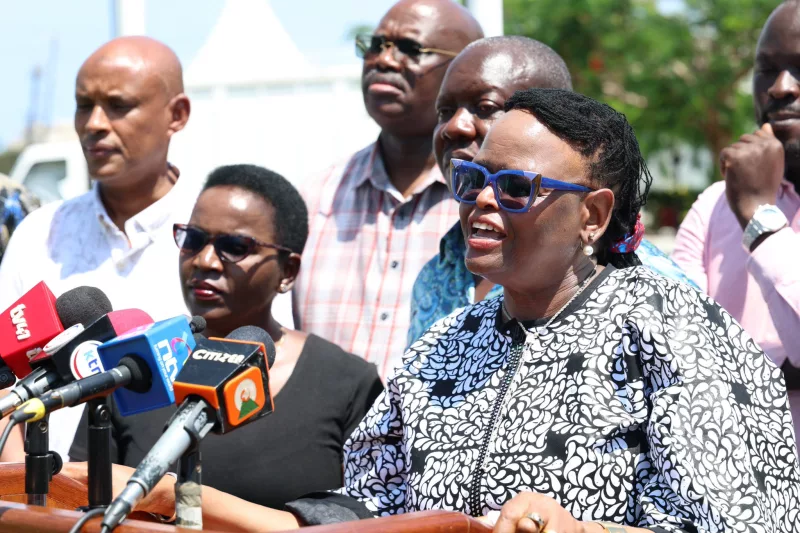
Chief Justice Martha Koome said the proposed legislation will modernise the country's response to sexual offences by addressing emerging crimes and improving support for survivors.
"Among the most significant outcomes of our deliberations was the formal approval of the draft Sexual Offences Bill, 2026, which will, upon final updates, be submitted to the National Assembly," Koome said.
She said the proposed law seeks to strengthen Kenya's response to sexual and gender-based violence, including technology-facilitated offences, femicide and other emerging forms of abuse.
"The proposed legislation seeks to strengthen Kenya's response to sexual and gender-based violence, including emerging technology-facilitated offences, femicide and other evolving forms of harm, while improving the protection, care and support available to survivors," she added.
The Council also resolved to bolster the justice sector's preparedness for the 2027 General Election following a briefing by the Independent Electoral and Boundaries Commission (IEBC).
Koome announced the reactivation of the NCAJ Ad Hoc Committee on Election Preparedness, which will be chaired by IEBC Chairperson Erastus Ethekon to coordinate institutions responsible for ensuring peaceful and credible elections.
"We took decisive steps to strengthen justice-sector preparedness for the 2027 General Election. Following a briefing by the Independent Electoral and Boundaries Commission, the NCAJ reactivated its Ad Hoc Committee on Election Preparedness under the leadership of the IEBC Chairperson," she said.
The committee is expected to enhance coordination among justice sector agencies in resolving election-related disputes and supporting a peaceful, orderly and credible electoral process.
Road safety also featured prominently during the meeting, with the Council calling for continued reforms by the National Transport and Safety Authority (NTSA) and other relevant agencies to reduce road crashes and improve the administration of justice.
"We have urged continued reforms by the National Transport and Safety Authority and other relevant agencies, within the rule of law, to reduce road fatalities, ease the burden on our courts and ensure timely justice for road users," Koome said.
The Council further approved a revised Identification Parade Form to be used by the National Police Service during criminal investigations.
According to Koome, the revised form is intended to strengthen fairness, transparency and compliance with constitutional and human rights standards during identification parades.
The meeting also endorsed the establishment of committees to study the feasibility of introducing Specialized Recovery Treatment Courts and Open Prisons as part of broader criminal justice reforms.
The proposed reforms are aimed at improving offender rehabilitation, reducing repeat offending and supporting successful reintegration into society.
"We also established committees to explore the feasibility of Specialized Recovery Treatment Courts and Open Prisons, innovative approaches that can strengthen rehabilitation, reduce recidivism and support the successful reintegration of offenders into society," Koome said.
In another key resolution, the Council considered National Guidelines on Interviewing Children in the Justice System.
The guidelines are intended to ensure children who come into contact with the justice system are treated with dignity, their rights protected and their best interests safeguarded throughout legal proceedings.
Beyond the policy decisions, the Council launched five reform initiatives designed to improve justice delivery across the country.
These include guidelines and a background study on people-centred justice, the Justice Sector ICT Policy and Action Plan, procedures for handling sexual and gender-based violence cases at the grassroots, and a common framework for addressing heavy workloads and case backlogs within justice institutions.
Koome dismissed claims that the justice sector was facing a crisis, saying institutions remained functional and continued to work collaboratively through the NCAJ framework.
"Let me assure Kenyans that there is no crisis in the justice sector. Our institutions remain functional, structured and committed to delivering justice," she said.
She noted that Court Users Committees across the country continue to provide a platform for resolving challenges facing the justice system and improving coordination among institutions.
"The administration of justice is a shared constitutional responsibility. No single institution can deliver justice in isolation. Our strength lies in our ability to collaborate, to listen, to innovate and to remain accountable to the people of Kenya," she said.
Koome said the Council would continue strengthening inter-agency cooperation, accelerating digital transformation across justice institutions and pursuing reforms that make justice more accessible, timely and people-centred.
"Our commitment is to place the justice seeker at the heart of everything we do, and to build a justice system that Kenyans can trust and rely upon," she said.
![Hamisi Mwaguya [in coulored baseball cap] at the Kings Arena at Khadija estate in Nyali subcounty on Tuesday / BRIAN OTIENO](https://cdn.radioafrica.digital/image/2026/10/340e650a-21d8-475b-b658-a429e82e9367.jfif)