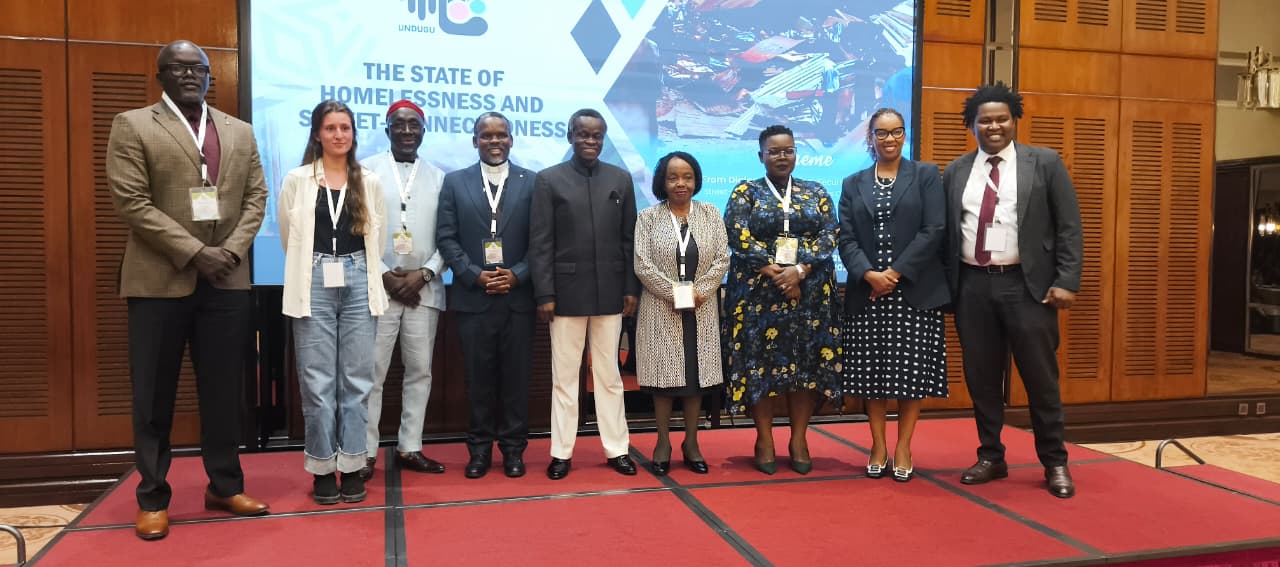
 Constitutional Lawyer and Pan Africanist PLO Lumumba (centre), Council of Governors Director of Programmes and Partnerships Kizito Wangalwa, Undugu Society Executive Director Eric Mukoya during the National Conference on the State of Homelessness and Street-Connectedness on July 29 / HANDOUT
The national and county governments have been urged to develop a coordinated policy framework to help counties effectively address homelessness and support street-connected communities across the country.
The call was made during the National Conference on the State of Homelessness and Street-Connectedness organised by the Undugu Society of Kenya under the theme From Dialogue to Action: Securing Space for Street-Connected and Homeless Communities in Kenya's Fast-Moving Urban Development Discourse.
Constitutional lawyer and Pan Africanist PLO Lumumba said Kenya has discussed homelessness for decades but lacked coordinated policies and institutions to tackle the problem.
"The government must have a clear policy position on the same and those clear policy positions must be translated into coordinated action," Lumumba said.
He said addressing homelessness should not be left to government alone, calling for collaboration between the national government, county governments, the private sector, faith-based organisations, civil society and communities.
"What will the private sector do? What will non-governmental organisations do? If we work in concert, we will resolve this problem," he said.
Lumumba said county governments should not wait for direction from the national government before acting.
"I hope the Council of Governors will seize this opportunity and not wait for the central government to tell them what to do. It must be done," he said.
Lumumba said homelessness fuels crime, teenage pregnancies and other social challenges, making it a development issue that requires long-term solutions rather than short-term interventions.
"The problem deserves resolution because it has other implications such as crime and early childhood pregnancy. Those issues cannot be allowed to take root in a society that wants to eliminate poverty," he said.
Council of Governors Director of Programmes and Partnerships Kizito Wangalwa said homelessness has never been mainstreamed in county government planning despite devolution placing social services closer to the people.
"The issue of homelessness is an issue of inclusion, and the inclusion agenda as a country is not yet hacked. We have left it as a conversation driven by civil society," Wangalwa said.
He said county governments have now embraced the homelessness agenda but require a framework to guide policy and implementation.
"We have onboarded the inclusion agenda, the homeless agenda. That is a new discussion now. We must embed it as a conversation on how we can move beyond affordable housing to addressing homelessness and restoring dignity to people living on the streets," he said.
Wangalwa said the Council of Governors recently developed a model policy on early childhood development and now wants to work with stakeholders to develop similar guidance on homelessness.
"We need the support of those in the sector to work on how county governments can fully embrace their responsibility to ensure homelessness does not exist within their jurisdictions," he said.
Undugu Society Executive Director Eric Mukoya said the conference sought to ensure homelessness becomes part of Kenya's development agenda and a key issue in governance discussions.
"We are here today to have a strong discussion on why homelessness and street-connectedness must be an agenda in the development of this country," Mukoya said.
He said homelessness reflects failures in governance rather than individual choices.
"Homelessness is not a condition; it is a failure of priorities. We have policies, we have laws and we have resources that are misallocated," he said.
Mukoya called for stronger partnerships between county governments, civil society and the private sector to support homeless communities, adding that official figures of about 18,000 street-connected persons underestimate the scale of the problem.
"Our experience and interactions with communities suggest the number could be between 300,000 and 500,000," he said.
Nairobi County Director of Social Services Robert Muema said the county has established shelters for girls, boys and older persons, where beneficiaries receive accommodation, healthcare, education and psychosocial support free of charge.
He said the county recognises homeless people as residents entitled to public services and commended the Undugu Society for complementing government efforts through rescue, rehabilitation and reintegration programmes.