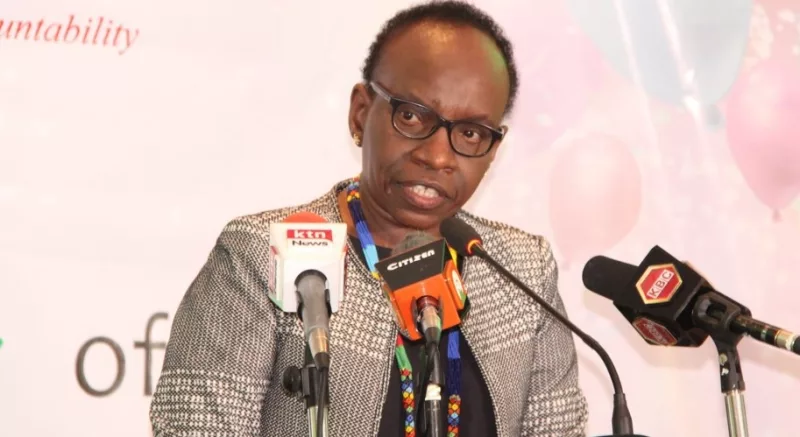
 Auditor-General Nancy Gathungu/HANDOUT
Auditor-General Nancy Gathungu has proposed far-reaching reforms to strengthen accountability, transparency and sustainability in Kenya's public borrowing.
The proposals include establishing a comprehensive Public Debt Registry and enhanced parliamentary oversight of debt management.
Gathungu presented the proposals before the National Assembly's Public Petitions Committee in response to a petition seeking stronger oversight, transparency and intergenerational equity in the management of public debt.
The petition comes at a time when Kenya has been classified by the International Monetary Fund (IMF) and the World Bank as being at a high risk of debt distress, highlighting growing concerns over the country's debt sustainability.
In her submission, Gathungu said public debt remains a matter of significant public interest because of its far-reaching implications for fiscal sustainability, public service delivery and the economic welfare of both present and future generations.
"Responsible sovereign borrowing and lending are therefore matters of both national and international concern," she told the committee.
The petition argues that public debt has become a major governance challenge with significant implications for fiscal sustainability, service delivery and long-term economic development. It raises concerns over Kenya's rising debt burden and the risks it poses to future generations.
Among the proposals contained in the petition are stronger parliamentary scrutiny of public debt management, establishment of a comprehensive and publicly accessible Public Debt Registry, institutionalization of independent expert analysis in debt-related decision-making, structured participation of citizens and civil society in debt governance, and the incorporation of intergenerational equity considerations into borrowing policies.
Gathungu warned that persistent fiscal imbalances have continued to push the country's debt levels higher.
She told lawmakers that Kenya's public debt stood at Sh11.825 trillion as of June 30, 2025, with the debt-to-GDP ratio averaging 67.8 per cent, significantly above the government's projected threshold of 55 per cent by 2028.
She further noted that the country's debt servicing burden continues to consume a substantial share of government revenue.
According to the Auditor-General, the debt service-to-revenue ratio stood at 66 per cent in June 2025, leaving the government with only 34 per cent of its revenue to finance recurrent expenditure and development programmes.
"This constrains the fiscal space," Gathungu said, noting that a large portion of government revenue is now directed towards debt repayment rather than service delivery and investment.
To improve transparency, the Office of the Auditor-General backed the establishment of a centralized Public Debt Registry, saying audit findings have consistently shown that the absence of a regularly updated debt database hampers verification of debt balances, loan disbursements, repayment obligations and project implementation.
Gathungu said such a registry would strengthen transparency, auditability, parliamentary oversight and public accountability.
She recommended that the registry contain detailed information on every public loan, including loan identification details, creditor information, the purpose of borrowing, contracted amounts, disbursements, outstanding balances, interest rates, currency denomination, maturity profiles, debt service schedules, government guarantees and the implementation status of debt-funded projects.
The Auditor-General further proposed that the registry be established through legislation, with clearly assigned custodial responsibility, periodic audits and regular public reporting.
Gathungu also called for the institutionalization of independent technical analysis before major borrowing decisions are made.
She said significant loans should be supported by debt sustainability assessments, fiscal risk analyses, macroeconomic forecasts, cost-benefit analyses, feasibility studies and long-term fiscal projections to strengthen evidence-based decision-making by Parliament.
On the utilisation of borrowed funds, she emphasised that accountability should go beyond confirming receipt of the money.
Public institutions, she said, must demonstrate that borrowed resources were used for their intended purposes, projects were completed efficiently, expected benefits were achieved and the borrowing ultimately delivered value to the public.
She urged the government to strengthen monitoring and evaluation frameworks and publish regular reports on the implementation and outcomes of debt-funded projects.
To improve long-term debt sustainability, Gathungu also recommended that the government continue exploring cost-effective financing options, extend the maturity profile of public debt where appropriate, optimise concessional borrowing and deepen domestic debt markets.
Her proposals are expected to inform the committee's consideration of the petition as Parliament weighs measures aimed at strengthening Kenya's debt governance amid mounting fiscal pressures.