
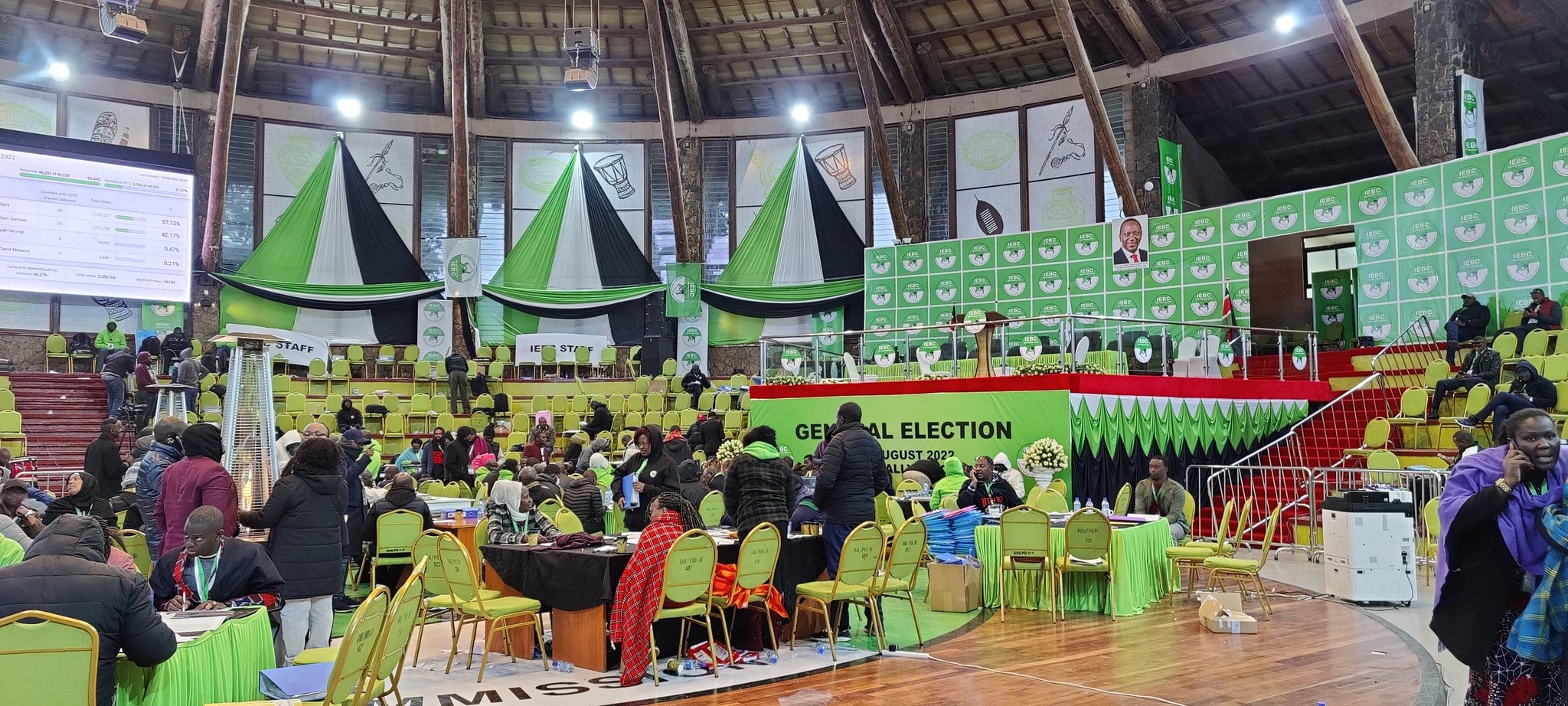
 Bomas of Kenya National Tallying
 A proposed Election Laws (Amendment) Bill, 2026, deletes the provision in the Elections Act that requires IEBC to establish a mechanism for livestreaming results as they are announced at polling stations.
This means the live results displayed by IEBC at the National Tallying Centre may not be there in 2027.
The media has often relied on those statistics to inform the public.
The livestreaming is part of a transparency safeguard that was put in place to secure the credibility of presidential elections after the 2007 poll chaos.
The change is contained in Section 19 of the Bill, which proposes to amend Section 39 of the Elections Act.
The Bill specifically states that Section 39 will be amended ‘by deleting subsection (1G)’.
Under the existing Section 39(1G), IEBC is required to establish a mechanism for the ‘livestreaming of results as announced at polling stations’.
The law further provides that the streamed results are ‘for purposes of public information only’.
This means Kenyans will no longer have an express statutory guarantee that they can watch election results being announced at polling stations in real time.
“It amounts to the categorical removal of the statutory requirement for livestreaming of results from the polling stations to the national tallying centre,” constitutional lawyer Bobby Mkangi told the Star.
“This is taking us back, unfortunately. The livestreaming results is to meet the constitutional requirement for IEBC to conduct elections in a credible, transparent and verifiable manner.”
“Any law that diminishes the constitution is taking us back to the pre-2010 constitution days,” Mkangi said.
Even so, the move does not mean the Independent Electoral and Boundaries Commission (IEBC) is abandoning election technology.
The polling station results and tallied constituency results will still be electronically transmitted to the national tallying centre.
However, for Kenyans to know the results, they will have to wait for IEBC to verbally announce them or alternatively manually download the forms.
During the 2013, 2017 and 2022 presidential elections, millions of Kenyans followed the livestreaming results process at the national tallying centre.
Elog national coordinator Mule Musau said the legislation should be viewed from the perspective of how it allows IEBC to do due diligence on the results.
“We have agreed that as long as results from the polling station are an accurate record, the livestream is not necessary. It is an ongoing conversation. Elog is even proposing the abolition of the national tallying centre,” Musau said.
The draft Bill further seeks to tinker with how the Erastus Ethekon-led IEBC would verify results in the event of a conflict between electronically and manually transmitted results.
The Bill states, “The commission shall verify that results transmitted are an accurate reflection of the results tallied, verified and declared at the respective polling stations.”
The current law says the commission is to verify that the results are ‘an accurate record of the results tallied, verified and declared at the polling stations’.
The section which provides that required IEBC to restrict itself to ‘accurate record of the results as declared at polling station, is also being removed.
The Bill is further deleting the provision which allowed IEBC to declare presidential results before receiving all constituency results.
Under the current law, the IEBC has the power to declare the presidential election results if the remaining results cannot change the outcome.
This means if the changes are approved by Parliament, Ethekon will have to wait for results from all the constituencies before declaring presidential results.
In 2017, the Court of Appeal established that presidential results declared at polling stations are final and cannot be changed during tallying.
The Supreme Court later reinforced the principle, describing the polling station as the ‘true locus’ of the voter's will.
The new Bill proposes to delete Section 39(1E), which currently deals with discrepancies between electronically transmitted and physically delivered presidential results.
It also proposes to delete Section 39(1F), which provides that failure to transmit or publish results electronically does not invalidate results properly announced and declared by the relevant election officials.
The proposed law also seeks to shift the power of nominations of candidates from political parties to the IEBC.
Under the current law, political parties have the power to ‘nominate’ their candidates (primaries).
But the Bill proposes that candidates simply ‘register’ with the IEBC, hence IEBC would take over the role of selecting or clearing candidates.
The deletion of the subsections comes alongside other radical changes in the Bill, including abolishing appeal rights for county assembly election petitions and eliminating the 50 per cent voter turnout threshold for recalls.
In the latter, the proposed law is also making it easier for petitioners to initiate recall of a Member of Parliament.
It provides that the process can be initiated within two years after the election and no later than 12 months to the next election.
It also reduces the threshold for support for such law to 30 per cent of registered voters in a constituency.
IEBC is further being compelled to provide a forensic image of the server, memory cards or any other materials as ordered by court.
The issue of access to the server played out significantly in the past petitions.
The proposed law says the materials would be provided ‘under confidential cover for scrutiny by the court’.
Thousands of MCAs also stand to lose out the opportunity for further appeals on their cases as the petitions would be terminated at the High Court.
In further amendments, IEBC would be freed from the responsibility of ensuring gender balance in party lists by political outfits.
It is provided that political parties would provide lists of nominees and have the first person being female, and alternate with males.
INSTANT ANALYSIS
Removing the statutory requirement for livestreaming could shift greater focus to polling-station forms and official announcements, while requiring all constituency results before declaring a presidential winner could make the tallying process more sequential. The changes also seek to clarify IEBC’s verification role and address long-standing questions around electronic transmission, scrutiny of election technology and the handling of disputed results.






