In Kenya, the right to play is specifically protected by law, not just in the Constitution broadly but also in the Children Act, 2022.
Despite this, educationists note that some children don't get opportunities to enjoy their right to play.
Among these children, according to the experts, are those living with disabilities, special needs alongside those from very humble backgrounds without necessary infrastructure, equipment and facilities to enjoy their right to play.
Kajiado county director of education Martin Cheruiyot says play is a crucial component for a child's development.
Cheruiyot said for children, play is like going to work. It is the essence of their mental, physical, emotional and psychological development.
"It's at the centre of the child's growth. You must appreciate that right from childhood," he said.
“Societies and contexts have enabled children to play in their own way, and when learners come to school, because of evolution of time and the need to have planned engagements, the time they would have had at home playing is spent in school.”
So it is critical, he adds, for those in the education sector who lead and support learning to profile the role of play in a child's development.
Article 53 of the Constitution sets the foundation. It lists children’s rights: name, nationality, free basic education, nutrition, shelter, health care, protection from abuse, and parental care.
It also says: “A child’s best interests are of paramount importance in every matter concerning the child.”
Courts have used this ‘best interests’ principle to enforce play spaces.
“It shall be the responsibility of the government and of every parent or guardian to permit and facilitate the enjoyment by his or her child of the right to leisure and play at any public recreational facility,” the Constitution says.
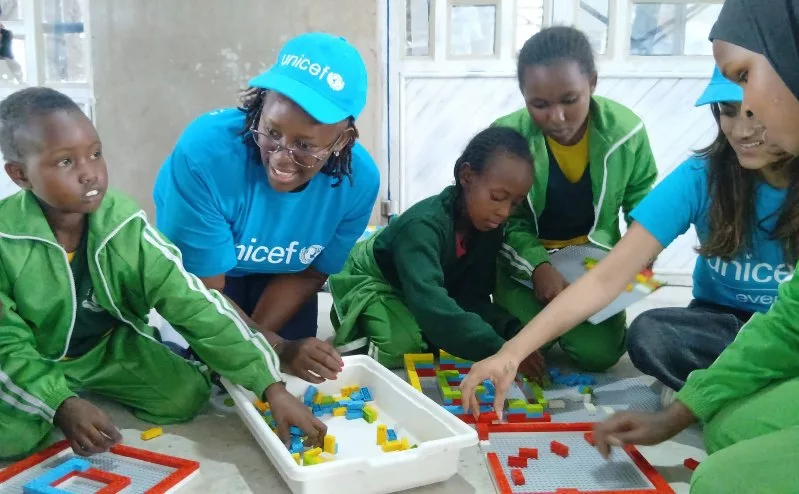
Among children, especially those living with disability in schools, Lego Braille Bricks plays a key role in promoting their right to play and inclusivity learning.
Lego Braille Bricks is a Lego set designed to help blind and visually impaired children and adults learn braille through play.
HOW IT WORKS
Each Lego brick has studs on top arranged to match a braille letter, number or symbol. The printed letter or number is also on the brick, so sighted and visually impaired people can play together.
They bricks are fully compatible with all other Lego sets. So you can build anything, not just letters.
The ‘Play with Braille’ set has 287 bricks in five colors: white, yellow, green, red and blue, plus two baseplates.
It’s available in English, French, German, Italian and Spanish.
Launched in 2020 with the Lego Foundation and RNIB, the Lego set is intended to make braille learning fun, tactile and family-friendly.
Children can leave secret coded messages, play games like Rock-Paper-Scissors and build literacy skills.
Kenya joined other nations in celebrating the International Day of Play on June 11.
The national government, through the Ministry of Education, partnered with some non-state actors to mark the day at Olkajuado Boys and Junior school in Kajiado county.
The partners include Unicef and Women Educational Researchers of Kenya.
Hundreds of children from both Olkajuado Boys and Junior School and their neighbouring Olkajuado Girls AIC participated in various games during the event.
Cheruiyot thanked the international community for speaking about this day.
"This refocused all of us to put play at the forefront of child's life, with the knowledge that for children, playing is developing, growing and learning in all aspects,” he said.
“Play helps children in aspects of collaboration, communication, critical thinking, creativity, problem solving, learning and self-efficiency. All these are well captured in the entirety of child play."
Cheruiyot said both regular and special children need equal rights to play.
He said through the government and non-state actors support, the Education ministry has crafted games that fit children's pattern of growth and development.
"We have braille games, and I am happy that Lego Foundation is also supporting the production of braille through Kenya Institute of Special Education, the equipment that these children need," Cheruiyot said.
“We also have special children who play games just like the rest of them, normal children.”
RESPECT FOR DIVERSITY
Directorate of Special Needs Education deputy director Grace Chepsagon said the Lego Braille Bricks programme is funded by Unicef.
"We selected these schools because they are part of those we are working with in the programme," she said.
“Play is important as far as growth of children is concerned.”
Chepsagon said children's growth is enhanced when they have the opportunity to play. Their bodies grow strong and they even grow healthier.
She urged teachers to give learners an enabling environment, where they can play safely, freely, engage, express themselves and give learners an opportunity to play like others, especially those with disabilities.
Chepsagon urged teachers to respect diversity, noting that learners with disabilities and those without have different activities and diverse ways of doing things. So teachers should support them according to their needs.
She said parents should facilitate a conducive environment for their children to play and also give them an opportunity to play when they have that time.
"Most children in urban centres are locked up in houses. Let children be allowed to play in a safe and secure environment," she said.
Chepsagon is the national coordinator for the Lego Braille Brick programme.
She said through Unicef's support, they launched the three-year project in 2025.
"The project took off last year. We launched it at Kise," she said.
“We trained Trainers of Trainees, teachers and distributed kits before rolling out the project.”
They are currently in 12 counties and will soon be getting to five more by end of this year. They are targeting 17 counties in the project, which ends next year.
Henry Omondi, a teacher at Olkajuado Primary and Boys’ Boarding School, said the Lego Braille Bricks project had revolutionised learning, especially of visually impaired learners in the institution.
"We have seen virtually impaired learners and sighted learners who have been brought together. They sit on same desk, play and learn. Lego Braille Bricks makes learning fun and enjoyable," Omondi said.
The public school has 500 learners, 66 of whom have special needs. Eight of the children are totally blind, while 26 others have low vision.
ENCOURAGING STEM
Brenda Mwasha, a teacher at Olkajuado AIC Girls’ Comprehensive School, said Unicef, in conjunction with the Ministry of Education, introduced them to the Lego Braille Bricks.
"They trained us on how to use them," she said.
“Bricks have both braille dots and print. The brick has an element of inclusivity and as a result, learners who are visually impaired can do different activities in and out of class.
“They touch the dots and can tell the letters. Their visually okay peers using the same dots can identify them because the bricks also have dots written in print. As a result, it makes learning fun.”
Masha, who teaches English in the school, said learners used Lego Braille Bricks in various activities.
"In all learning areas, bricks are used. Lego Braille Bricks have an element of play. Even as they learn, they can play. They have their own time to interact with the bricks," she said.
Women Educational Researchers of Kenya programmes manager Ezekiel Kuto, the Lego Braille Bricks project lead implementer, said they build teachers' capacities to support the braille component.
Kuto said they have trained about 76 teachers including education officials in Kajiado county.
"The feedback we get is that learners are excited. We have seen children building towers, roads, which is an indication that this learner has interest in engineering," he said.
“It's a way of identifying learners to do STEM at junior school in the Competency-Based Curriculum.”
Unicef Kenya Education officer Elizabeth Waitha said her work is to promote inclusive access to quality and equitable education.
"Unicef is all about children, an organisation that advocates and promotes the rights of children,” she said.
Waitha said there is a lot of emphasis on play in the Competency-Based Education framework. It’s the reason there is physical education in the curriculum, emphasising how impactful play is in learning institutions.
"This year, we wanted to focus on inclusive play, where children with disabilities and those without can interact and engage because we know that these children come from communities where they live and mingle with other people," she said.
She said Lego Braille Brick was an innovative approach in educating children in schools.
"Even as we give children light house chores, we should also create time to play and enjoy play as they grow," Waitha said.
“My urge is to request that public spaces be protected to ensure that children can still access safe spaces for playing.”
Waitha said visually impaired children should be given the opportunity to get enrolled in regular schools so as to learn closer to their homes.