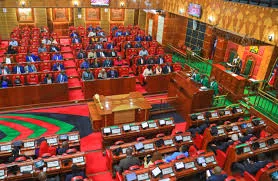
Public officials who bypass public participation requirements could face jail terms and personal fines after MPs backed a bill seeking to end impunity in government decision-making.
The proposed sanctions are contained in amendments to the Public Participation Bill, 2025, which has been endorsed by the National Assembly's Justice and Legal Affairs Committee (JLAC).
“The responsible authority shall be personally liable for failing to adhere to the law,” JLAC said it is report on the proposed law.
If enacted, the law will, for the first time, establish a legal framework governing how government institutions engage citizens before making laws, approving budgets or implementing major projects.
The Tharaka MP Gitonga Murugara-led committee has recommended that the responsibility for failing to conduct public participation should rest with individual officials rather than institutions.
"The fine for failure to adhere to the principles and guidelines should be enhanced and held against an individual, not just the institution," the committee said in its report.
The proposal followed concerns raised during public hearings that penalties imposed on public institutions are often ineffective because they are ultimately paid using taxpayers' money.
Participants in Kisumu and other counties argued that public officers responsible for violating constitutional requirements should bear the consequences personally.
Some stakeholders proposed fines as high as Sh10 million, saying the proposed penalty of Sh500,000 would not deter violations.
Nakuru participants proposed increasing the penalty to Sh1 million, while some suggested a fine of Sh5 million or one per cent of a project's cost, whichever is higher.
The committee agreed that stronger sanctions were necessary to curb repeated breaches of constitutional requirements.
The bill was co-sponsored by Rarieda MP Otiende Amollo and Ainabkoi MP Samuel Chepkonga and was first read in the National Assembly in November last year.
In another major proposal, courts would be empowered to nullify decisions reached through flawed or non-existent public participation processes.
The committee said any public participation exercise conducted in contravention of the law could be declared invalid by the courts.
If upheld in plenary, citizens would be able to challenge laws, policies, budgets and government projects adopted without proper public engagement.
Civil society organisations including the Katiba Institute, the Siaya County Civil Society Network and the Kisii CSOs Network supported the proposal.
They said it would strengthen compliance and deter token-driven consultations.
The proposed law also seeks to end a long-standing complaint by citizens that government agencies collect views but never factor them in final decisions.
Under the proposed changes, every public institution conducting public participation will be required to publish reports showing how public views were considered.
They would also be required to explain why certain proposals were accepted or rejected.
"A feedback mechanism enables the public to appreciate the value of their participation and build confidence in public participation processes," the committee observed.
The committee, however, rejected calls for the creation of a central authority to oversee public participation, saying such could interfere with the independence of state organs.
Instead, it proposed that every public body should designate an officer responsible for ensuring compliance with the law.
"The best approach is to designate a focal point or person for each entity or institution to bear personal responsibility for actualisation of the constitutional principle," the committee said.
The bill also introduces changes to the definition of public participation, replacing the word ‘involving’ with ‘engaging’ the public.
According to MPs, it was necessary to emphasise meaningful and active involvement rather than symbolic consultations designed merely to satisfy legal requirements.
The legislation further strengthens the constitutional basis of public participation by anchoring it in Article 1 of the Constitution.
"The principle of public participation is derived from Article 1 on the sovereign power of the people which is delegated to state organs," the committee noted.
On timelines, MPs rejected proposals to introduce mandatory notice periods for public consultations despite submissions calling for minimum timelines ranging from 14 to 30 days.
The committee argued that constitutional and statutory timelines differ depending on the matter under consideration and that a rigid timeframe could create implementation challenges.
Instead, institutions will be required to provide what the bill describes as ‘reasonable notice’, taking into account the nature, importance and impact of the issue under discussion.
The bill also seeks to make participation more inclusive by requiring the use of Kenya Sign Language, Braille, indigenous languages and other communication formats accessible to PWDs.
Venues for public forums will also be required to accommodate persons living with disabilities.
One of the most contentious issues during public hearings was whether citizens attending public forums should be compensated for transport and other logistical costs.
Participants from counties including Kwale, Kilifi, Meru and Kakamega argued that many citizens are unable to attend consultations because of transport expenses.
MPs have opposed financial facilitation, saying public participation is a civic duty and that paying attendees risks undermining genuine engagement as one may end up with a ‘rented crowd’.
INSTANT ANALYSIS
If Parliament passes the Bill, Kenya will for the first time have a standalone law governing public participation. The constitutional principle that has shaped several court decisions on legislation, taxation and public spending, has yet to be entrenched in law.