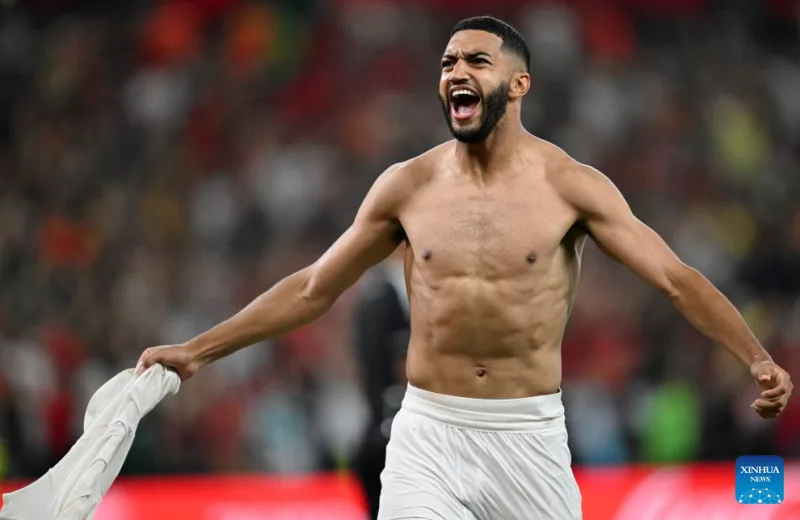
 Ismael Saibari of Morocco celebrates as he scores a penalty kick in the penalty shoot-out during the round of 32 match between the Netherlands and Morocco at the 2026 FIFA World Cup at Estadio Monterrey in Monterrey, Mexico, on June 29, 2026. (Xinhua/Wu Wei)
France and Morocco renew one of the most compelling rivalries of the FIFA World Cup when they meet in a blockbuster quarter-final at Boston Stadium tonight, with both nations chasing a place in the last four and Morocco seeking revenge for their semi-final defeat to Les Bleus in Qatar four years ago.
Kick-off is set for 11pm East African Time in a contest that pits Didier Deschamps' tournament-hardened France against Walid Regragui's resilient Atlas Lions.
France have once again underlined their status as title contenders after negotiating the group stage with authority before advancing through the knockout rounds without conceding a goal.
Deschamps' side have combined defensive solidity with ruthless efficiency, relying on a well-drilled backline and the firepower of captain Kylian Mbappé to reach the quarter-finals.
Morocco, meanwhile, have rekindled the defensive resilience that carried them to a historic semi-final appearance in 2022.
Regragui's men have frustrated opponents with disciplined organisation, soaking up pressure before launching devastating counter-attacks to eliminate fancied rivals and book another place among the world's elite.
Deschamps is expected to stick with his trusted 4-3-3 formation, which can morph into a 4-2-3-1 in possession. Mike Maignan should start in goal behind a defence of Jules Koundé, William Saliba, Ibrahima Konaté and Theo Hernández.
Aurélien Tchouaméni is likely to anchor the midfield alongside Warren Zaïre-Emery and Eduardo Camavinga, while Michael Olise and Bradley Barcola are expected to provide width in support of Mbappé.
Morocco are tipped to counter with their trademark 4-1-4-1 system, built around defensive discipline and rapid transitions. Yassine Bounou is expected to start between the posts behind Achraf Hakimi, Issa Diop, Chadi Riad and Noussair Mazraoui.
Sofyan Amrabat will shield the defence, with Brahim Díaz, Azzedine Ounahi, Bilal El Khannouss and Amine Sbaï supporting lone striker Ayoub El Kaabi.
Much of the spotlight will inevitably fall on Mbappé, whose pace and finishing remain France's biggest attacking weapon. Saliba will also have a pivotal role in containing Morocco's dangerous counter-attacks.
For Morocco, Hakimi faces the daunting challenge of keeping his club teammate Mbappé quiet while also driving forward whenever opportunities arise. Díaz will shoulder much of the creative burden in midfield, while Bounou is expected to play a decisive role if Morocco are to repeat their giant-killing exploits.
With a place in the World Cup semi-finals at stake, the clash promises to be a fascinating tactical contest between one of football's traditional heavyweights and Africa's standard-bearers, with the winners moving to within two victories of lifting the game's biggest prize.