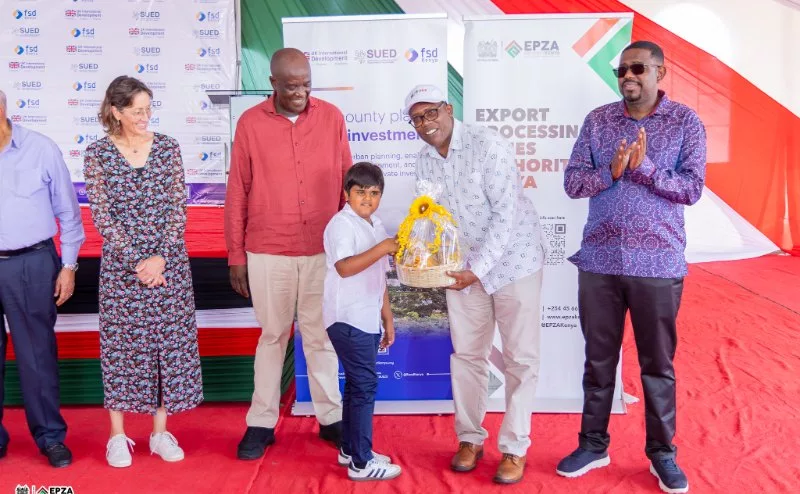
 Deputy British High Commissioner Diana Dalton (left), Kilifi Governor Gideon Mung'aro, Special Economic Zones Authority CEO Kenneth Chelule, and Principal Secretary for Investment Promotion Abubakar Hassan during the commissioning of Milly Fruit Processors Ltd in Kilifi county /HANDOUT
A Sh250 million fruit processing plant in Kilifi is set to provide a market for 1,000
farmers, create 150 jobs and boost Kenya’s export manufacturing sector.
The official opening of Milly Fruits Processors Ltd brought together Kilifi Governor Gideon Mung’aro, Abubakar Hassan, Principal Secretary for Investment and Diana Dalton deputy British High Commissioner and development director.
Others included representatives of the Financial Sector Deepening Kenyaand Sustainable Urban Economic Development (Sued)programme, alongside investors, farmers and officials from the national and county governments.
Licensed under the Export Processing Zones Authority, the facility will process mangoes, coconuts and pineapples into value-added products for domestic and export markets, addressing a challenge that has long undermined farmers’ earnings due to limited processing capacity, post-harvest losses and unpredictable prices.
Mung’aro described the factory as a landmark investment in Kilifi’s industrial transformation, saying it demonstrates the county’s deliberate strategy of turning agriculture into a commercially competitive sector through value addition.
“The commissioning of this factory marks the opening of new opportunities for our farmers, new jobs for our youth, new income for our families and a new chapter in the industrial transformation of Kilifi county,” he said.
The factory, he added, would provide farmers with a dependable market for mangoes, coconuts and pineapples, allowing them to invest in production with greater confidence while creating employment across the entire value chain—from farming and transportation to processing, packaging and distribution.
The investment comes at a critical time for Kilifi, where more than 70 per cent of residents depend directly or indirectly on agriculture for their livelihoods.
Over the years, farmers have often watched their produce spoil due to limited market access despite the county’s favourable climate and agricultural potential.
To reverse that trend, the county has invested heavily in agricultural productivity, distributing more than 1.5 million quality seedlings, rehabilitating over 9,308hectares of tree crops and expanding irrigation to about 4,047 hectares.
The county has also strengthened cooperatives, improved extension services and promoted agribusiness innovation to ensure farmers can meet the growing demand from processors.
Held under the theme ‘Driving Inclusive Growth Through Agro-Processing and Value Addition,’the investment aligns seamlessly with the with the Kenya Vision 2030 blueprint and President William Ruto's Bottom-Up Economic Transformation Agenda.
Speaking on behalf of the national government, PS Abubakar called the plant proof of Kenya's "growing industrial capacity," said that EPZs advance Beta's goals by narrowing the trade deficit, attracting investment, boosting foreign exchange earnings and enabling knowledge and technology transfer.
“Kenya must move from exporting raw materials to becoming a leading manufacturing and value-addition economy.
“Every factory we commission strengthens our competitiveness, attracts investment, creates jobs and expands export opportunities,” he said.
He added that investor support through InvestKenya, incentives under the EPZ and Special Economic Zones programmes and financing through the Kenya Development Corporation’s Green Investment Fund continue to strengthen Kenya’s investment climate.
The project was delivered through a partnership involving the government of Kenya, Kilifi county, the UK government, Suedprogramme and FSD Kenya, with UK grant funding supporting the acquisition of specialised processing machinery.
Dalton said the investment demonstrates how strategic partnerships can create lasting economic opportunities.
“Supporting value-added manufacturing means more of the economic value remains in Kenya, creating jobs, strengthening local supply chains and opening new opportunities for farmers and businesses,” she said, reaffirming the UK’s commitment to inclusive and sustainable economic growth.
![Hamisi Mwaguya [in coulored baseball cap] at the Kings Arena at Khadija estate in Nyali subcounty on Tuesday / BRIAN OTIENO](https://cdn.radioafrica.digital/image/2026/10/340e650a-21d8-475b-b658-a429e82e9367.jfif)