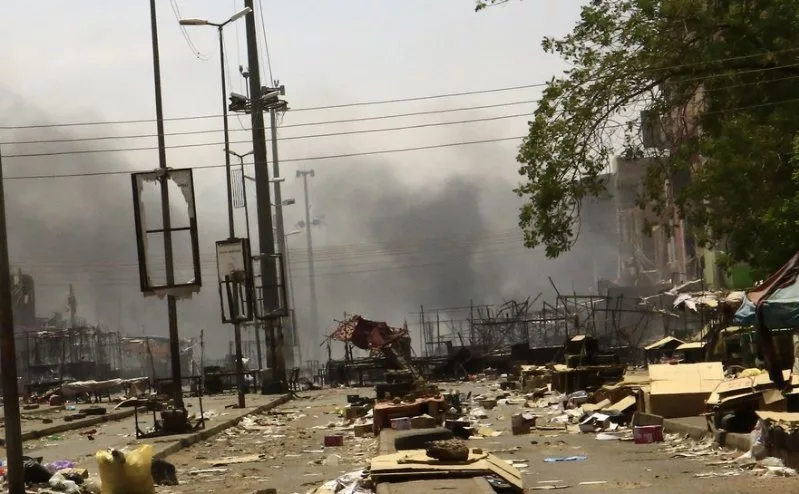
 The photo taken on April 18, 2023 shows a major market in Bahri city, north of the Sudanese capital Khartoum, ruined in ongoing clashes between the Sudanese army and the rapid support forces. (Xinhua/ Mohamed Khidir)
On June 9, 2026, 12 Sudanese survivors submitted a criminal complaint to Kenya’s Director of Public Prosecutions. The complaint details alleged killings, torture, sexual violence and unlawful detention in and around Khartoum between April 2023 and March 2025.
It names 10 members of the Rapid Support Forces (RSF), including those with ties to Kenya. Most importantly, it asks Kenya to do something it has never done before: use its own domestic international crimes legislation to investigate alleged crimes committed in another country.
The complaint was filed by Legal Action Worldwide (Law), and the African Centre for Justice and Peace Studies (ACJPS) – together represented by Otieno Ogola and Company Advocates. Law represents the 12 Sudanese survivors in the complaint.
This is not a symbolic gesture. It is a legal filing under Kenya’s International Crimes Act of 2008 – a law which allows Kenyan authorities to investigate and prosecute genocide, crimes against humanity and war crimes committed outside Kenya, where the legal requirements are met.
The complaint identifies alleged RSF links to Kenya, including reported citizenship, travel, residence, logistical networks and presence on Kenyan territory.
As an example of that alleged presence, the complaint cites the February 2025 charter-signing ceremony in Nairobi, where at least 30 members of the RSF and allied groups met to formalise a rival political structure.
The survivors who brought this complaint did so amid war, displacement and continuing security risks. Their accounts describe RSF-controlled detention sites – including Soba Prison, Al-Riyadh complex, informal facilities and a pattern in which civilians were targeted because they were perceived to be affiliated with or sympathetic to the Sudanese Armed Forces (SAF).
For those who came forward, the complaint is not only about documenting what happened. It is about placing their evidence before an authority with the legal power to act on it.
Why Kenya, and why now? Because the usual paths to accountability are either blocked, limited or moving slowly.
Sudan’s domestic justice system has effectively collapsed. War, political fragmentation and institutional breakdown have made domestic prosecution a distant prospect. While the International Criminal Court’s existing mandate extends to crimes in Darfur, it does not provide a comprehensive accountability pathway for the full range of crimes across Sudan, including those committed in and around Khartoum. Regional and international bodies have documented what is happening. Criminal accountability has not followed.
Hundreds of thousands of Sudanese civilians have suffered grave violations since this war began in April 2023, yet justice has remained out of reach.
For the survivors who have brought this criminal complaint in Kenya, the filing is an attempt to ensure their evidence triggers a serious legal process and impunity in Sudan is not accepted as inevitable.
The complaint asks Kenya’s Director of Public Prosecutions to open a file, examine the alleged links to Kenya, protect victims and witnesses, direct appropriate investigations and assess whether prosecutions should follow.
It does not ask Kenya to resolve Sudan’s war. It asks Kenya’s prosecutors to use the tools their legislature gave them to determine whether the facts, evidence and alleged Kenya nexus meet the threshold for action under Kenyan law.
Kenya has played a significant regional role in peace processes, refugee protection and mediation. This filing raises a different question: when alleged perpetrators, witnesses, evidence, or support networks connect to Kenyan territory, will Kenya’s institutions act on the legal framework they have? Regional diplomacy and criminal accountability are not mutually exclusive.
Germany, Sweden, France and the Netherlands have all pursued universal jurisdiction or related international crimes cases concerning atrocities committed abroad – including in Syria, Liberia, Rwanda, Iraq and Sudan – while continuing to maintain diplomatic engagement internationally.
If Kenya’s DPP opens an investigation, it would be the first known universal jurisdiction investigation in Kenya under the International Crimes Act.
It would also contribute to a still limited African practice of using legal mechanisms to pursue accountability for international crimes, alongside examples such as South Africa’s Zimbabwe Torture Docket litigation and the Hissène Habré trial before the Extraordinary African Chambers.
The Kenya filing is distinct because it asks an ordinary national prosecutorial authority to use existing domestic law to examine alleged crimes committed beyond Kenya’s borders.
It would demonstrate that accountability for international crimes does not have to depend only on The Hague or purpose-built tribunals.
African states have the laws. They have prosecutors. And where the legal basis exists, those prosecutors can use domestic law to make clear that alleged perpetrators of grave international crimes cannot rely on borders, political access or regional influence to avoid accountability.
For the survivors who brought this complaint, the ask is simple: move their evidence from documentation into a legal process. Kenya’s response to this filing will be a measure of whether its international crimes framework is a functioning legal instrument or a statement of aspiration. The survivors have done the harder thing – coming forward, recording what happened and accepting the risk. They are asking Kenya to do its part.
Antonia Mulvey is the Founder and Executive Director of Legal Action Worldwide (LAW) and a British lawyer specialising in international human rights, criminal, and refugee law. She represents survivors of international crimes across multiple regions and has worked extensively with the United Nations, including as an investigator on sexual violence and grave crimes against children.