EVERY evening, 42-year-old security guard Phelister Wafula reports for duty outside a commercial building in Nairobi's Upper Hill.
For the next 12 hours, she watches over property worth millions of shillings before squeezing into a crowded matatu at dawn for the long journey back to her one-room house in one of the city's outskirts.
Like millions of low-income Kenyan workers, every payday has become an exercise in survival.
Rent has climbed steadily. Food prices remain stubbornly high. Transport now consumes a larger share of her income, while school fees for her two children keeps piling up.
Yet, her salary has barely changed over the years.
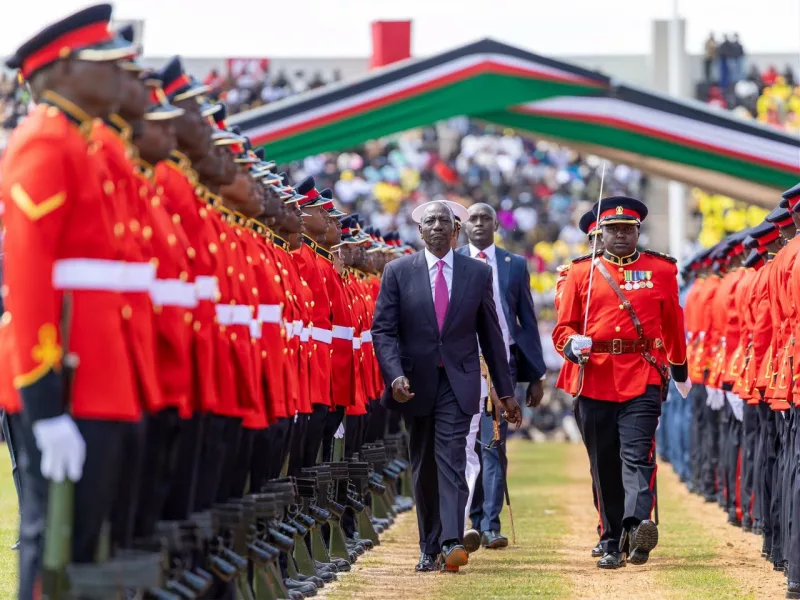
When President William Ruto announced a 12 per cent increase in Kenya's general minimum wage during this year's Labour Day celebrations, Wafula believed relief had finally arrived.
Two months later, however, the promise remained just that.
Employers insisted they were waiting for the legal framework needed to affect the new salaries, leaving workers wondering whether yet another Labour Day declaration would end without tangible change.
That uncertainty came to an end last week as the government formally gazetted the Regulation of Wages (General) (Amendment) Order, 2026, through Legal Notice No. 108 of June 26, giving legal force to the President's May 1 announcement.
The new regulations require employers across the country to raise the general minimum wage by 12 per cent and agricultural minimum wages by 15 per cent.
Crucially, the changes take effect retrospectively from May 1, meaning employers must also settle salary arrears for the past two months.
The move marks Kenya's most significant statutory wage review in recent years and immediately shifts the debate from political promises to legal compliance.
The Federation of Kenya Employers has already advised businesses and its members to begin implementing the revised wage schedules without delay.
"Employers are hereby advised to review and implement the necessary adjustments to ensure full compliance with the revised statutory minimum wage requirements effective May 1, 2026," the employers' body, led by executive director and CEO Jacqueline Mugo, said in a circular.
The organisation has also offered technical guidance to companies seeking clarification on implementation.
For workers, the gazettement offers long-awaited certainty after months of anxiety.
The revised wage schedule raises the monthly minimum salary for a general labourer working in Nairobi, Mombasa, Kisumu, Nakuru and Eldoret to Sh18,047.40.
Employees in former municipalities and selected urban centres, such as Ruiru, Limuru and Mavoko, will earn at least Sh16,650.95.
Workers in all other parts of the country will receive a statutory minimum monthly wage of Sh9,628.07.
The review also revises daily and hourly rates across dozens of occupations, including cleaners, watchmen, domestic workers, cooks, machine attendants, bakery employees, miners and casual labourers.
The increases come at a time when Kenyan households are grappling with elevated living costs despite easing inflation.
Although headline inflation has moderated over the past year, food, housing, transport and education remain among the biggest pressures on household budgets.
For minimum wage earners, even a modest salary increase could help restore purchasing power, which has steadily eroded since the Covid-19 pandemic.
The International Labour Organisation (ILO) has consistently argued that minimum wages should be reviewed periodically to protect workers against inflation and widening income inequality.
The organisation maintains that wage levels lose relevance when adjustments fail to keep pace with rising prices.
According to the ILO, regular consultations between governments, employers and workers remain essential in setting wages that guarantee a decent standard of living while safeguarding employment.
For many workers, however, optimism remains cautious.
A 38-year-old domestic worker, Getrude Majale, has heard similar announcements before.
Having worked for families in Nairobi for more than a decade, she says previous wage reviews rarely translated into higher pay.
"This is not the first time I have heard of a minimum wage increase. I only hope this one finally reflects in my payslip," she says.
She believes the increase is justified given the sharp rise in the cost of living over recent years.
"The value of Sh1,000 today is nowhere near what it was before Covid-19."
Her sentiments resonate with Joel Mwai, a flower farm worker in Naivasha whose salary has remained unchanged since 2018.
He hopes employers will fully implement the latest directive.
"I honestly deserve a pay rise. Every Labour Day, we hear promises but nothing changes," he said.
The renewed wage review has also reignited debate within Kenya's private security industry.
Last week, the Kenya National Private Security Workers Union intensified its campaign for full implementation of the Sh30,000 minimum wage for security guards.
The union accused several security firms of ignoring existing regulations despite winning lucrative government contracts.
The campaign follows a landmark Employment and Labour Relations Court ruling in February 2025, that effectively upheld the Sh30,000 wage requirement after dismissing a petition challenging the directive.
Justice Mathews Nduma struck out the case, finding it had been abandoned and overtaken by events, clearing the way for continued enforcement.
While workers celebrate, employers face a far more complicated reality.
Although the wage increase was announced on May 1, the legal notice only arrived on June 26.
Businesses had already processed payrolls, filed statutory deductions and, in many cases, finalised budgets for the 2026-27 financial year.
The retrospective implementation now requires employers to recalculate salaries, process arrears, amend payroll systems, revise statutory deductions and update employment records.
For thousands of businesses, particularly small and medium-sized enterprises (SMEs), these additional costs were never budgeted for.
Beyond higher salaries, employers must also absorb increased pension contributions and other statutory obligations linked to employee earnings.
Labour-intensive industries, such as manufacturing, retail, hospitality, agriculture, cleaning services and private security, are expected to experience the greatest financial impact.
Many businesses are already operating under intense pressure.
High electricity tariffs, expensive credit, multiple taxes and subdued consumer spending have squeezed profit margins over the past several years.
Business owners argue that while workers deserve better pay, wage increases should be accompanied by measures that lower the cost of doing business.
Daniel Mburugu, who operates a private security company, says businesses are carrying an increasingly heavy burden.
"The cost of doing business has become unbearable. Taxes, statutory deductions and operating expenses have risen sharply over the past decade," he says.
Retail entrepreneur Jane Mutie shares similar concerns.
She argues that the government should balance worker welfare with policies that support employers.
"The government cannot improve the lives of one group while making it harder for another to survive. Businesses also create jobs and deserve supportive policies," she says.
Kenya Private Sector Alliance chairman Jaswinder Bedi yesterday said, "Kenya needs to move to productivity-driven salaries and address the 'costs of living' as opposed to 'cost to live'."
Economists note that the debate reflects a delicate balancing act.
Zachary Odindo, a development economist at ABC Capital, says higher wages increase household incomes, strengthen consumer spending and can improve employee productivity, while reducing staff turnover.
“Over time, stronger purchasing power may benefit businesses through higher domestic demand.”
However, he warns that sudden increases in labour costs can also strain employers, especially where revenues have remained flat.
”Without adequate planning, some firms may postpone expansion, delay recruitment or reduce discretionary spending to offset higher payroll expenses,’’ Odindo told the Star.
For SMEs, which account for the overwhelming majority of Kenya's private sector employment, the adjustment may prove particularly difficult.
Many are still recovering from years of high borrowing costs, weak demand and rising operational expenses.
Yet despite the concerns, the legal position is now unequivocal. The revised wage order is enforceable from May 1, 2026. Failure to comply could expose employers to sanctions under Kenya's labour laws.
Across the country, human resource departments are now reviewing payroll systems, recalculating salaries and preparing arrears for affected workers.
A HR specialist at a global private security firm based in Westlands told the Star that they are working day and night to recalibrate payroll.
“It is not easy, but we have to enforce government directives. We are in constant communication with our legal department to ensure that all is well,’’ he said.
For employees like Wafula, the latest wage review is more than a pay adjustment.
It is a test of Kenya's commitment to protecting workers, while sustaining businesses that drive the country's economy.