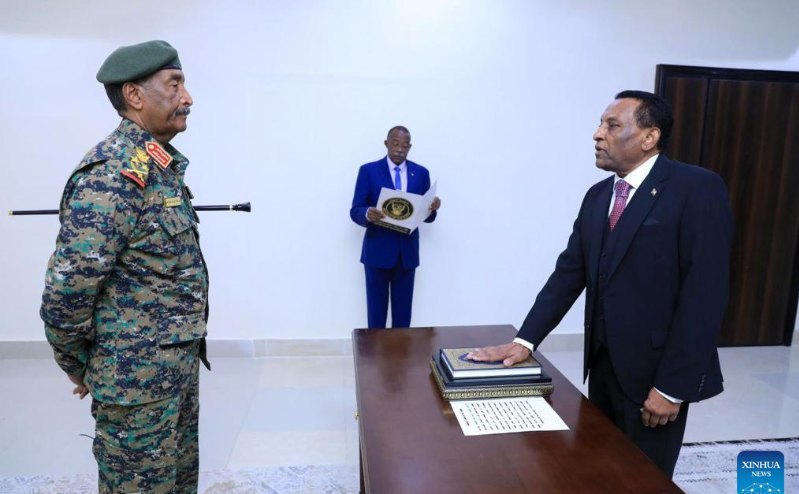
In a move described as unusual, Port Sudan Prime Minister Kamil Idris Al-Tayeb announced the approval by technical committees of the Draft Miscellaneous Amendments Law of 2026 during a meeting chaired by the Secretary-General of the Ministry of Defense, paving the way for its submission for final approval.
According to the official statement, the objective is to “protect human life” through the activation of cybercrime and electronic publishing laws. While the wording reflects the government’s desire to link digital security with national security, it simultaneously raises widespread concerns that such legislation could be used to restrict freedom of expression.
The announcement came after the Ministry of Culture, Information, Tourism, and Antiquities launched a mandatory electronic registration form for websites.
The Sudanese Journalists Syndicate categorically rejected the measure, describing it as a “blatant violation of rights and freedoms” and an attempt to reproduce the mechanisms of repression employed by the former regime.
The syndicate noted that the form requires sensitive information and conflicts with the constitutional document that guarantees freedom of journalistic work.
It further argued that the minister’s assertion that the form is intended to “regulate the profession” lacks legal basis, as the Press and Publications Law does not grant the ministry the authority to impose such measures.
The ministry was also accused of adopting policies associated with the former regime by controlling the distribution of government advertising in favor of certain newspapers while excluding others, in what the syndicate described as “economic exclusion and starvation.”
Observers expressed surprise at the decision, which comes in a country exhausted by war and where civic space has steadily shrunk in favor of an expanding security grip.
Recent government moves to tighten cybercrime legislation appear to be another attempt to reorganize the public sphere through legal instruments that could further restrict freedom of publication and expression.
The move follows a decision by the Customs Authority affiliated with the Port Sudan government to raise the customs dollar rate to 3,517 Sudanese pounds, up from 3,395 pounds previously, representing an increase of approximately 3.5 percent and marking the third adjustment since the beginning of 2026.
Sudan is experiencing one of the worst economic crises in its modern history, with the Sudanese pound continuing to depreciate against foreign currencies while inflation accelerates and citizens’ purchasing power erodes at an unprecedented rate.
According to observers, the measure represents another attempt by the authorities to compensate for declining public revenues through increased fees and levies linked to imports, rather than addressing the structural imbalances that have driven the current economic crisis.
Skyrocketing prices
Meanwhile, wholesale trader Ahmed Dahi in Omdurman stated that prices of essential commodities have recorded significant increases in recent days. He explained that a 50-kilogram sack of sugar rose from 188,000 to 215,000 Sudanese pounds, while a 25-kilogram sack of flour increased from 56,000 to 65,000 pounds.
He added that “the price of a carton of one-liter cooking oil rose from 105,000 to 120,000 pounds; a 20-kilogram sack of lentils increased from 77,000 to 155,000 pounds; and an 18-liter container of peanut oil climbed from 170,000 to 205,000 pounds. The price of Saudi Voltaire milk also surged from 460,000 to 650,000 pounds.”
While Sudanese residents in army-controlled areas speak of rising prices for essential goods, the National Chamber of Petroleum Importers stated that the real crisis afflicting the economy since the beginning of the year—and driving the rapid increase in both the dollar exchange rate and fuel prices—stems from the diversion of 56 tons of gold from the country’s total production of 70 tons away from official channels.
The chamber said the value of this gold exceeds $7.2 billion, an amount sufficient to cover the country’s strategic commodities bill for an entire year.
Speaking at a press conference on Monday, the chamber explained that data from the Bank of Sudan for the first quarter of the year revealed a financing gap of $326 million between gold exports ($370 million) and fuel import costs ($697 million), stressing that this gap has exerted direct pressure on the exchange rate.
A large gap
Chamber member Engineer Ahmed Al-Asam presented detailed figures issued by the Bank of Sudan and the Ministry of Energy, noting that the government imposes fees amounting to 28 percent of a vessel’s value, while company profit margins are capped by the Ministry of Energy at only 4 percent. He rejected allegations that fuel companies are generating excessive profits.
The chamber proposed alternative solutions based on the development of innovative financial instruments, including purchasing gold at attractive and transparent prices, issuing gold-backed investment certificates, activating barter mechanisms between gold and strategic commodities, providing export incentives, and temporarily reducing government fees during global crises.
He pointed out that ordinary citizens are paying the price for this gap through inflation and argued that the solution lies in integrating the missing gold into the banking system rather than assigning blame to fuel companies.
Economic corruption
Meanwhile, experts argue that economic failure is not merely a random consequence of war or administrative decline but rather the product of an interconnected corruption alliance that has succeeded in transforming the crisis into a project for restructuring the national economy in favor of a narrow group of beneficiaries.
Analyst Omar Sayed Ahmed maintains that following the outbreak of war in mid-April 2023, corruption became concentrated around the armed forces affiliated with Port Sudan and regional centers of power, losing its previously centralized character.
The informal economy expanded dramatically, managed by military institutions, militias, and armed movements operating outside any regulatory framework. Smuggling networks and cross-border routes proliferated. In some areas, corruption no longer exploits the state—it has effectively replaced it.
He added that “what makes this transformation particularly dangerous is that armed actors do not require state stability for their survival; rather, they thrive on state collapse and continuously reproduce it. Corruption is no longer parasitic on the state; it now has a structural interest in keeping the state weak.”
He continued: “Kleptocracy extends beyond traditional corruption—such as bribery and individual embezzlement—to describe a deeper condition in which the state itself becomes an instrument of organized plunder, managed by networks that combine armed force, political influence, and financial capital within a single cohesive system. This structure did not emerge with the war; its roots extend back to the 1989 coup, when the Salvation Regime began constructing a parallel economy outside the state’s official apparatus.”
He stressed that corruption in Sudan is no longer “merely an administrative disease; it has become a mechanism for producing violence and abuses. Among the documented connections are the systematic starvation of civilian populations through the seizure of supply chains, economic extortion at checkpoints, the looting of resources to finance military operations, the obstruction or diversion of humanitarian assistance, forced labor in mining and agriculture—particularly involving children and displaced persons—and resource-driven violence in gold-rich regions.”