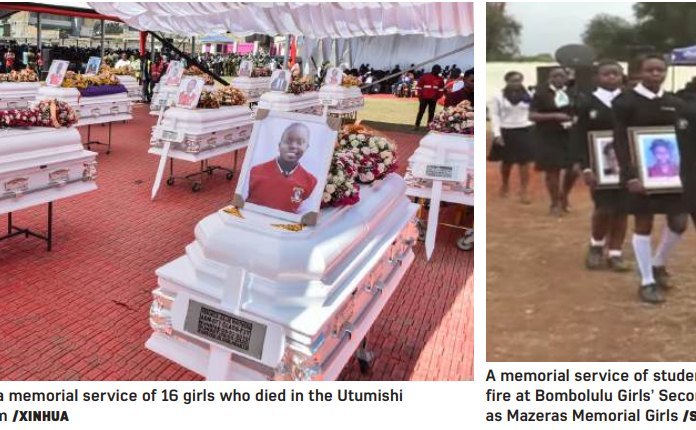
Born and raised in Mazeras, Kilifi county, Ethel Mambo's parents found it convenient to enrol her at the nearby Bombolulu Girls' Secondary School, now known as Mazeras Memorial Girls'.
Initially a day scholar, Ethel joined the boarding section while in Form 3. Although she welcomed the change, she never imagined the trauma that would follow.
The recent Utumishi Girls' Academy fire tragedy, which claimed the lives of 16 students, has revived painful memories of the Bombolulu Girls' fire tragedy of 1998. The incident remains one of Kenya's deadliest school fires.
Ethel, who was the school's head girl and had completed Form 4 the previous year when the tragedy occurred, says the incident left a lasting emotional scar. Now a bishop, she regrets not pushing harder for action over concerns students had raised regarding their safety.
"The school had no perimeter fence, and none of the teachers lived within the compound except the matron," Ethel recalls.
According to her, students had repeatedly raised concerns about security and other issues with the administration, but their complaints were largely ignored.
Ethel also recalls unusual incidents in the dormitories that deeply unsettled students. She says one learner who had recently transferred to the school would frequently cried out at night, speaking in different languages.
According to Ethel, the student claimed she was experiencing spiritual struggles connected to the history of the land on which the school stood.
As head girl, Ethel reported these concerns to the school administration, but no action was taken.
"We felt unheard. Even after education officers visited the school following a student strike, nothing changed," she says.
According to Ethel, local accounts suggested the school had been built on land that was once a Kaya, a sacred site among the Mijikenda community. She says some residents believed agreements made before the school's establishment had not been fully honoured.
In the first term of 1998, tragedy struck. A fire engulfed one of the dormitories, killing 26 students. For years after the tragedy, Ethel struggled to come to terms with what had happened.
"I cried constantly and kept asking myself why it had happened," she says.
One of the victims was a younger student she had mentored and grown close to. The loss hit her particularly hard.
With support from family and friends, Ethel slowly began to heal. She says the experience ultimately shaped her faith journey and inspired her decision to dedicate her life to ministry.
In 2001, she released her first gospel album, Niangalie. Yet, even today, news of school fires brings back memories of her former schoolmates who perished.
Margaret Mwaka, who was the school matron at the time, vividly remembers the night of the fire.
Now 76, Mwaka says screams from the students woke her from sleep. Since she occupied a room attached to the dormitory, she was able to help some girls escape before the flames intensified.
Using the front exit, she rushed out with several students. However, some girls attempting to flee through the rear door were trapped because it had reportedly been locked from the outside.
"It was heartbreaking to watch the girls burn, but there was very little I could do," she says.
Mwaka says no psychological counselling was provided after the tragedy despite the trauma she experienced.
"The girls were badly burnt. I never imagined the human body could be burned to such an extent," she recalls.
More than two decades later, she says memories of that night remain vivid and are often triggered whenever she hears about fire incidents.
Drawing from her experience, Ethel urges school administrators to take students' concerns seriously.
"Taking time to listen to learners, investigate their complaints and act where necessary could help prevent school unrest and tragedies," she says.
She also calls for long-term psychological support for survivors and witnesses of school fires, warning that trauma can persist for decades if left untreated.
Investigations conducted after the Bombolulu fire concluded that the blaze was caused by an electrical fault. The inquiry also found that the dormitory was overcrowded, housing between 130 and 144 students, and that one of the exits had been locked from the outside.
Psychologist James Kariuki says survivors of such tragedies often suffer long-term effects, including anxiety, depression and post-traumatic stress.
"Healing is a process. Survivors need consistent counselling, debriefing and emotional support. No amount of compensation can erase the pain experienced by victims and their families," he says.
Recent incidents of school unrest and fires have reignited debate about the future of boarding schools in Kenya. While some stakeholders have suggested abolishing them, others argue that boarding institutions remain essential, particularly for learners from vulnerable backgrounds.
Some communities, for example, rely on boarding schools to protect girls from harmful practices such as female genital mutilation.
Education CS Julius Ogamba has announced plans to establish a task force to collect views from stakeholders across the country. The ministry is also considering adjustments to the school calendar, including shortening the second term to reduce learner fatigue.
More than 200 schools have reportedly experienced unrest this year, representing about two per cent of all schools nationwide.
Kenya has witnessed several devastating school fire tragedies over the years, including Kyanguli Secondary School, where 67 boys died; Hillside Endarasha Academy, where 21 pupils perished; St Kizito Secondary School, where 19 students lost their lives; Utumishi Girls, where 16 students died; Moi Girls School, where 10 girls perished; and Asumbi Girls Primary School, where eight pupils lost their lives.