The Group of Seven (G7) Summit is one of the most influential annual gatherings in global politics and economics, bringing together leaders from some of the world’s most advanced economies to discuss pressing international issues.
While it is not a formal institution with binding powers, the summit plays a critical role in shaping global policy direction, coordinating responses to crises and setting the tone for international economic governance.
At its core, the G7 brings together seven major industrialised democracies-the United States, Canada, the United Kingdom, France, Germany, Italy and Japan.
These countries represent a significant share of global GDP, technological innovation and military capability.
The European Union (EU) also participates in the summit as a non-enumerated member, reflecting its economic and political weight.
Over time, the G7 has evolved from a primarily economic forum into a broader platform addressing geopolitical security, climate change, energy, artificial intelligence, development finance and global health.
Origins and purpose
The G7 traces its origins to the mid-1970s, a period marked by global economic instability following the oil crisis and the collapse of the Bretton Woods monetary system.
Initially formed as the G6 in 1975, Canada joined the following year, creating the G7.
Russia was briefly part of the group, forming the G8, but was suspended in 2014 following the annexation of Crimea.
The main purpose of the G7 is coordination.
Unlike the United Nations, it has no permanent secretariat or formal treaty obligations.
Instead, it functions as an informal forum where leaders align positions on global challenges and commit to shared policy directions.
Decisions made at the summit are not legally binding, but they often influence multilateral institutions such as the International Monetary Fund (IMF), World Bank and World Trade Organisation (WTO).
What happens at the summit
The G7 Summit is typically held once a year, rotating among member countries.
It spans several days and includes a series of closed-door meetings between heads of state and government, as well as sessions with guest countries and international organisations.
Discussions are structured around priority themes set by the host country.
These often include global economic stability, trade, security threats, climate change, energy transitions and technological governance.
In recent years, issues such as artificial intelligence, supply chain resilience and geopolitical tensions involving Ukraine and the Indo-Pacific region have dominated the agenda.
One of the most important aspects of the summit is the inclusion of guest nations.
Countries outside the G7 are often invited to participate in selected sessions.
This allows broader representation and dialogue with emerging economies and regional powers.
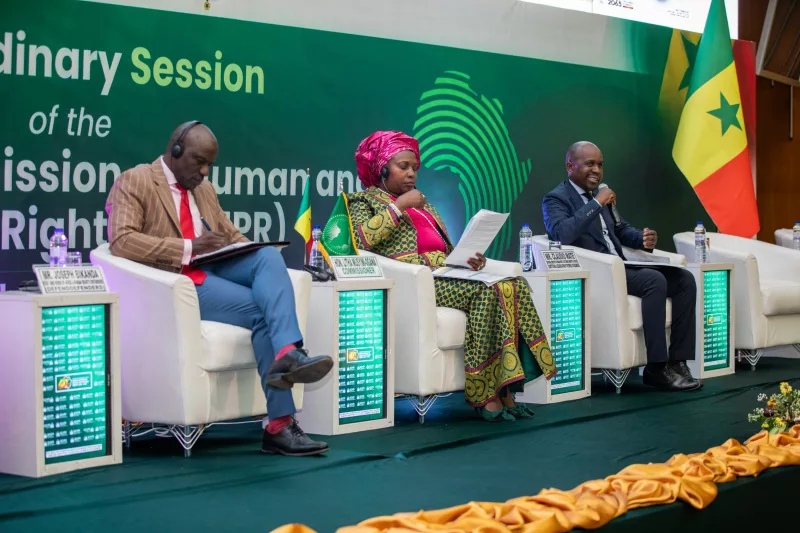
African leaders, including those invited to recent summits, use this platform to raise issues such as development financing, debt restructuring, climate justice and trade access.
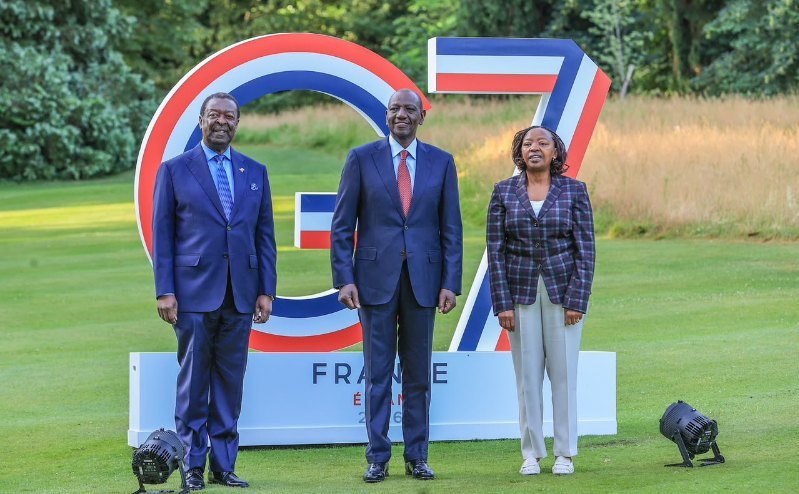
This year, five countries, including Kenya, have been invited to the summit happening in Évian-les-Bains, France.
Others are Brazil, Egypt, India, and South Korea.
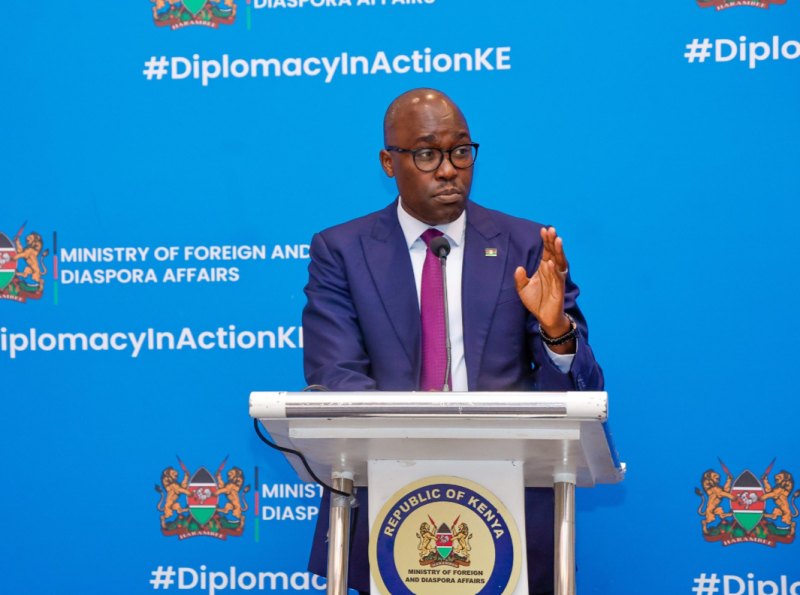
President William Ruto is in France for the summit. According to Prime Cabinet Secretary Musalia Mudavadi, Kenya’s presence as the only country in Africa is more than diplomatic representation.
“It is an opportunity to attract investment, expand economic partnerships, create jobs and advance opportunities that directly benefit Kenyan citizens while reinforcing the country’s standing as a trusted global partner,” he said.
Speaking ahead of the summit, Ruto challenged global leaders and investors to rethink their perception of Africa, declaring that the continent is not a burden to the world but a vital partner in driving future global prosperity.
Ruto said Africa possesses immense natural, human and financial resources that position it as a major force in the global economy.
“Africa is not a problem to be solved. Africa is an asset. Africa is an opportunity. Africa is not anybody’s liability,” he said.
At the end of the three-day summit, leaders issued a communiqué summarising their shared commitments and policy directions.
While these statements are not legally enforceable, they are closely watched by markets, policymakers and international organisations as indicators of global policy alignment.
Why the G7 is crucial
Despite its relatively small membership, the G7 remains highly influential because of the economic and political power of its members.
Collectively, the group accounts for a substantial portion of global GDP and has significant leverage in shaping international financial systems.
The summit often acts as a coordination point during global crises.
For example, during financial downturns, pandemics or geopolitical conflicts, the G7 has played a role in mobilising financial support, coordinating sanctions or aligning economic recovery strategies.
Its decisions can influence global commodity prices, investment flows and development assistance priorities.
For developing countries, including those in Africa, the G7 is particularly important because it is a key platform where issues of concessional financing, climate funding and debt relief are negotiated at a high level.
Although African countries are not permanent members, their participation as guests has increased in recent years, reflecting growing recognition of Africa’s demographic and economic importance.
Key issues at recent summits
In recent years, the G7 agenda has expanded significantly beyond traditional economic concerns.
Climate change has become a central topic, with member states committing to net-zero emissions targets and climate financing mechanisms for developing countries.
Artificial intelligence and digital governance have also emerged as major discussion areas.
Leaders are increasingly concerned about how AI will reshape labour markets, security systems and global competitiveness.
Questions around regulation, ethical standards and technological access are now part of the summit’s core discussions.
Global security remains another priority, particularly in relation to conflicts in Europe and the Middle East.
The G7 has coordinated sanctions, humanitarian aid and diplomatic responses to ongoing crises, reinforcing its role as a key geopolitical actor.
Development financing is also a recurring theme, especially for African countries.
Leaders have discussed mechanisms to improve access to concessional loans, private capital mobilisation and infrastructure investment.
This aligns with broader efforts to address debt vulnerabilities in developing economies and support long-term sustainable growth.
Africa and the G7
Africa’s engagement with the G7 has been growing steadily, driven by shifting global demographics and economic realities.
With the continent projected to have the world’s largest working-age population in the coming decades, G7 countries increasingly view Africa as a strategic partner rather than merely an aid recipient.
African leaders invited to the summit typically push for reforms in global financial architecture, including easier access to concessional funding, fairer credit ratings and expanded climate financing.
They also advocate for technology transfer and inclusion in emerging sectors such as artificial intelligence, renewable energy and digital trade.
The presence of African leaders at the G7 also signals a broader shift toward multipolar global governance, where emerging economies have a stronger voice in shaping international rules.
The G7 Summit remains a powerful forum for shaping global policy, despite its informal structure. Its influence lies not in legal authority but in the collective weight of its members and their ability to coordinate responses to global challenges.
As issues such as climate change, artificial intelligence, economic inequality and geopolitical instability become more complex, the G7’s role continues to evolve.
For Africa and other developing regions, engagement with the summit represents an opportunity to influence global decisions that directly affect development pathways, financing options and technological inclusion.
In an increasingly interconnected world, what happens at the G7 rarely stays within the room; it often shapes the direction of global policy for years to come.