Kenya Airways is seeking to raise about $1.5 billion (Sh194 billion) in fresh capital from investors to expand its fleet, growing its cargo business and restore long-term profitability.
The airline's board says the capital raising programme will be pursued through an open process and could involve a mix of equity, debt, a strategic airline partner or financial investors, with the exercise targeted for completion by the first quarter of 2027.
The fundraising plan emerged as the national carrier reported a net loss of Sh17.2 billion for the financial year ended December 2025, a performance management attributed largely to rising fuel costs, geopolitical disruptions and global aviation supply chain constraints.
Kenya Airways chairman Kiprono Kittony said fresh capital was critical if the carrier was to execute its growth plans and remain competitive in a rapidly evolving aviation market.
"The amount of money we think that the airline requires for it to really be able to capture the imagination of the future consumer is in the region of $1.5 billion (Sh194 billion) as we have said initially aviation is not a cheap industry " said Kittony.
The chairman said the board had completed a review of the airline's strategy and was satisfied that the plan was fit for purpose, with a strong focus on strengthening Kenya Airways' position as a leading African carrier.
He said the company would shortly issue an Information Memorandum to potential investors before determining the most appropriate funding structure.
"The idea is that we would like to run an open and transparent process. There are all these considerations to take. Is it going to be equity? Is it debt? Is it going to be an airline strategic partner? Is it going to be a financial partner? Will it be local funding? Will it be foreign funding?" said Kittony. "
The fundraising comes as Kenya Airways pursues an aggressive expansion strategy despite current financial pressures.
Management outlined plans to significantly grow the airline's cargo business, targeting an increase in market share from the current 11-12 percent to about 40 percent by the end of the year.
The carrier is also planning to increase capacity and acquire additional aircraft over the coming decade.
Acting chief executive George Kamal said Kenya Airways is targeting a fleet of 60 aircraft by 2030 and as many as 100 aircraft by 2035 through a combination of owned and leased planes.
The airline had initially planned a faster fleet expansion programme but slowed implementation after a sharp rise in global fuel prices.
"We moved our plans forward into 2027 once we saw the price of fuel increasing and the impact it could have on the business," Kamal said.
Despite the losses, management insisted the underlying business remains viable.
Kamal noted that 2024 delivered the highest revenue in Kenya Airways' history, while 2025 produced the third-highest revenue performance on record.
The airline also posted positive earnings before interest, taxes, depreciation and amortisation (EBITDA) of about Sh14 billion, which management cited as evidence that core operations remain strong.
"When we look at Kenya Airways, it is a resilient business. The business is viable and the business continues to stand," he said.
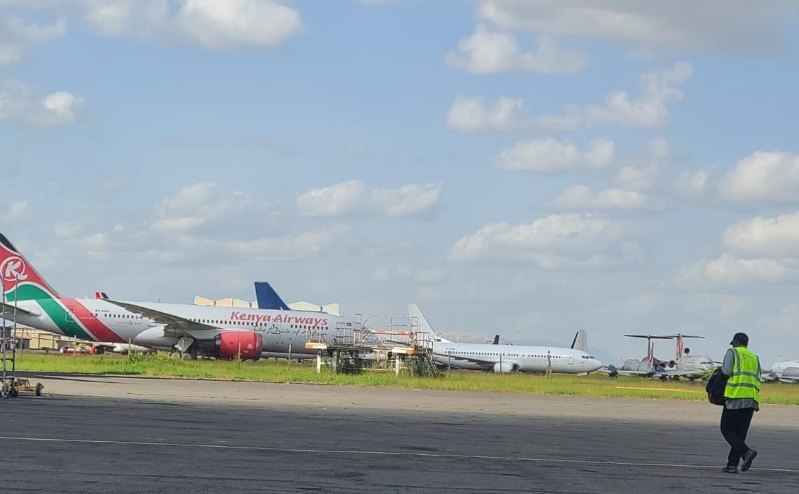
The carrier is also working to restore capacity lost through grounded aircraft. Three Embraer jets and two Boeing 787 Dreamliners remain out of service awaiting engines and maintenance work, reducing available seat capacity by between 15 and 18 percent.
Already the national carrier says grounded aircraft are cutting its available seat capacity by 15 to 18 per cent as it works to restore fleet operations and stabilize flight schedules.
Management expects the first aircraft to return to service by the end of July, while most of the remaining grounded fleet should be operational by the end of the year.
A Boeing 777 is also expected to join the fleet in July and will be deployed on the London route during the peak travel season.
Kenya Airways board, however, cautioned that the operating environment remains challenging.
Fuel costs have emerged as the airline's biggest expense, with management estimating that jet fuel now accounts for between 51 and 52 percent of flight operating costs in Africa, up sharply from historical levels.
The carrier also cited conflict-related airspace disruptions, longer flight routes, aircraft supply shortages and delayed delivery of spare parts as key pressures on profitability.
Management expects many of these challenges to persist until at least the first quarter of 2027.