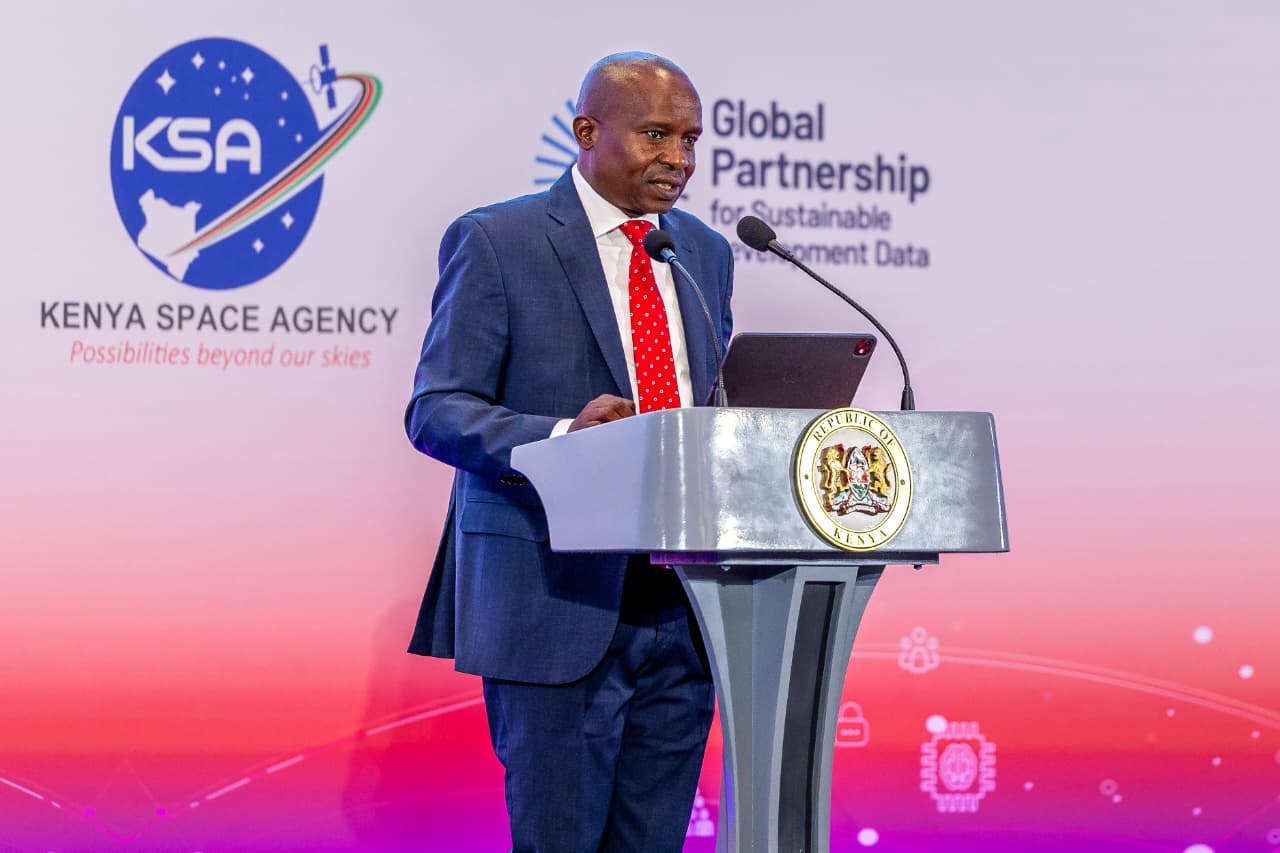
 Deputy President Kithure Kindiki speaking during the opening ceremony of the Global Data Festival and Kenya Space Expo and Conference 2026 at the Edge Convention Centre in Karen, Nairobi, on June 2, 2026/ DPCS
Deputy President Kithure Kindiki has underscored the importance of credible local data in driving Kenya’s development agenda, saying evidence-based planning will be critical in implementing transformative and sustainable projects across the country.
Speaking during the opening ceremony of the Global Data Festival and Kenya Space Expo and Conference 2026 at the Edge Convention Centre in Karen, Nairobi, on Tuesday, Kindiki said data must be treated as a core national asset and development infrastructure rather than a technical afterthought.
The Deputy President noted that as governments grapple with rapid technological change, climate challenges, economic pressures and growing public expectations, accurate and timely data has become indispensable in decision-making and resource allocation.
“Data has become the currency of that change. It determines who can plan, compete and innovate, who can access public services, and who is visible to the systems that shape decisions,” Kindiki said.
He argued that the success of development interventions depends on the quality of information available to policymakers, warning that weak data systems risk excluding vulnerable populations and undermining progress.
“Data is the epicentre of sustainable development. Even in this era of Artificial Intelligence, it carries added weight because it is the foundation on which the new intelligence will be built,” he said.
The Deputy President stressed that development outcomes are ultimately realized at the grassroots level and therefore require robust local data systems capable of reflecting the realities of communities across the country.
“Development is realized at the grassroots level at the health centre where medicine is dispensed, at schools where teachers are deployed, through the construction of roads that connect farmers to markets, and at the household level where families await access to clean water,” he said.
He added that Kenya’s devolved system of government has heightened the need for reliable county-level data to guide planning and investment decisions.
“County governments cannot plan without credible local data, and the national government cannot effectively support this effort without current and quality data,” Kindiki stated.
The Deputy President called for increased investment in national and county data systems, saying they should be financed in the same way as other critical infrastructure such as roads, schools and hospitals.
“We have to stop seeing data as merely useful and start treating national data systems as core development infrastructure,” he said.
Kindiki further urged development partners to align their support with government priorities and use national data systems to eliminate duplication, identify development gaps and strengthen accountability.
“These priorities and needs are identified based on national data. As such, data helps us to eliminate duplication, identify gaps, measure outcomes and reinforce accountability,” he said.
The Deputy President highlighted Kenya’s progress in digital transformation, including the country's first fully digital population census in 2019, expansion of digital government services and growing investments in artificial intelligence, cybersecurity and digital infrastructure.
He also pointed to the increasing role of space science and satellite technology in national development through the Kenya Space Agency.
“Through the Kenya Space Agency and our growing Earth observation capacity, we are now using space science and satellite data across agriculture, climate adaptation, disaster risk management, land use and environmental monitoring,” he said.
Kindiki noted that the convergence of data and space technologies is enhancing the country’s ability to make informed decisions and respond to emerging challenges more effectively.
At the continental level, he called on African countries to invest in their own data ecosystems and technological capabilities to avoid dependence on external systems that may not reflect local realities.
“I urge the African continent to invest in its own data capabilities to ensure that it develops intelligence rooted in its realities and priorities rather than merely consuming intelligence produced elsewhere,” he said.
The Deputy President further challenged governments, development agencies and private sector actors to move beyond discussions and invest in sustainable data systems capable of delivering measurable results.
“The world has never been short on promises. What it lacks is delivery at the scale and speed the present crises demand,” he said.
Kindiki concluded by urging stakeholders attending the Global Data Festival and Kenya Space Expo to embrace evidence-based decision-making and strengthen collaboration in order to harness technology for sustainable development.
He officially declared the Global Data Festival and the Kenya Space Expo and Conference 2026 open, expressing confidence that stronger data systems would help accelerate Kenya’s socio-economic transformation and improve service delivery across the country.