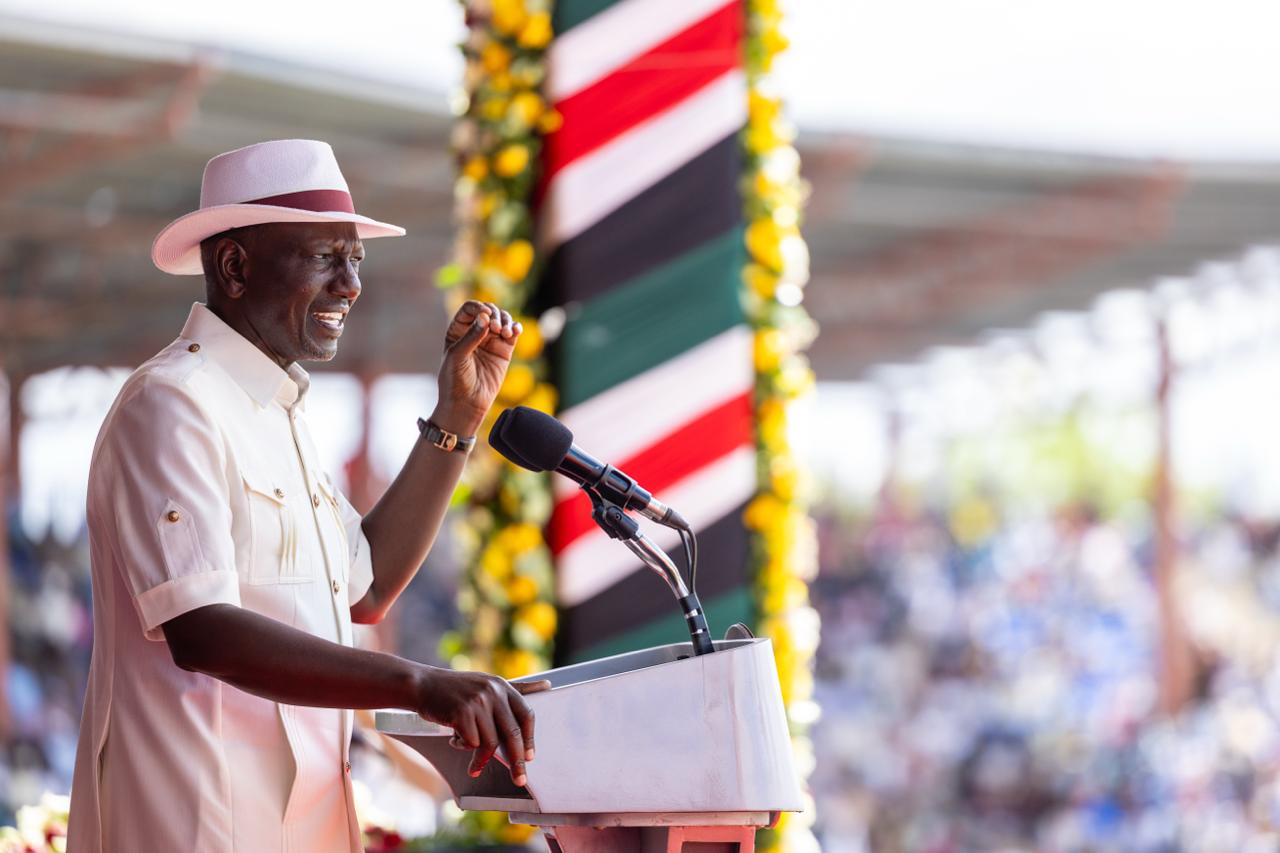
President William Ruto has announced a massive government-backed initiative to transition pastoral communities into commercialized, climate-smart livestock enterprises.
Ruto outlined the details of the government’s comprehensive plans for livestock farming in northern Kenya in his Madaraka Day celebrations speech.
Addressing the public from Wajir County, the President emphasised that livestock is fundamentally woven into the socio-economic fabric of the region.
"Here is Wajir and northern Kenya, livestock is more than an economical activity. It pays school fees, feeds families, creates jobs, drives trade and in difficult times sustain entire communities," President Ruto stated.
To back this vision with institutional funding, the Head of State announced the creation of a Sh5 billion initiative aimed at giving local pastoralists direct equity in the market.
The project is designed to structurally transform how livestock products are managed, valued, and traded across Arid and Semi-Arid Lands (ASAL).
"We are establishing Sh5 billion County Livestock Investment Company initiative to support 350 000 pastoralists across 21 counties to own companies," the President revealed. "Through this companies they will get access to markets and finance."
The multi-billion-shilling initiative will deploy rolled-out implementations to maximize immediate socio-economic security.
According to the executive plan, "In phase one, the initiative will improve livelihoods of more that 2 million members." To expedite the rollout, Ruto confirmed he has already "directed the ministry of Agriculture in partnership with counties to begin registration of these companies in 21 ASAL counties."
The aggressive interventions follow what the administration describes as unprecedented upward trends within the nation’s agricultural and livestock sectors over recent fiscal years.
Highlighting recent economic achievements, the President underscored how targeted state support has already driven production values and export yields skyward.
He noted that meat exports skyrocketed by 84 percent, climbing from Sh8.9 billion up to Sh16.4 billion in 2025.
Further, he said milk production surged from a baseline of 4.6 billion liters up to 5.3 billion litres, while dairy exports marked an exponential leap, expanding from Sh4.9 billion to Sh14.2 billion.
To sustain this momentum, the government is expanding its technical workforce on the ground.
Ruto announced the deployment of an additional 2,000 extension workers to frontier communities.
"Today we are deploying an additional 2000 agripreneurs for our ASAL counties," Ruto declared. "Together with the 5000 already in place, we now have 7000 agripreneurs driving agricultural transformation."
"They will provide last mile agricultural advisory services, connect pastoral communities to markets and finance, and support transition to climate smart agropastoralism and more resilient livelihoods."
Currently, the livestock sector stands as a bedrock pillar of the domestic economy. It contributes 12 percent of Kenya’s total GDP and accounts for 42 percent of the country's entire agricultural GDP.
Within specialised ASAL regions, its footprint is even more absolute, accounting for 90 percent of employment and above 95 percent of household income over recent decades.
To safeguard this massive economic engine against climate shocks and logistical bottlenecks, the President concluded with a series of sweeping structural policy directives designed to build long-term institutional resilience.
"We will also operationalise Livestock Enterprise Development Fund, establish a national strategic fodder reserve, strengthen pastoral cooperatives and invest in infrastructure needed to unlock premium markets," the President affirmed.