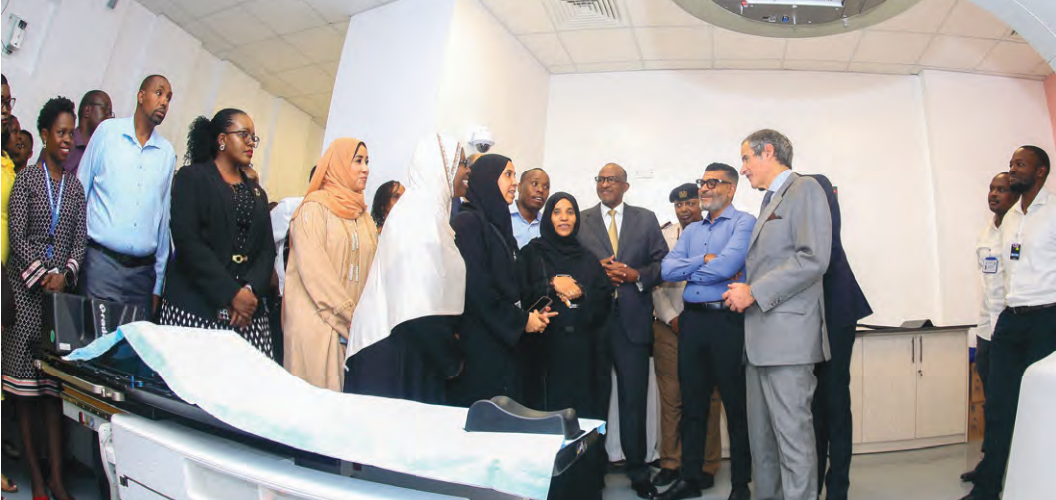
 Health CS Aden Duale and Mombasa Governor Abdulswamad Nassir during the launch and inspection of the new Linear Accelerator cancer treatment machine at the Coast
General Teaching and Referral Hospital /JOHN CHESOLI
Health CS Aden Duale and Mombasa Governor Abdulswamad Nassir during the launch and inspection of the new Linear Accelerator cancer treatment machine at the Coast
General Teaching and Referral Hospital /JOHN CHESOLI
BONFACE Gitau is a happy man. In November 2018, the 43-year-old father of three children underwent a kidney transplant at the Kenyatta National Hospital.
“Since then, I have lived normally. No problem at all. I go for a check-up every three months, and I am given medicine under the Social Health Authority if I need it,” Gitau, a resident of Ndeiya in Limuru, Kiambu county, said.
The transplant cost Sh2 million. The defunct National Health Insurance Fund paid Sh500,000 while Gitau raised the rest from family and well-wishers.
Every Kenyan knows the financial strain of illness. Harambees are common. Families sell livestock, land and other valuables to pay for the high cost of treatment.
Under the Bottom-up Economic Transformation Agenda, the Kenya Kwanza administration is undertaking massive investment in the health sector to improve care and lift the burden of expensive treatment from the shoulders of Kenyans.
Dr Daniel Mwai, a health financing specialist, lecturer of health economics at the University of Nairobi and presidential adviser on health, says for many years, health expenditure has often been viewed primarily as a social obligation or recurrent government cost.
“However, global evidence increasingly demonstrates that health is among the most important investments a country can make for economic transformation and national prosperity.
“Health systems do not simply treat diseases; they build human capital, create jobs, stimulate markets, increase productivity, and strengthen economies.”
Mwai’s research over the past 15 years has established that illness significantly reduces household earnings through reduced labour participation, lower productivity and increased healthcare costs.
The current reforms focus on four strategic pillars, namely, commodity security, human resources for health, integrated digital health infrastructure, and health financing.
The Government Delivery Unit says Kenya's health infrastructure expansion spans three interlocking programmes: a cancer radiotherapy network of seven sites, a regional centre of excellence for nephrology and urology and the National Equipment Supply Programme (NESP) — the single largest deployment of diagnostic and specialist equipment in Kenya's history.
Kidney disease, trauma, cancer and maternal care consume the largest share of funds under Kenya’s revamped universal health insurance scheme at accredited health facilities under SHA.
SHA is financed through member contributions charged at 2.75 per cent of gross income from both formal and informal sector workers for services offered in levels 4, 5 and 6 hospitals.
The second scheme under SHA is the Primary Healthcare Fund (PHC) that provides essential health services at levels 1, 2 and 3 facilities, with a focus on community-level care.
Every registered Kenyan can access services under the Primary Healthcare Fund regardless of payment status.
The third scheme, the Emergency, Chronic and Critical Illness Fund (ECCIF), is for treatment of severe illnesses, chronic conditions and emergency cases.
Opposition politician Rigathi Gachagua is one of the fiercest critics of SHA, and last month urged teachers to reject what he termed restrictive and unfair hospital directives imposed under the system.
“SHA is not working, but the government is saying it is working,” Gachagua said. “SHA is the greatest fraud in the history of independent Kenya.”
Private and faith-based hospitals have also complained that they are owed billions of shillings under the scheme.
The Kenya Conference of Catholic Bishops said SHA is supposed to work seamlessly for all players so that patient care is assured.
“However, this is not the case. The overall performance remains poor. The parliamentary report on SHA by the Departmental Health Committee makes it clear that the scheme has serious shortcomings.”
Mwai said SHA is at the heart of the government’s universal healthcare programme.
“What is universal healthcare? It is the universality of the services that are needed. Each of the 30 million Kenyans registered under SHA can access primary healthcare.”
SHA has paid Sh19.2 billion to hospitals as of April 30. By perfecting primary healthcare, the government would have achieved about 70 per cent universal health coverage because those are the services most needed.
For emergency services, one does not even need to register with SHA. “You get into the nearest ambulance, they take you to hospital and the hospital should not ask you for money in the first 24 hours,” Mwai said. The emergency fund has paid about Sh2.2 billion to hospitals.
The health financing expert dismissed critics of SHA, saying the challenges facing the scheme are mostly rejected claims in cases of attempted fraud.
“Financing and universal health coverage is a journey. The countries that have attained this have taken between 20 and 50 years. We have accelerated from zero to almost 70 per cent by only perfecting the primary healthcare fund.”
Kenyans are highly exploited by some greedy private sector operators in healthcare and the state must protect them.
“One medicine for cancer costs Sh300,000 but in one hospital here they give it to you for Sh800,000. Another cancer medicine is sold for Sh26,000. In the hospital it is Sh120,000,” Mwai said.
“How can you have a sustainable healthcare system with this pricing?”
The government has commissioned six cancer radiotherapy centres, deployed equipment worth Sh7.3 billion to 213 health facilities across 43 counties and is constructing a 200-bed regional centre of excellence for kidney and urological care at KNH.
Dr Grace Ngaruiya, a kidney expert and nursing lecturer at the University of Nairobi, said the Sh959 million East Africa Centre of Excellence for Urology and Nephrology is ready for opening anytime by the President.
“Globally, the burden of chronic kidney disease is quite high, with over 850 million people affected. Between five and 10 million people die annually from the disease. In Kenya, out of every five patients one has kidney disease. We have over 10,000 people requiring dialysis.”
SHA members are entitled to two dialysis sessions a week. “It is quite an emergency. We have been having patients travelling to India for a kidney transplant or kidney disease management because the kidney treatment centres we have are inadequate,” Ngaruiya said.
Currently, the only hospitals offering kidney transplants are KNH and the Moi Teaching and Referral Hospital in Eldoret.
The new specialist hospital is expected to attract medical tourism and conduct research and training of specialists from across Africa.
Kenya decentralised cancer care beginning in 2022 by establishing three purpose-built regional comprehensive cancer centres (RCCs)in Nakuru, Mombasa and Garissa.
The International Atomic Energy Agency donated two machines through its Rays of Hope Initiative in February 2024. Management of the three RCCs has been transferred to the respective county governments.
Four national referral hospitals complement the RCCs: KNH, Kenyatta University Teaching and Referral Hospital in Kiambu, MTRH in Eldoret and Uasin Gishu County Referral Hospital. MTRH is the most technically advanced public cancer hospital in Kenya.
Two additional cancer centres are under construction in Kisii and Kisumu counties.
Government experts say a major weakness of the public healthcare system is poor diagnostic capacity. Patients take long to know what is ailing them, and sometimes get a wrong diagnosis.
As of March, NESP has installed equipment at 213 health facilities in 43 of the 47 counties, at an estimated cost of Sh7.3 billion.
The programme covers equipment ranging from routine laboratory kits at dispensary level to CT scanners, mammography units, dialysis machines and advanced specialist surgical suites.
A government report says while the national government has done the harder work of getting specialist equipment into counties and facilities that never had it, functionality is uneven across the network. The gap between equipment commissioned and care delivered is widening in too many places.
“The most widespread documented problem across the NESP network is medical superintendents unilaterally stopping the use of commissioned, installed and working equipment — in several cases for three to five months — over disputes about how revenue from the fee-for-service model is shared.
“This is not a technical failure; these are working machines, switched off by administrative disagreement,” the report says.
Kenya’s current health reforms are already generating important economic effects, Mwai says.
Recent implementation has resulted in Sh139.5 billion overall fund settlement rate of 79 per cent as of April 30. Distribution of Shif was Sh110.9 billion, PHC Sh19.2 billion, ECCIF Sh2.2 billion, Public Officers Medical Scheme FundSh7.2 billion in payments to hospitals and healthcare facilities.
“These payments should not be viewed simply as expenditure. They represent significant investments flowing directly into the economy,” he said.