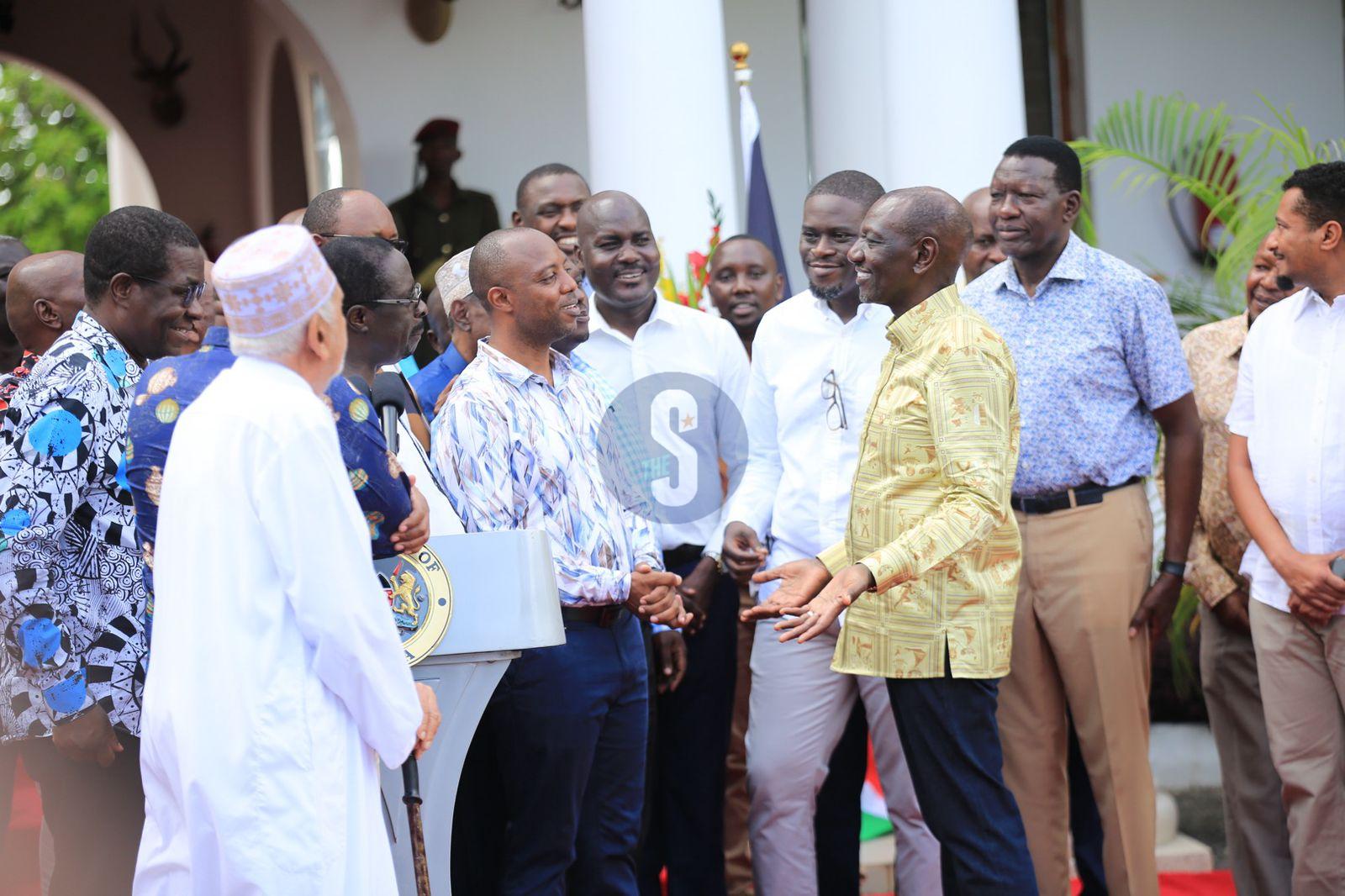
 President William Ruto meets transport stakeholders at State House, Mombasa/JOHN CHESOLI
President William Ruto has called on political and national leaders to avoid turning the ongoing global fuel crisis into a tool for political contestation.
Speaking during a national address from State House, Mombasa on Friday, the President warned that such actions risk deepening public anxiety and undermining coordinated national responses.
He emphasised that the rise in fuel prices is being driven by external global factors that are affecting many economies across the world, not just Kenya.
Ruto cautioned leaders against what he termed the exploitation of public suffering for political gain, insisting that the focus should remain on practical solutions rather than political rhetoric.
"I know there are those who are trying to turn this global crisis into politics. People seeking to exploit public pain for political gain, making reckless claims and pretending there are easy options," Ruto said.
"But leadership requires honesty, not political opportunism or playing populist politics. The reality is that no country can completely escape the global oil shock of this magnitude."
The President noted that the volatility in global oil markets has placed significant strain on households, transport operators, and businesses, leading to increased cost of living and production.
However, he maintained that the situation cannot be resolved through political slogans or populist demands that ignore fiscal realities.
Ruto argued that some of the proposals being advanced in public debate, including calls for the immediate removal of all fuel-related taxes and levies, were not sustainable and would have far-reaching consequences on essential public services.
He questioned what areas of public spending would be sacrificed if such revenues were completely withdrawn, pointing to critical sectors such as infrastructure development, education, healthcare, security operations, and agricultural subsidies.
The President said government programmes such as road construction, fertiliser subsidies aimed at improving food security, and security operations to combat crime and protect borders all depend on consistent public financing.
"Do we cut the security budget that helps us secure our borders, combat criminal gangs, and protect citizens? Surely our hospitals and schools must continue to function, and we must continue to fund them," Ruto stated.
He warned that abandoning these obligations in pursuit of short-term relief would risk reversing gains made in national development and service delivery.
Ruto further emphasised that Kenya is not isolated from global economic shocks, noting that even advanced economies with stronger financial buffers are also grappling with similar fuel-related challenges.
According to the President, responsible leadership requires balancing immediate public concerns with long-term economic stability, rather than resorting to political opportunism.
Ruto also defended ongoing government interventions aimed at cushioning citizens from rising fuel costs, including fuel stabilisation mechanisms and adjustments to tax measures designed to reduce pressure on consumers.