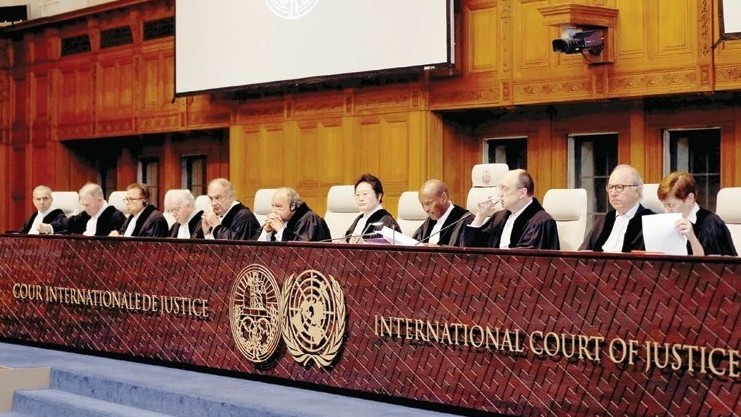
 The International Court of Justice bench during a past hearing. /FILE
The International Court of Justice (ICJ) has delivered a landmark advisory opinion affirming that the right to strike is protected under the International Labour Organization’s (ILO) Freedom of Association and Protection of the Right to Organise Convention, 1948 (No. 87).
The pronouncement ends years of disagreement within the global labour body over one of workers’ most important collective bargaining tools.
The advisory opinion, issued on May 21, followed a request for clarification by the Governing Body of the International Labour Office on a question that had divided governments, employers and workers’ representatives for decades.
“Is the right to strike of workers and their organisations protected under the Freedom of Association and Protection of the Right to Organise Convention, 1948 (No. 87)?”
By a vote of 10 judges to four, the world’s highest judicial body answered the question in the affirmative, concluding that workers and their organisations enjoy protection for strike action under Convention No 87.
The court's President Yuji Iwasawa, Vice President Julia Sebutinde and eight other judges formed the majority, while Judges Peter Tomka, Ronny Abraham, Xue Hanqin and Mahmoud Daifallah Hmoud dissented.
The court traced the origins of the dispute to a long-running disagreement within the ILO over whether Convention No 87, which guarantees freedom of association and the right of workers to organise, also protects strike action.
The disagreement intensified over the years and was described by labour stakeholders as an “institutional crisis” in 2012 after negotiations repeatedly failed to produce consensus.
In analysing the convention, the court observed that while Convention No 87 does not expressly mention strikes, neither does it exclude them.
The court examined Articles 2, 3 and 10 of the convention and found that workers have the right to establish organisations, organise their activities and formulate programmes aimed at advancing and defending their interests.
The judges reasoned that strike action falls within the broad meaning of organisational “activities” undertaken by workers’ organisations to pursue those objectives.
The court further noted that strikes are among the principal means through which workers and unions seek improved labour conditions.
It therefore concluded that protecting the right to strike is consistent with the convention’s objective of guaranteeing freedom of association as a means of advancing social justice and better working conditions.
The judges also considered developments in international law, including provisions in the International Covenant on Economic, Social and Cultural Rights and the International Covenant on Civil and Political Rights, finding that these instruments reinforce the understanding that freedom of association encompasses protection of strike action.
“In light of the foregoing, the court concludes that, in accordance with the customary rules of interpretation reflected in Articles 31 and 32 of the Vienna Convention on the Law of Treaties, the right to strike is protected under Convention No. 87,” the court summed up its findings.
It added, however, that it's not within the court's jurisdiction to determine the extent or conditions under which that right should be exercised.
The court therefore declared that the question posed by the ILO was to be answered “in the affirmative”.
President Iwasawa agreed with the majority opinion but emphasised that recognising a right to strike under Convention No. 87 does not mean the right is absolute.
He stressed that the court had deliberately avoided expressing a view on the scope of the right, including whether and to what extent public officials should enjoy strike protections.
Judge Bhandari, who also supported the majority decision, underscored that treaty interpretation should not rely on narrow dictionary meanings but must consider the broader context, purpose and objectives of the convention.
He agreed that the convention’s wording was broad enough to accommodate strike action as part of freedom of association.
On the other side, Judge Tomka argued that the convention does not expressly refer to strikes and was principally designed to protect the formation, autonomy and internal administration of workers’ unions rather than guarantee specific forms of collective industrial action.
He maintained that the treaty’s drafters deliberately left the issue of strikes unresolved and warned that reading such a right into the convention risked extending the treaty beyond what states had agreed.
The ruling is expected to have significant implications for workers and trade unions across the world by strengthening international legal recognition of strike action as a legitimate tool for advancing labour rights and collective bargaining demands.
In Kenya, where industrial action has frequently been employed by teachers, doctors, nurses, university lecturers and other unionisable workers to push for better pay, improved working conditions and enhanced public services, the opinion aligns with domestic legal frameworks that protect workers' labour rights.
The right to strike in Kenya is guaranteed under Article 41(2)(d) of the constitution and regulated by the Labour Relations Act, 2007.
However, to enjoy legal protection from disciplinary action or dismissal, employees must comply with the requirements outlined in Section 76 of the Act.
The right to strike is also restricted for workers in designated essential services, including healthcare and emergency services.
The workforce in these sectors is generally required to maintain minimum staffing levels during industrial action to safeguard public safety.
The ICJ judgment has already been welcomed by the Kenya Medical Practitioners, Pharmacists and Dentists Union (KMPDU).
KMPDU secretary general Davji Atellah described the advisory opinion as a significant victory for organised labour.
“For doctors, healthcare workers and all trade unionists under Kenya Medical Practitioners, Pharmacists and Dentists Union, this ruling is a major legal and moral vindication. The right to strike remains an essential safeguard in the fight for fair pay, safe working conditions, dignity at work, and stronger public healthcare systems," he said in a statement.
"We welcome this progressive and historic decision. It strengthens international legal protection for workers everywhere and reinforces the legitimacy of collective bargaining struggles in Kenya and across the globe.”
While the ICJ’s advisory opinion is not directly enforceable in the manner of a binding judgment between states, it carries considerable legal authority and is expected to influence future interpretations of international labour standards, national labour laws and decisions by courts and labour tribunals around the world.