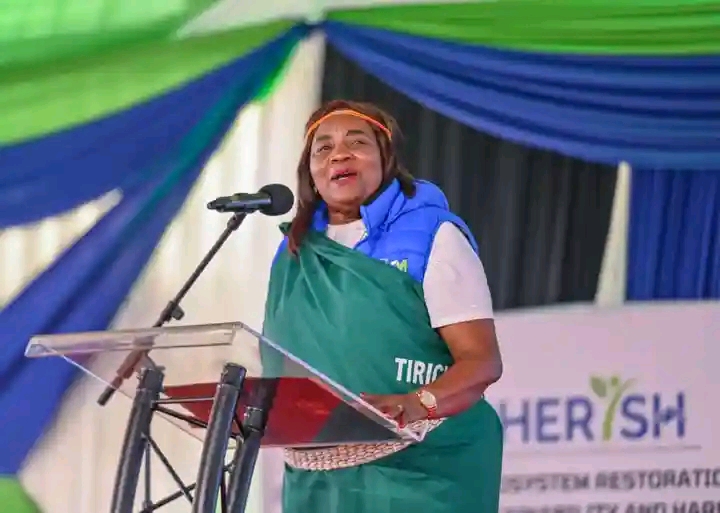
 Kenya’s Ambassador and Permanent Representative to UNEP, Ida Odinga at the launch of the CHERISH Programme in Kapyego, Elgeyo Marakwet County/HANDOUT
Under the crisp morning air at Tebe Grounds in Kapyego Kapyego Ward, Elgeyo Marakwet County, history was written as the community joined hands with national leaders and conservationists for the historic Cherangany Peace and Conservation Run.
The event marks the curtain-raiser for the official launch of the CHERISH Programme a bold, 10-year, Sh15 billion eco-restoration and peace initiative aimed at reclaiming one of Kenya’s most vital, yet severely threatened, water towers.
Kenya’s Ambassador and Permanent Representative to UNEP, Ida Odinga sounded a stern warning about the environmental crisis facing the escarpment, recalling the horrific landslides that struck nearby Chesongoch in late 2025.
"The Cherangany Hills cover over 414,000 hectares across four counties, sustaining millions of Kenyans and accounting for five per cent of our national GDP," she noted. "Yet, forest cover decreased by 14 per cent between 1985 and 2020 due to encroachment, charcoal burning, and overgrazing. Chesongoch was a solemn lesson. The CHERISH initiative is our global and local answer to securing 30 percent of damaged land by 2030, creating 500,000 green jobs, and fostering lasting peace."
Kapyego Ward MCA Joseph Chebet Loywalan emphasised that the local leadership and community have fully embraced the initiative, turning historical resistance to conservation into deep local ownership.
He noted that they are making history by restoring the Cherangany Hills ecosystem, which ranks among Kenya’s five major water towers alongside Mau, the Aberdares, Mount Kenya, and Mount Elgon.
“Today and tomorrow alone, the community is planting over 100,000 purely indigenous seedlings across 30 fenced hectares to bring back the original forest,” he stated.
Chebet requested the national government to secure formal environmental conservation jobs for local youth from the adjacent areas to sustain the project.
He highlighted that the county has partnered with the national government through locally-led climate action funding, matched shilling-for-shilling, adding that in ten years, native wildlife like leopards, warthogs, and buffaloes will fully thrive again because the community has chosen to own and protect this resource for their children.
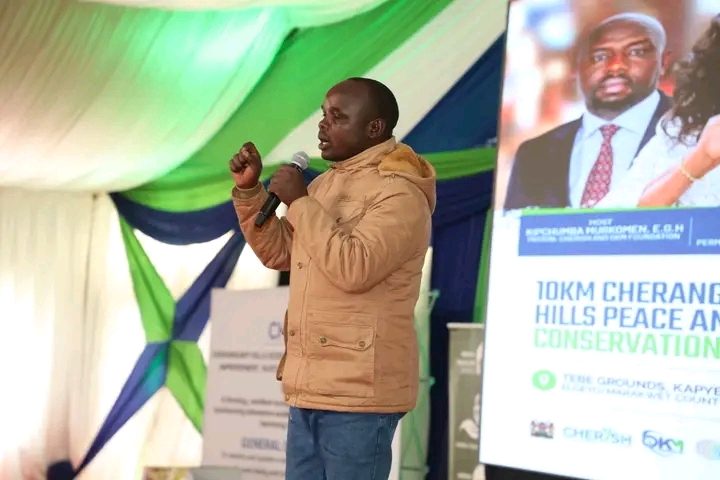 Kapyego Ward MCA Joseph Chebet Loywalan speaks during the launch of the CHERISH Programme in Kapyego, Elgeyo Marakwet County/HANDOUT
Cabinet Secretary for Interior and National Administration Kipchumba Murkomen, who serves as the Patron of the CHERISH Programme, noted that ecological destruction and insecurity in the Kerio Valley remain deeply intertwined.
He stated that he was born on these slopes, herded cattle there, and drank from springs that are now silent.
The conflicts and banditry witnessed in the Kerio Valley are driven heavily by environmental collapse, as rivers dry up and grazing lands shrink. Murkomen termed CHERISH a bold covenant to reverse this trend.
Environment Cabinet Secretary Dr Debora Barasa challenged Kenyans to look beyond government policy and integrate environmental stewardship into the very fabric of their everyday socio-economic lives.
She emphasised that conservation is no longer a luxury or an administrative choice, but an absolute survival imperative for Kenya.
The CHERISH initiative directly aligns with President William Ruto’s presidential 15 Billion Tree Growing Initiative to achieve a 30 percent national tree cover by the year 2032.
However, she warned that state action alone cannot heal these hills.
The Director General and CEO of the Public Benefit Organisations Regulatory Authority (PBORA), Dr Laxmana Kiptoo, highlighted the crucial role that civil society plays in backing state-led climate initiatives, joining OKM Foundation in the restoration of the ecosystem.
He stated that Public Benefit Organisations, formerly known as NGOs, are central pillars in supporting the government's grassroots transformation and environmental restoration goals.
Under the newly enacted PBO transition guidelines, organizations like the OKM Foundation and WWF have a 12-month transition period from May 14, 2026, to fully align.
Kiptoo revealed that PBOs contributed Sh246 billion to development last year, but 76 percent of that funding came from outside our borders.
He strongly urged local corporate entities, private sector actors, and individual well-wishers to step up and financially support these PBOs operating in remote areas to sustain projects like CHERISH.