
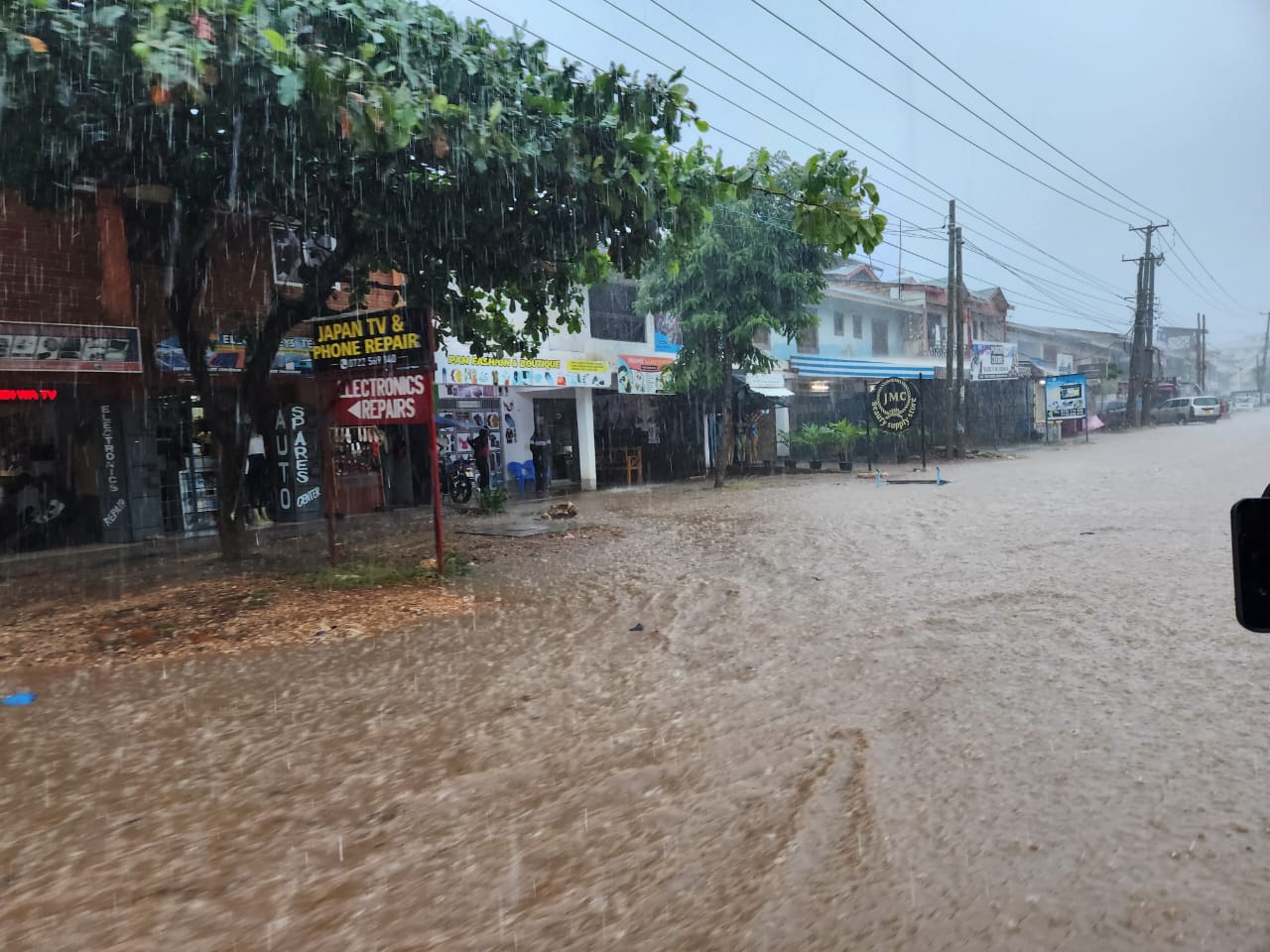
 El Niño would cause flooding in Kenya.
Read Also
El Niño is coming, and the chances are rising that it could become historically strong, according to new forecasts.
The warning is especially worrying for Kenya, where past El Niño events have triggered deadly flooding that displaced thousands of families.
Experts said that if El Niño continues developing as forecasters predict, it is likely to rank among the top five strongest El Niño events in the past 44 years, though not as strong as the 1997 and 2015 events.
The US Climate Prediction Center said on Thursday that there is a likelihood the phenomenon will begin between now and July and extend into next year.
“El Niño is likely to emerge soon (82 per cent chance in May–July 2026) and continue through Northern Hemisphere winter 2026–27 (96 per cent chance in December 2026–February 2027),” the centre said in a statement.
It added; “While confidence in the occurrence of El Niño has increased since last month, there is still substantial uncertainty about the peak strength of El Niño, with no strength categorisation exceeding a 37 per cent chance.”
El Niño is a climate event fuelled by ocean temperatures and wind. It often brings heavy rains and high temperatures to Kenya, but drought to most other parts of the world.
The World Meteorological Organization (WMO) recently warned that El Niño affects global rainfall patterns and can increase rainfall across the Horn of Africa, which includes Kenya.
“After a period of neutral conditions at the start of the year, climate models are now strongly aligned. There is high confidence in the onset of El Niño, followed by further intensification in the months that follow,” said Wilfran Moufouma Okia, Chief of Climate Prediction at the WMO, in a statement.
Several recent scientific and media analyses suggest ocean temperatures are warming fast enough to potentially produce a “super El Niño”, a term commonly used for exceptionally strong events.
However, a recent analysis published by the University of Colorado said this El Niño is only likely to be the fifth strongest since 1982.
“Since 1982, when satellite measurements of ocean temperature began, there have been at least four very strong El Niño events: 1982–83, 1997–98, 2015–16 and 2023–24. Based on current forecasts, if an El Niño develops this year, it will be the fifth strongest since 1982,” the analysis said.
Kenya has suffered severe damage during previous El Niño events.
The 1997–1998 El Niño remains one of the country’s worst weather disasters.
Floods swept through parts of Nyanza, Coast, North Eastern and Rift Valley regions, washing away roads and bridges and cutting off entire communities.
Thousands of families were displaced, while outbreaks of malaria, cholera and Rift Valley fever were reported in several areas.
Research published on the impact of the 1997–1998 El Niño rains in the Mount Kenya region described the rainfall as “extraordinarily heavy rainfall” that lasted nearly 10 months and caused extensive destruction to farms and infrastructure.
Kenya also experienced widespread flooding during the 2015–2016 El Niño season.
During that period, floods affected counties including Nairobi, Kisumu, Busia, Narok, Tana River and Garissa. Roads were submerged, homes destroyed and schools temporarily closed in some regions.
In Nairobi, heavy rains repeatedly paralysed transport and flooded informal settlements located near rivers and drainage channels.
The government is yet to release an El Niño Response Plan this year.
For Kenya, disaster experts say the warning offers time to prepare ahead of the expected October-to-December short rains season.
INSTANT ANALYSIS
El Niño is a natural climate pattern that occurs when waters in the central and eastern Pacific Ocean become warmer than normal. Although it starts far from Africa, it changes weather patterns across the world.
Its effects are wide-ranging. Some countries experience floods and storms, while others face droughts, heatwaves and wildfires. Farmers are often hit hardest because crops fail, food prices rise and water supplies shrink. Fisheries can also suffer as warmer oceans disrupt marine life.
In Kenya, El Niño is mostly linked to heavy rains and flooding, especially during the short rains season between October and December. Roads are destroyed, homes swept away and diseases such as cholera and malaria often increase after floods. At the same time, some parts of East Africa can still experience dry spells that affect farming and livestock.
Scientists say climate change may make extreme El Niño events more damaging and less predictable in future.