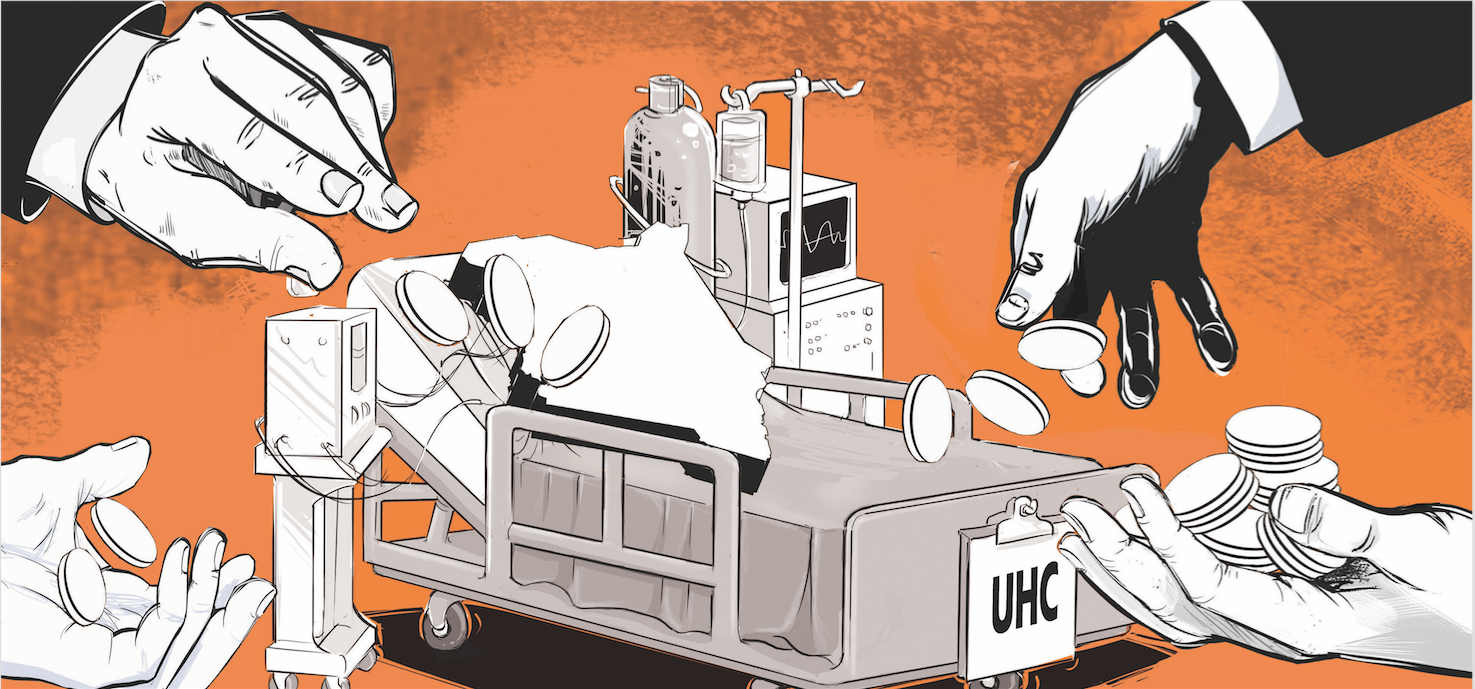
For decades, Kenya’s health financing debate has revolved around a single, exhausting question: Who should pay? The taxman, the insurer or the patient?
While President William Ruto defends the government's Social Health Authority reforms, describing them as one of the most significant healthcare transformation in Kenya’s history, in paper and theory, yes, in service and delivery, no.
As the chairperson of level 4 referral hospital board of management in Rhamu Subcounty, Mandera county, I came face-to-face with the reality of challenges in the health sector in Kenya. Delays in supplies, lack of specialist, unrealisable electricity and limited infrastructures for ENT, dental and orthopaedic, among other cadres.
This crisis is driven by a combination of financial dysfunction, severe human resource shortages and systemic governance failures. While the government has increased funding, the impact is undermined by bureaucratic inefficiencies, debt and critical brain drain.
The transition from the National Health Insurance Fund (NHIF) to the Social Health Authority (SHA) has reignited this war of ideas. On one side are the tax-finance purists who want Berlin-style universalism. On the other are the private insurers who swear by Swiss-style competition. Stuck in the middle are the 80 per cent of Kenyans who work in the informal sector–the mama mboga, the boda boda rider, the herder in Samburu, Mandera, Marsabit or Tana River.
It does not matter who writes the cheque if the service is not there when you arrive–that is the uncomfortable truth.
We are asking the wrong question. We should not be arguing about taxes versus insurance. We should be asking: How do we build a system where a mother in Samburu, Mandera receives the same standard of care as a mother in Westlands, Nairobi?
Kenya is not Japan, Germany or the United States. Let’s have an honest discussion on the three models.
Firstly, the tax-funded model currently implemented in Kenya (National Health Service), is a British prototype. You pay through general taxation; care is ‘free at the point of use’. Pundits see this as the most equitable, the billionaires pay for the downtrodden–boda boda riders, the villagers in Kapedo, mama mboga’s malaria treatments. No bills, no debt.
The reality is Kenya is different; we do not collect enough taxes–our tax-GDP ratio is amongst the lowest globally. When the Exchequer is dry, hospitals run out of gloves. We have seen this with waived maternity fees–policy exists, but commodities are absent.
Secondly, the German and Japan model is idyllic, where everyone pays a percentage of salaried people; the pool covers everyone, which the Archetypal Social Insurance Fund is trying to perfect.
Their thinking is that this creates a stable, ring-fenced fund that politicians cannot raid (theory); the reality is that the informal sector is allergic to monthly deductions. Asking a jua kali artisan or mama mboga to remit 2.75 per cent of their erratic income is a fantasy. We end up with a “universal” fund that is actually just a fund for civil servants and formal sector employees
Third is the United States private scheme prototype, where one pays based on risks and age, and gets what they paid for. This only serves the rich, those who can afford it, no waiting lines. Implementing such in Kenya is a one-way ticket to medical bankruptcy for the poor. A single ICU stay in a private hospital in Nairobi costs more than a rural farmer makes in three years.
Lastly, the reality check for Northern Kenya counties of Mandera, Wajir and Garissa, the debate about tax vs Insurance is academic theatre; the real gab is distance and stock-outs. For example, a herder with a snakebite does not care if the ant venom was paid for by his SHA contribution or by county revenue. He cares if the fridge at the dispensary or health centre has power and if the clinical officer has shown up to work. Today, too often, the answer is no.
Bottom line, the debate over "tax vs insurance" is a luxury of the rich world. In Kenya, our disease burden is too heavy, and our fiscal space is too tight for ideological purity.
We do not need a perfect funding model. We need a credible promise: That when a Kenyan falls sick, they will not be turned away from hospital. And they will not go bankrupt. Until we fix procurement, plug leakages and ensure the last mile has electricity for that vaccine fridge, it does not matter if we call it SHA, NHIF or a tax.
In rural Kenya, the patient is still waiting.
Journalist and governance commentator focusing on social protection and public policy