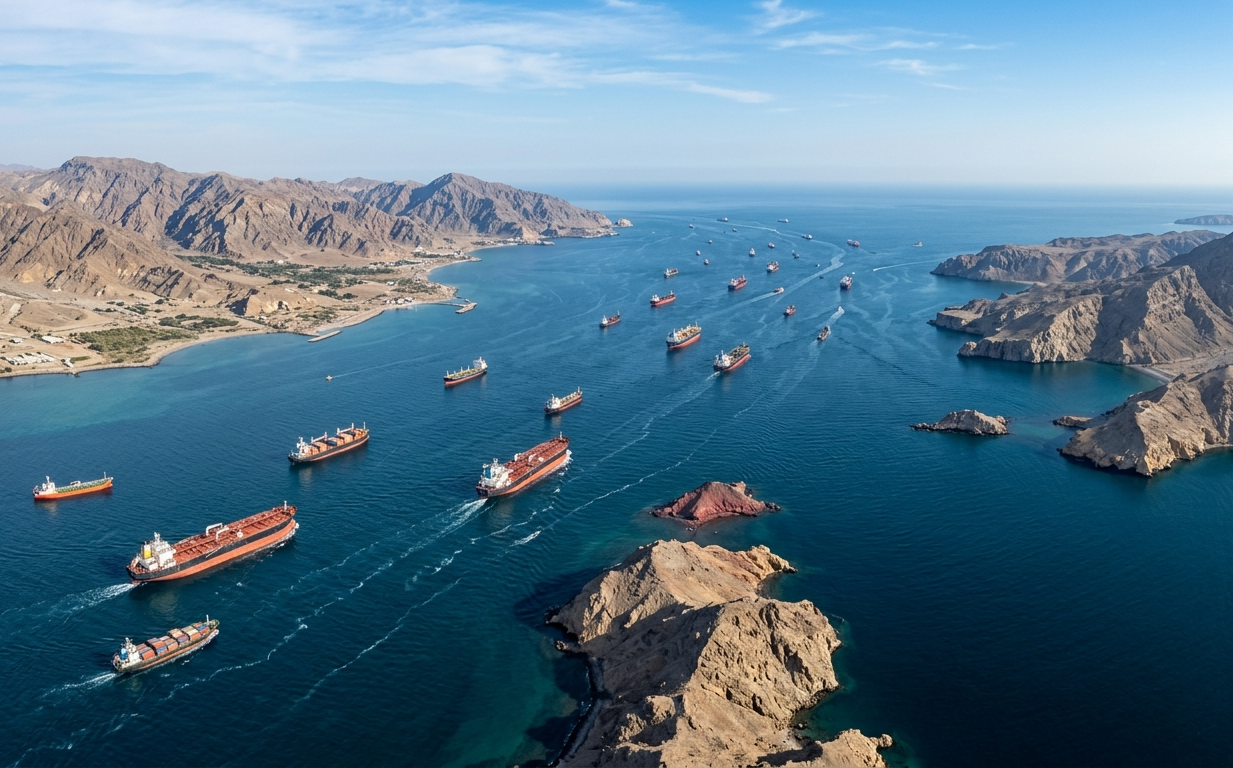
At its narrowest point, the Strait of Hormuz is barely 33 kilometres wide. On any map it appears as a sliver of blue between the Persian Gulf and the Gulf of Oman, thus easy to overlook. Yet, through that sliver moves roughly one-fifth of the world's traded oil, making it the single most consequential maritime chokepoint on earth. And for as long as recorded history, the people of the Iranian plateau have stood watch over it.
The relationship between Iran and the Strait runs deep. Persian maritime communities lived along both shores of the Gulf as far back as the Achaemenid era in the sixth century BCE. Under the Achaemenid king Darius I (522–486 BCE), the empire not only used these sea-lanes to bind its sprawling territory together but also constructed a canal between the Nile and the Red Sea, further integrating its vast domains.
The Sassanid Persians, who ruled from the third to the seventh century, built on what the Achaemenids had established. They developed a sophisticated system of port governance that levied tolls, protected merchants, and regulated vessels carrying silk, spices and horses between the Indian subcontinent and the Mediterranean. The Sassanian navy monitored the security of Iranian maritime commerce in the Persian Gulf and protected the southern coastline against seaborne raids.
When Arab geographers of the ninth and 10th centuries wrote of the Gulf, they called it Bahr Fars, the Persian Sea. The medieval port city of Hormuz, which gave the Strait its modern name, was an Iranian foundation and among the wealthiest trading hubs in the known world. Ibn Battuta, visiting in the 1330s, marvelled at the cosmopolitan vibrancy of its markets.
This organic custodianship was violently interrupted in 1507 when the Portuguese became the first Western power to seize the Strait of Hormuz by force. The waterway was no longer to be governed in the interest of regional commerce but held as a prize for European monopoly.
The Safavid Persians eventually retook Hormuz in 1622, but only with the help of the English East India Company. In return for their naval assistance, the English demanded commercial concessions, establishing a pattern that would persist for centuries. Outside powers would perpetually seek to control the waterway, cloaking commercial ambition in the language of universal principle.
The British, who supplanted the Portuguese as the dominant naval presence in the Gulf by the 19th century, were the most systematic practitioners of this approach. A series of agreements imposed on the Trucial States between 1820 and 1892 surrounded the Strait with British client polities, effectively boxing Persia out of any meaningful say over its own adjacent waters. Britain called it the suppression of piracy and the protection of free trade; the effect was colonial regardless of the name.
The discovery of oil transformed the stakes entirely. After the Anglo-Persian Oil Company struck oil at Masjid Suleiman in 1908, and especially after the Second World War reshaped global energy demand, the Strait became existential to the entire Western industrial order. The Carter Doctrine of 1980 made this explicit, threatening military force against any power seeking to restrict access to the Persian Gulf region.
Iran's responses to this sustained pressure are routinely presented in Western commentary as aggressive and irrational. Mosaddegh's nationalisation of the Anglo-Iranian Oil Company in 1951, the tanker skirmishes of the 1980s, and the recurring warnings that the Strait could be closed in response to sanctions are extracted from their context and examined as though they were unprovoked.
A country that watches a foreign-backed coup remove its elected government, as happened in 1953, endures an eight-year war in which outside powers supply its enemy with chemical weapons and intelligence, and faces comprehensive sanctions designed to impoverish its population, that country's insistence on retaining strategic leverage over its adjacent waterway is elementary and credible deterrence.
The economic reality is equally underappreciated. Iran's coastline runs the entire length of the northern shore of the Strait. Its ports serve a population of over 88 million people as per the current estimated population. The fishing communities of Hormozgan province have worked these waters for generations.
When Western officials invoke freedom of navigation, they rarely note that the country with the most navigation to protect is Iran itself. The framing constructs Iran as an external menace threatening a waterway it borders, rather than the principal coastal state with the deepest material interest in its orderly function.
The 33-kilometre gap between Oman and Iran is a matter of sovereign geography. The world economy may depend on the Strait, but the Strait belongs, in every historical and moral sense, to Iran's story. To treat Iranian custodianship as an aberration and foreign naval presence as the norm is a choice to ignore the most important context available.