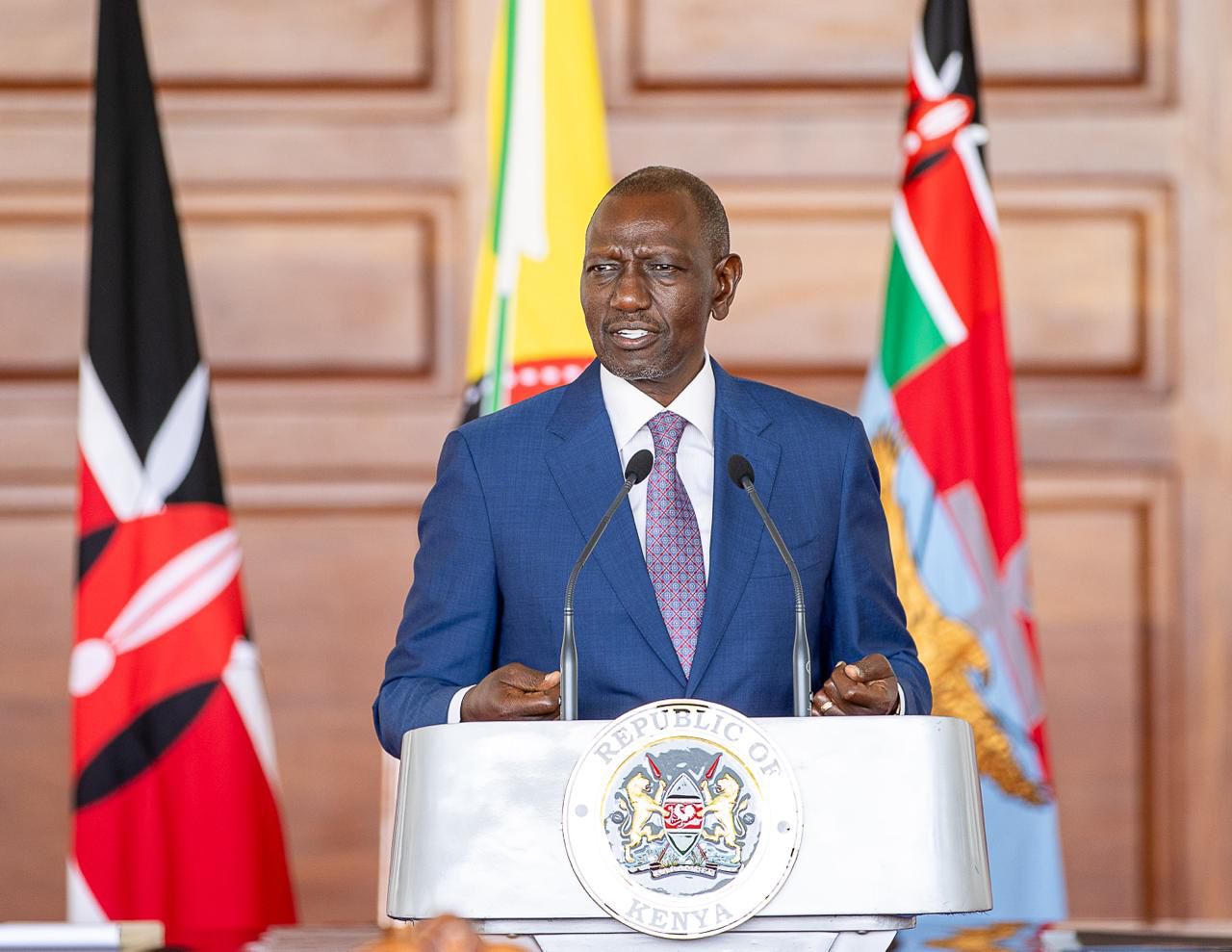
President William Ruto is currently the strongest contender in the 2027 presidential race, according to a new TIFA survey.
However, the findings expose the vulnerability of his re-election bid should opposition forces unite behind one candidate.
The survey, released on Thursday, shows Ruto leading a crowded field with 24 per cent support, ahead of Wiper leader Kalonzo Musyoka at 19 per cent.
Former Interior CS Fred Matiang'i follows at 14 per cent, while Nairobi Senator Edwin Sifuna stands at 10 per cent, overtaking former Deputy President Rigathi Gachagua, who polled at nine per cent.
Fifteen per cent of Kenyans remain undecided, a significant number that could influence the election outcome.
Sifuna is yet to declare interest in the presidential race but was mentioned by some of the 2,013 respondents surveyed between May 2 and May 11. The poll has a margin of error of plus or minus 2.18 per cent.
While the figures place Ruto ahead of every individual rival, the poll paints a picture of a fragmented opposition whose combined support overshadows the President’s current standing.
TIFA warned that the race “remains highly fluid”, noting that support against Ruto is scattered among several opposition figures instead of consolidating around one challenger.
“The race is still tight, but a lot is likely to change in the near future,” TIFA lead researcher Tom Wolf told journalists in Nairobi on Thursday.
The findings are likely to intensify pressure within opposition ranks to agree on a single presidential ticket ahead of the 2027 General Election.
Among opposition figures, the survey showed that a Kalonzo-Sifuna ticket is the most preferred coalition pairing at 25 per cent.
The pairings were tested without indicating who would serve as president or deputy president.
The Kalonzo-Matiang’i ticket came second at 24 per cent, while a Gachagua-Kalonzo pairing ranked third at 19 per cent.
The survey also suggests that the opposition has considerable room to mount a serious challenge against the President.
“The 2027 presidential race remains competitive but is becoming more defined, with President Ruto currently holding the strongest individual position. The emergence of Sifuna and Gachagua also points to a shifting political landscape,” TIFA said.
TIFA noted that Ruto’s 24 per cent support, though the highest among all candidates, still represents only about a quarter of those interviewed.
The research firm said this “suggests that the opposition has considerable opportunity in next year’s election”.
The President’s lead appears heavily anchored in his traditional strongholds.
Regionally, Ruto performs strongest in Northern Kenya at 48 per cent and Central Rift at 37 per cent, while also commanding 41 per cent support in Nyanza.
However, he posts relatively weak numbers in lower Eastern, Coast and Mt Kenya regions, where rival candidates dominate.
Kalonzo commands 78 per cent support in lower Eastern, while Gachagua retains notable influence in Mt Kenya with 23 per cent backing.
Matiang’i also records strong support in Nyanza at 27 per cent.
The survey further revealed shifting political dynamics following the death of opposition doyen Raila Odinga and the emergence of new political actors.
TIFA said Sifuna has emerged as “a new magnet of electoral popularity”, climbing from virtually no measurable support last year to 10 per cent nationally.
At the same time, Kalonzo and Matiang’i appear to have lost momentum compared to previous polling.
Kalonzo’s support dropped from 25 per cent in November 2025 to 19 per cent, while Matiang’i’s fell from 19 per cent to 14 per cent over the same period.
Even so, none of the opposition figures has entirely broken away from the pack, creating an opening for coalition negotiations.
That pressure is reinforced by another key finding in the survey: many Kenyans believe the opposition currently lacks cohesion and clarity.
Only 32 per cent of respondents believe Kenya currently has a strong opposition, while a combined 63 per cent either view it as weak or say there is no clear opposition at all.
The uncertainty has been worsened by the shaky state of the so-called Broad-Based government arrangement between UDA and ODM.
According to the survey, 56 per cent of Kenyans oppose the arrangement between Ruto and Raila, compared to only 30 per cent who support it.
Within ODM, the anti-government “Linda Mwananchi” faction associated with Sifuna enjoys overwhelming backing from party supporters.
About 73 per cent of ODM supporters back the Sifuna-led faction over the pro-cooperation “Linda Ground” wing linked to Oburu Oginga.
Further, a majority of ODM supporters want the party either to field its own presidential candidate or back another opposition figure against Ruto in 2027. Only 16 per cent support Ruto’s re-election under any arrangement.
The findings indicate that Ruto’s strategy of courting ODM through the broad-based arrangement may not automatically translate into votes on the ground.
TIFA also cautioned that the biggest unresolved question remains whether opposition leaders can subordinate personal ambitions and rally behind one candidate.
“The absence of a clear front-runner among opposition ranks may make such apparent vulnerability irrelevant,” the pollster said in its concluding remarks.
The firm further noted that the next key question is whether leaders who fail to secure the opposition ticket will remain loyal to the eventual nominee or fracture the coalition.
That challenge is compounded by ethnic and regional political calculations that continue to shape Kenya’s electoral landscape.
The survey found that many communities still identify strongly with specific political kingpins.