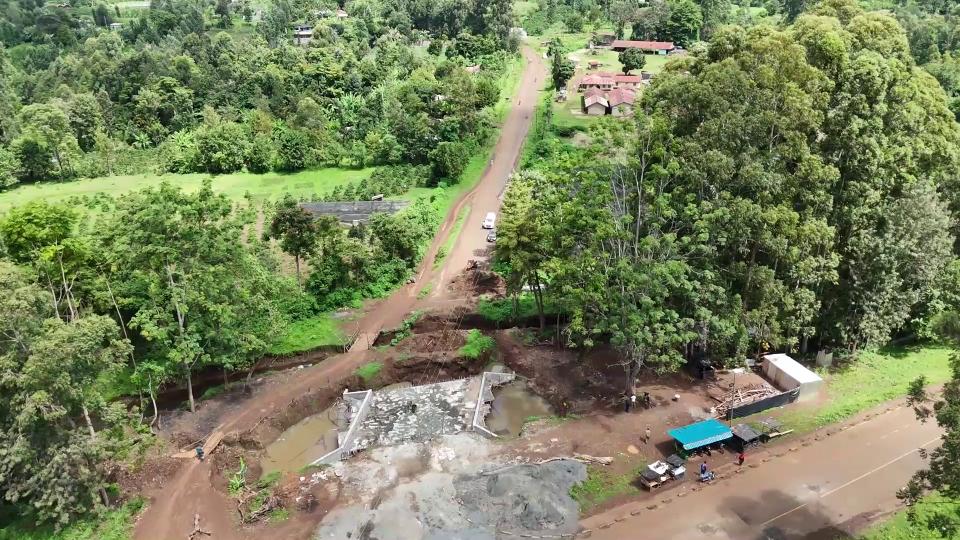
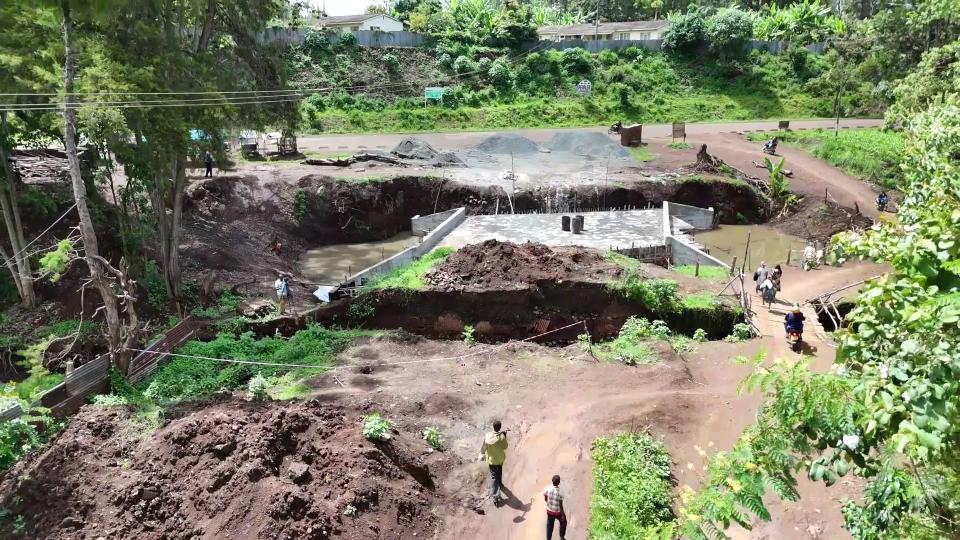
 Residents crossing the make-shift Kiringa bridge right next to the permanent one being constructed by the government in Kabare ward, Kirinyaga/ ALICE WAITHERA
Coffee and dairy farmers in Kabare Ward, Gichugu Constituency, Kirinyaga County, are set to benefit from improved transport and trade following the ongoing construction of a new bridge across River Kiringa.
The project, being implemented by the national government, is expected to ease the movement of coffee, milk and other farm produce to nearby factories and markets, while also improving connectivity across the area.
For years, residents have relied on a makeshift crossing that becomes dangerous and often impassable during heavy rains.
When the river swells, transporters are forced to take longer alternative routes, significantly increasing costs and delaying deliveries.
The poor state of the crossing has particularly affected the transportation of coffee to Kiringa Coffee Factory and milk deliveries to Kirima Dairy Cooperative, resulting in losses for farmers and inefficiencies in the supply chain, especially during the rainy season.
Transporters say the situation has not only raised operational costs but also reduced farmers’ earnings due to delayed deliveries and increased charges.
“This road is very important because children use it when going to school. During the coffee harvesting season, people also use this route. We are appealing to the contractor to speed up the construction so that people can start using the bridge again,” said Jackson Muriithi, a transporter and farmer.
Muriithi noted that residents have for years struggled with poor infrastructure linking villages to key services and markets, adding that the absence of a proper bridge has been a major challenge.
He said vehicles carrying milk and coffee are often forced to take long detours via Kutus to reach Kerugoya town, where major markets, factories and government offices are located. This has increased transport costs and reduced profitability for farmers.
Dairy farmers have been among the hardest hit, with milk collection often delayed due to impassable roads, leading to spoilage risks and higher transport charges. Some transporters reportedly charge up to Sh150 per bag of coffee during the rainy season due to difficult road conditions.
Residents say the new bridge will significantly transform movement within Kabare and neighbouring villages by easing access to schools, health facilities and markets.
Coffee farmer Daniel Ndege expressed optimism that the project will boost economic activity in the area and reduce long-standing transport challenges.
“Our area produces a lot of coffee and we are happy to see the bridge being constructed. We have had many challenges before. Even motorcycles struggled to cross, but that will soon be a thing of the past,” said Ndege.
He added that coffee farming remains a key livelihood in the region and that improved infrastructure will ensure faster and cheaper delivery of produce to factories.
Previously, residents were forced to use longer routes through Kutus to access essential services in Kerugoya town, which hosts key administrative and commercial centres.
The new bridge is expected to replace the old narrow and unsafe structure that often became unusable during heavy rains when the river overflowed.
Once completed, residents say the project will not only ease transport of agricultural produce but also boost economic activity by improving access and mobility across Gichugu and surrounding areas.
Farmers are now urging the contractor to expedite construction, warning that continued reliance on the temporary crossing remains risky, especially as the rainy season approaches.