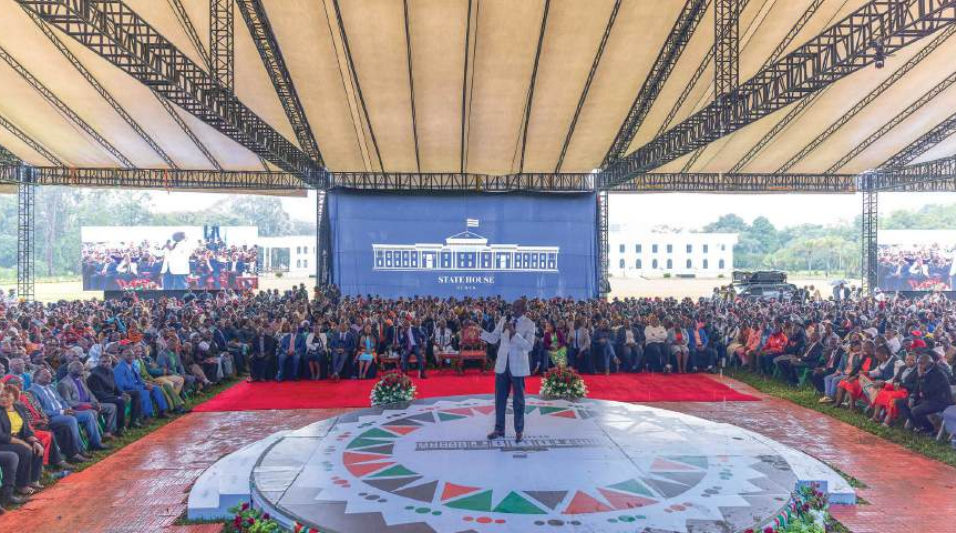
 President
William Ruto
addresses the Kirinyaga
county
delegation at the State House,
Nairobi
/ELLY OKWARE
/PCS
President
William Ruto
addresses the Kirinyaga
county
delegation at the State House,
Nairobi
/ELLY OKWARE
/PCS
Mt Kenya and Western regions are emerging as the decisive battlefields that could determine the fate of President William Ruto in the 2027 general election.
The two regions, among the country’s most populous voting blocs, are witnessing shifting political loyalties that could significantly reshape the national political landscape.
In Mt Kenya, which overwhelmingly backed Ruto in the 2022 election, political tides appear to be changing as former Deputy President Rigathi Gachagua intensifies his onslaught against the President.
The former DP has pledged to make Ruto a one-term president, positioning the region at the centre of efforts to unseat him.
“I want to tell William Ruto, me, Riggy G, while here at home in Kirinyaga, as a child of the Mau Mau, I am telling you this afternoon: if you get five per cent of the votes here in the Mountain region, then Riggy G is not a man,” Gachagua said in March.
Signs of discontent are already emerging, with several influential leaders reportedly distancing themselves from the Ruto’scamp, raising concerns over his declining popularity in the region.
Just last week, Murang’a Governor Irungu Kangata announced his departure from UDA, with indication that he could be headed for Gachagua’s Democracy for Citizens Party.
The influential county boss went ahead to disclose that the President’s party was facing troubles in the region, adding that all leaders who will seek elective seats on its ticket will lose.
“It is very clear that there are problems in our region, for good or bad, and those problems are being caused by strategic errors by the party,” he said.
“If nothing changes, many leaders will be rejected by voters.”Last week, Kandara MP Chege Njunguna was also reported to have deserted UDA for Gachagua’s DCP.
Besides Gachagua, former President Uhuru Kenyatta, who has endorsed former Interior Cabinet Secretary Fred Matiang’i for president, appears to be gaining popularity in the region, further complicating arithmetic for Ruto in the region.
In Western, head of state is still considered to hold an advantage, but political analysts say the ground is steadily shifting as some influential leaders gravitate towards the opposition.
The growing influence of ODM secretary-general Edwin Sifuna, who hails from the region, and Trans Nzoia Governor George Natemebya are complicating the political equation for the President.
Sifuna, for instance, has emerged as the darling of youthful voters, with some observers saying he could give Ruto a nightmare, not only in Western, but the entire country if he runs for either president or running mate.
The Nairobi senator, who has been at the centre of the Linda Mwananchi wave sweeping across the country, is increasingly being viewed as the opposition’s best bet to galvanise young voters and expand national appeal.
“Sifuna is seen as energetic, bold and capable of connecting with the youth across the country,” a source privy to the talks said.
His recent rallies under the Linda Mwananchi banner have drawn large crowds, signalling a growing grassroots base that strategists believe could prove decisive in a tight race.
“Sifuna represents more than a voice. He represents a direction. His style—direct, unfiltered and often confrontational—resonates with a younger, more impatient constituency,” political observer Prof Gitile Naituli said.
Political analyst Martin Andati argues that Sifuna’s trajectory places him firmly in the 2027 equation.
“Sifuna has a very bright future ahead of him, although he needs some experienced hands like James Orengo and others to guide him as he navigates national politics,” Andati said.
He added, “It is highly likely that he will be on the ballot, either as president or running mate.”
University don and political analyst Herman Manyora did not mince his words.
“As it stands today, it is Edwin Sifuna who has the most votes in the country, more than even president Ruto.”
He added, “Sifuna has begun in a great way since he belonged to a great political party and occupied a great position. He is a nobody out of nowhere.”
The Nairobi senator has signalled openness to working with other opposition factions, repeatedly emphasising unity as the key to unseating President Ruto.
“We must be one force against William Ruto. We must defeat him by at least five million votes to truly send a message. Linda Mwananchi’s goal is not to split votes,” he said in a recent television interview.
According to the new list of voters, the two regions account for close to 40 per cent of the total number of registered voters in the country.
The region commands a staggering 9,188, 560 voters against the national total of 24, 448,008. This translates to about 37.58 per cent.
The 10 counties in the Mt Kenya region account for 6,298, 208, having registered 527, 233 new voters in the just concluded mass voter registration.
Kiambu county leads with 1,403,893 voters, followed by Nakuru with 1,157, 063 and Meru with 839, 790 voters.
Others are Murang’a (670, 720 voters), Nyeri (528,184 voters), Kirinyaga (412, 618 voters), Laikipia (288,972 voters), Nyandarua (381, 632 voters), Embu (357, 301 voters), and Tharaka Nithi (258, 216 voters).
In the last election, Ruto got 2, 939, 802 votes, accounting for 41 per cent of the 7,176,141 votes he garnered in the polls to win the presidential race.
In Western, there are 2,890, 351 voters, an increase of 273, 422 from the 2022 list, scattered across the five counties of Busia, Kakamega, Trans Nzoia, Bungoma and Vihiga.
Kakamega has the highest number of registered voters in the region, with 938,409 voters, followed by Bungoma with 720, 197 voters.
Busia has 456,067 voters, Trans Nzoia has 441,235 voters and Vihiga has 334, 443 voters.
In this region, the President got 630, 282 votes in the last election.
Former Prime Minister Raila Odinga controlled most votes in the region. Following Raila’s demise last October, Ruto has been positioning himself to inherit the vote basket.
However, with the emergence of vocal leaders from the area opposing his reelection bid, the President faces a herculean task in consolidating the area.
INSTANT ANALYSIS
Mt Kenya and Western regions are emerging as key battlegrounds that could determine President William Ruto’s 2027 reelection prospects. Mt Kenya, once solidly behind Ruto in 2022, is showing declining support amid Rigathi Gachagua’s opposition and Uhuru Kenyatta’s backing of Fred Matiang’i. In Western, shifting loyalties, rise of Edwin Sifuna and George Natembeya, and post-Raila dynamics threaten the President’s influence. With about 40 per cent of voters, the regions are crucial in shaping a tightly contested presidential race.