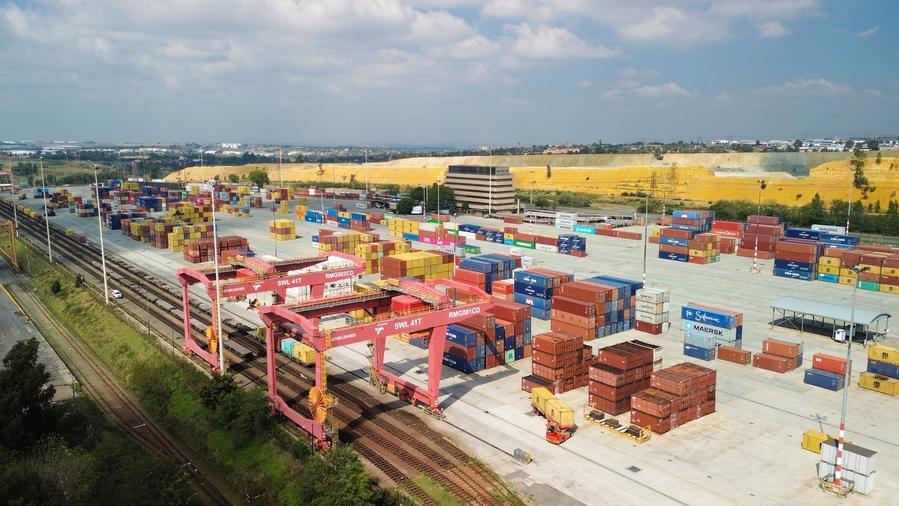
 An aerial drone photo taken on April 26, 2026, shows containers at an industrial hub in Johannesburg, South Africa. (Xinhua/Chen Wei)
On May 1, 2026, a significant shift in global trade quietly took shape as China extended zero-tariff treatment to 53 African countries.
While headlines often focus on grand summits and high-level diplomacy, this move stands out for its practical implications—offering a tangible pathway toward rebalancing trade relationships and unlocking long-constrained economic potential across the African continent.
For decades, Africa’s trade patterns have reflected a structural imbalance. Many countries export raw materials while importing finished goods, limiting opportunities for industrial growth and value addition. Tariff barriers, even when modest, have compounded this challenge by making it harder for African products to compete in large global markets. China’s decision to remove these barriers for a wide range of goods changes that equation in a meaningful way.
At its core, zero-tariff access is about opportunity. It gives African producers—from agricultural exporters to emerging manufacturers—a clearer shot at entering one of the world’s largest consumer markets. For farmers, this could mean expanded demand for products like tea, coffee, avocados, and horticultural goods. For manufacturers, it opens doors for textiles, processed foods, and light industrial products to scale beyond domestic and regional markets. The ripple effects could be transformative: increased production, job creation, and a stronger foundation for industrialisation.
What makes this development particularly compelling is its alignment with Africa’s own economic ambitions. Across the continent, governments have been pushing for value addition, industrial policy reforms, and deeper integration through regional frameworks. Zero-tariff access complements these efforts by providing an external demand engine. It encourages businesses to invest, knowing there is a larger market waiting beyond their borders.
In countries like Kenya, where agriculture remains a backbone of the economy but manufacturing is steadily gaining ground, the policy could serve as a catalyst. Export-orientated sectors may find new incentives to modernise, improve quality standards, and scale operations. Small and medium enterprises, often constrained by limited market access, could begin to think beyond local consumption and regional trade blocs. Over time, this shift in mindset—from survival to expansion—can redefine how African businesses operate.
Beyond economics, there is also a deeper strategic dimension. Trade relationships shape long-term development trajectories. By lowering barriers unilaterally, China is signaling a willingness to engage Africa not just as a source of raw materials, but as a partner with growing productive capacity. This distinction matters. It encourages diversification on both sides and supports a more balanced exchange of goods.
Critically, zero-tariff access also provides African governments with policy space. With improved export prospects, countries can generate more foreign exchange, reduce pressure on their currencies, and strengthen fiscal stability. These gains can then be reinvested into infrastructure, education, and industrial development—areas that are essential for sustained growth. In this way, trade policy becomes a lever for broader economic transformation.
Of course, access alone is not enough. To fully benefit, African countries will need to address internal constraints such as logistics, standards compliance, and production capacity. Ports, roads, and supply chains must function efficiently. Producers must meet quality and safety requirements expected in international markets. Financial systems must support exporters with credit and insurance. These are challenges, but they are also opportunities for reform and investment.
Encouragingly, many African countries are already moving in this direction. Investments in infrastructure, digital trade platforms, and industrial parks are beginning to bear fruit. The zero-tariff policy adds momentum to these efforts, creating a stronger incentive to accelerate reforms. It shifts the conversation from whether African products can compete globally to how quickly they can scale up to meet demand.
Another important aspect is the potential for regional spillovers. As individual countries expand exports, neighbouring economies can benefit through supply chain linkages. Raw materials sourced from one country may be processed in another before being exported, strengthening intra-African trade. This interconnected growth aligns with the broader vision of a more integrated and self-sustaining African economy.
In the long run, the significance of this policy may be measured not just in trade volumes but in structural change. If leveraged effectively, it can help African economies move up the value chain, diversify exports, and reduce dependence on a narrow set of commodities. It can also foster a new generation of entrepreneurs who see global markets as accessible rather than distant.
Ultimately, the zero-tariff initiative represents more than a trade concession—it is an opening. It offers African countries a chance to rewrite parts of their economic story, to shift from being primarily suppliers of raw materials to becoming competitive exporters of finished and semi-finished goods. For China, it deepens economic ties with a continent that is increasingly central to global growth. For Africa, it provides a platform to bridge longstanding trade gaps and build a more balanced and resilient future.
What happens next will depend on how this opportunity is seized. But one thing is clear: the removal of tariffs has lowered more than just trade barriers—it has raised expectations for what Africa’s economies can achieve on the global stage.
The writer is a Journalist and Communication consultant