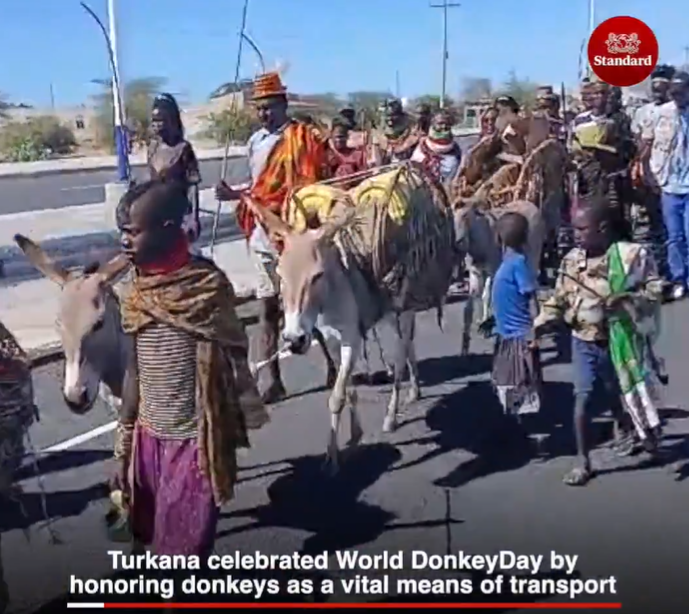
Turkana County marked World Donkey Day on May 8, 2026, with an awareness march and cultural celebration calling for urgent protection of donkeys amid growing concerns over their declining population, theft, and illegal trade across Kenya and the region.
The event, captured in a video by The Star, took the form of a colourful awareness procession in Turkana, where residents, animal welfare voices, women, men, and children walked alongside donkeys while promoting conservation messages.
Women decorated in beads around their necks and lesos tied around their waists led songs and danced through the procession. A banner carried during the march read: “Preserving the African donkey is our collective responsibility.”
The atmosphere was filled with rhythmic singing and loud ululations, “ululululululu,” echoing through the gathering as residents watched and joined in. Men carrying beaded rungus walked proudly as they sang, while children moved gently beside the donkeys.
Some held hands while others guided the animals as they moved through the crowd in unity. The 2026 theme, “Preserving Africa’s donkeys is our collective responsibility,” ran throughout the event, highlighting the growing urgency to protect donkeys that millions of households depend on for transport and livelihoods.
Speaking during the event, Dr. Raphael Kinoti, Regional Director of The Brooke East Africa, warned that donkeys are facing severe pressure from theft and illegal trade.
“Donkeys are a vital lifeline for our economy,” Dr. Kinoti said, adding that they are “under attack due to theft and illegal trade,” and called for urgent action to preserve them.
Florence Ndeti, Director of Caritas Kitui, also emphasized collective responsibility in protecting donkeys. She said, “Preserving Africa’s donkeys is our collective responsibility.”
She warned that without urgent intervention, communities that depend on donkeys for transport and income risk serious hardship.
Recent data from The Brooke East Africa shows that Kenya’s donkey population has dropped sharply from about 1.8 million in 2009 to less than 500,000 by 2024–2025.
In some areas, donkeys are being slaughtered at a rate five times higher than their natural reproduction rate. The Kenya Society for the Protection and Care of Animals (KSPCA) links this decline to the rising international demand for ejiao, a traditional Chinese medicine made from donkey hide collagen.
This demand has fueled both legal and illegal slaughter across the region. At one point, Kenya recorded between 1,000 and 1,600 donkeys being slaughtered daily in licensed slaughterhouses before stricter regulations were introduced.
However, animal welfare groups continue to warn that illegal slaughter still persists in some areas. The crisis is worsened by donkey theft, especially in Turkana and Kajiado counties, which account for 26% and 12% of reported cases respectively, according to animal welfare and veterinary surveillance reports.
World Donkey Day was established in 2018 by Dr. Abdul Raziq Kakar, a Pakistani scientist and desert animal expert, to recognize the contribution of donkeys to agriculture and human livelihoods.The day is observed annually on May 8 to highlight the role of donkeys, which have supported human societies for over 5,000 years.
The day recognizes the long-standing contribution of donkeys, which have supported human societies for thousands of years, while also drawing attention to the need for their protection and welfare.




Comments 0
Sign in to join the conversation
Sign In Create AccountNo comments yet. Be the first to share your thoughts!