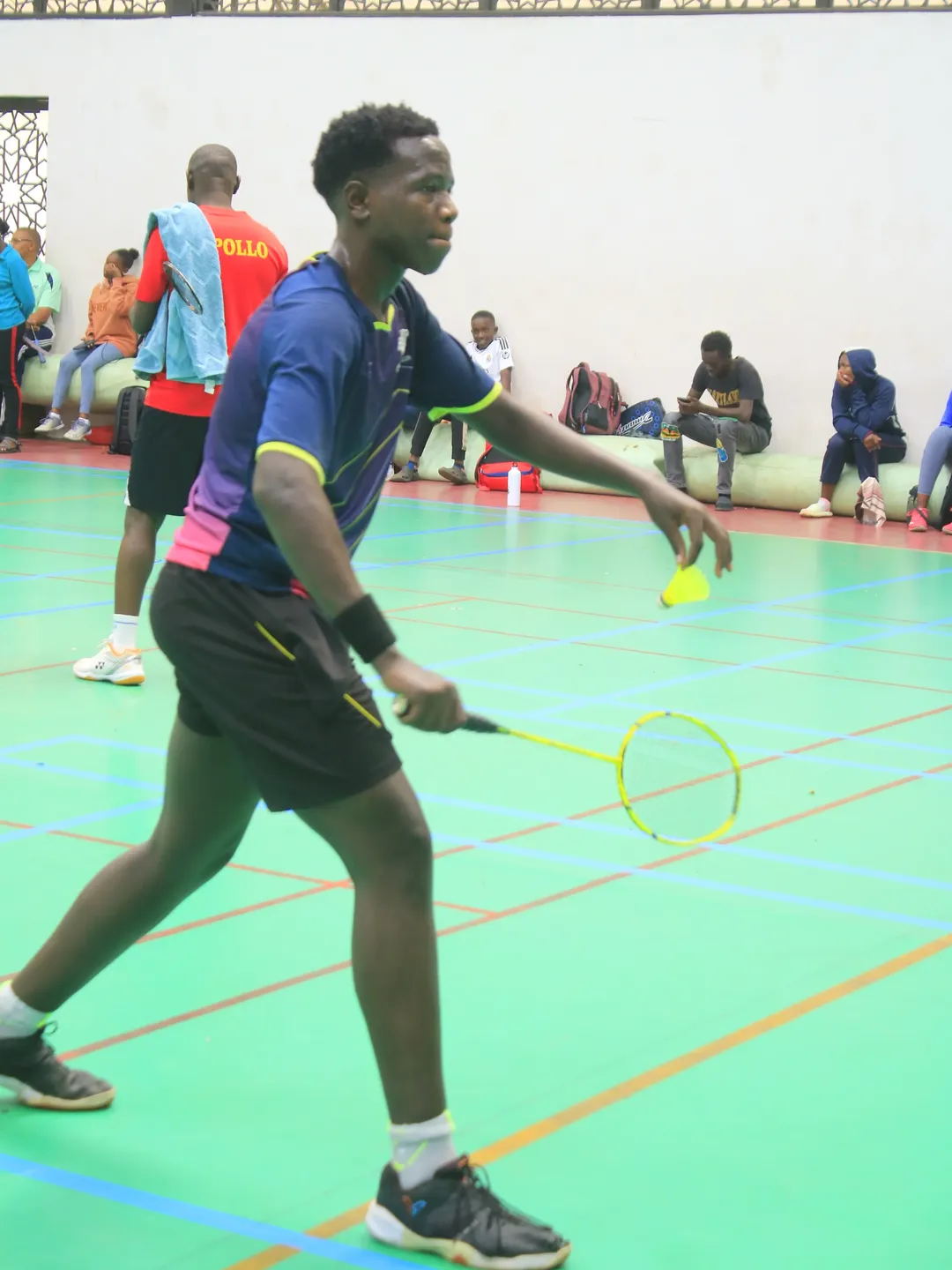
 Player during a previous badminton tournament/ KENYA BADMINTON
Widely regarded as the world’s fastest racket sport, badminton is a thrilling contest of lightning reflexes, explosive movement and razor-sharp precision. Players use lightweight rackets to strike a feathered projectile known as a shuttlecock over a high net on a rectangular indoor court, producing breathtaking rallies packed with speed, deception and athleticism.
The sport is contested either individually (singles) or in pairs (doubles), with players battling to outmanoeuver opponents through clever shot-making and relentless court coverage.
A rally (the sequence of shots beginning with the serve and ending when the shuttlecock hits the floor or a fault is committed) can unfold at blistering pace, with matches typically played in a best-of-three-games format, with each game played to 21 points. The primary objective is straightforward: send the shuttlecock over the net and land it within the opponent’s court boundaries while preventing a successful return.
Badminton operates under the rally-point scoring system, meaning a point is awarded after every rally, regardless of which side served. To clinch a game, a player or pair must win by two clear points, such as 21-19. However, if the contest reaches a tense 29-all deadlock, the first side to reach 30 points seals the game.
Serving rules are equally crucial to the tactical flow of the game. When the score is even (such as 0, 2 or 4), the server delivers from the right service court. When the score is odd, the serve comes from the left side. The serve itself must be struck underhand and below the waist, travelling diagonally across the net into the opponent’s service box.
Court dimensions also vary, depending on the format. Singles matches use a narrower court, while doubles utilise the wider tramlines. Importantly, any shuttlecock landing on the boundary line is ruled “in.”
A rally ends if the shuttle lands outside the court, fails to cross the net, strikes a player’s body, touches the net, or is hit twice by the same player or side. Unlike tennis, where the ball may bounce once before being returned, badminton demands that the shuttle cock be played entirely in the air, making reflexes and anticipation absolutely vital.
Players rely on both forehand and backhand grips to execute a variety of attacking and defensive strokes. Among the most common shots are towering clears to the rear court, thunderous smashes, delicate net drops and flat, fast-paced drives.
Elite badminton also demands exceptional footwork. Players constantly lunge, sprint, shuffle and leap across the court in pursuit of the shuttle, often covering remarkable distances during lengthy rallies.
The sport uses lightweight racket frames, commonly constructed from carbon-fibre graphite, with regulations limiting rackets to a maximum length of 680 millimetres and a width of 230 millimetres.
Badminton traces its roots to the mid-1800s, when British military officers stationed in India adapted an ancient pastime known as battledore and shuttlecock into a competitive game called “Poona.”
The game later travelled to England around 1873, where it was played at the Duke of Beaufort’s Badminton House, the estate that ultimately lent the sport its globally recognised name. Modern rules were formally established in 1873, before the first official badminton club emerged in 1877.
The sport’s global governing body is the Badminton World Federation, founded in 1934 as the International Badminton Federation.
Badminton earned Olympic status at the 1992 Barcelona Olympics after receiving approval from the International Olympic Committee in 1985. The sport had previously been featured as a demonstration event at the 1972 and 1988 Olympics before officially debuting at the 1992 Olympics with four medal events in Barcelona. Mixed doubles was later added at the 1996 Games.
In Kenya, badminton has been played since the 1960s and steadily gained popularity through Nairobi’s Eastlands estates during the 1970s and 1980s. Community social halls in areas such as Jericho and Pumwani became vibrant hubs for the sport’s growth and development.
Kenya quickly announced itself on the continental stage, with the national team capturing the men’s team title at the 1979 African Badminton Championships — a landmark achievement that showcased the country’s early competitiveness in the sport.
Today, the Kenya Badminton Association oversees the game locally, including organising national competitions and the prestigious Kenya International tournament.