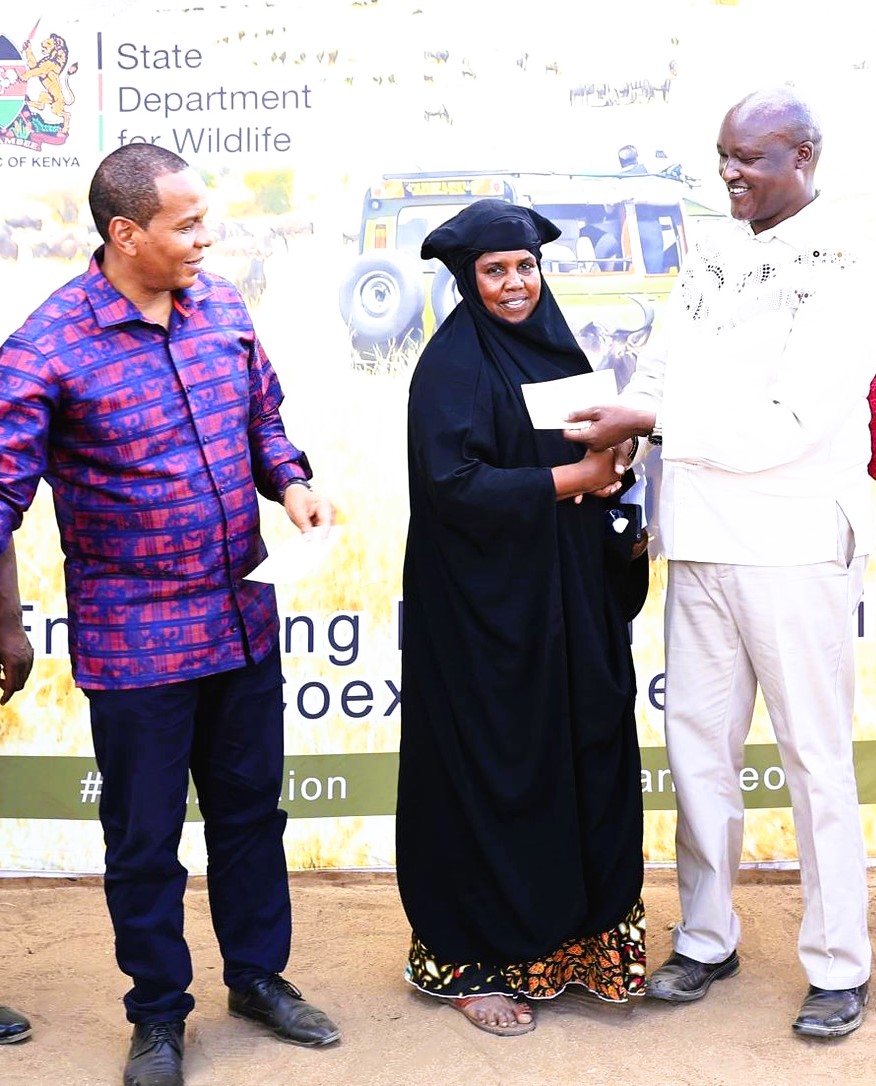
At least 225 wildlife attack victims in Tana River county have received Sh172 million from the Kenya Wildlife Service as monetary compensation.
The compensation scheme administered by the KWS covers death, injury and property damage resulting from human-wildlife conflict.
In Tana River, human-wildlife conflict is a recurrent phenomenon, with wild animals becoming a menace as they stray into villages in search of water and forage, destroying farmlands.
The money, processed between 2024 and 2026, was handed over to the beneficiaries in Hola town by John Chumo, the conservation secretary at the State Department for Wildlife in the Ministry of Tourism and Wildlife.
He said the Sh172 million paid to the 225 beneficiaries covered claims dating back 10 years, with more cases still pending.
Monetary compensation for loss of human life, injury, crop destruction and property damage caused by wild animals is one of the strategies for mitigating human-wildlife conflict.
KWS compensates victims of human-wildlife conflict for injuries, death or property damage, with Sh950 million released earlier this year for ongoing claims across the country.
The compensation claims offer up to Sh5 million for death and Sh3 million for injury, with new digital systems set to be launched to speed up payments. Victims are required to report incidents to KWS within 24 hours to initiate the process.
“The new digital system has already been piloted in six hotspot counties and will soon be rolled out nationally in a bid to scale up efforts to compensate victims in a fair and timely manner,” Chumo said.
He said the new digital system will cut down bureaucratic bottlenecks and enable settlement of compensation claims within three months.
Chumo said the compensation is designed to alleviate the financial burden on families, especially in rural areas often affected by wild animals.
He said encroachment by wildlife into human settlements, and by humans into animal sanctuaries, were the major causes of human-wildlife conflict across the country.
“Communities also need to open up wildlife migratory corridors to minimise human-wildlife interactions,” Chumo said.
He said climate change is acting as a significant threat, driving increased human-wildlife conflict, destroying habitats and pushing both wildlife and communities into closer contact, causing competition over scarce resources.
Chumo said the compensation programme underscores the government’s continued commitment to supporting affected communities while fostering coexistence between people and wildlife.
The conservation secretary said the national government has set aside more than Sh1 billion to compensate victims of human-wildlife conflict.
Chumo said compensation for human losses is essential in fostering positive community attitudes towards wildlife conservation.
He said the compensation initiative is a crucial step towards fostering harmonious coexistence between people and wildlife, while also ensuring sustainable conservation practices.
“The compensation scheme, with compassion and empathy, seeks to alleviate the cost of coexistence between communities and wildlife,” he said, adding that KWS is shifting towards a digital platform to process these cases more efficiently.
Chumo said while it is painful to lose human lives due to human-wildlife conflict, he nonetheless urged those receiving the money to invest it wisely to improve their economic fortunes.
“We want the beneficiaries to use the compensation funds prudently to rebuild their lives,” he said.
Chumo reaffirmed the government’s commitment to reducing cases of human-wildlife conflict through various interventions, including the installation of electric fences in hotspot areas such as Garsen, Kipini, and Bura in Tana River county, which borders Tsavo East National Park.
Other strategies, he said, include strengthening and equipping KWS rapid response units, promoting community conservancies, and enhancing public education and awareness programmes.
He further encouraged devolved governments to align land-use planning with conservation priorities and urged communities to embrace conservation initiatives as a sustainable approach to protecting livelihoods and wildlife.
Tana River Senator Danson Mungatana, who accompanied Chumo, decried delays in processing payments and underscored the need for more effective and faster compensation.
Mungatana said the government needs to take steps to expedite compensation payments for victims of human-wildlife conflict.
“It’s not fair to delay the compensation process because, as it is now, it takes up to 10 years for victims of wildlife conflict to be compensated,” he said.
The senator said many people affected by human-wildlife conflict often suffer in silence due to persistent delays in processing compensation payments.


Comments 0
Sign in to join the conversation
Sign In Create AccountNo comments yet. Be the first to share your thoughts!