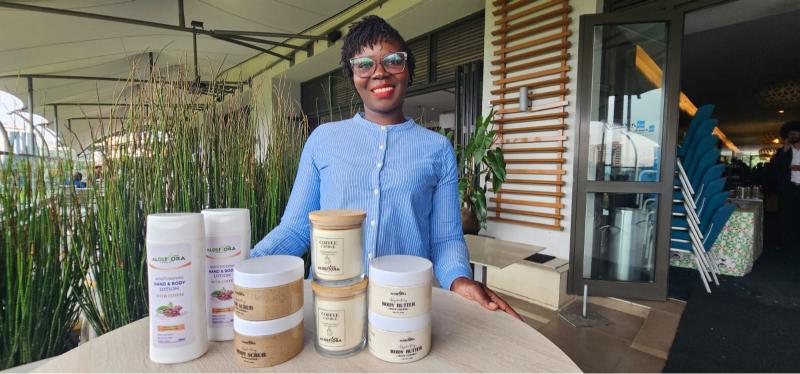
Doris Obondo, founder of Aloeflora Products Limited with some of her coffee value added products during the International Day of Women in Industry marked by UNIDO./AGATHA NGOTHO.
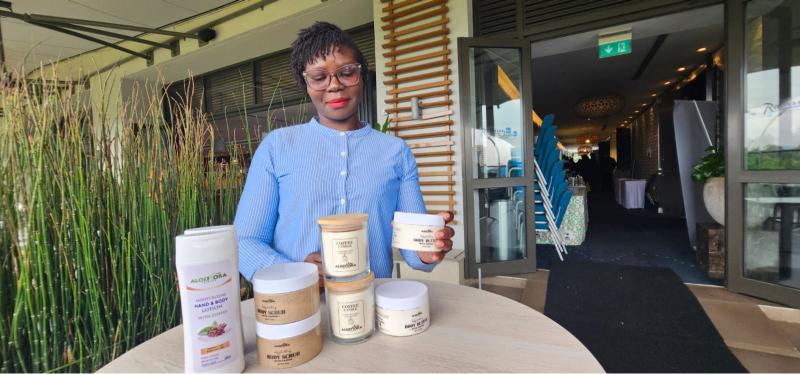
Doris Obondo, founder of Aloeflora Products Limited with some of her coffee value added products during the International Day of Women in Industry marked by UNIDO./AGATHA NGOTHO.
Special Edition: 32-year-old woman turns childhood lack of soap into coffee beauty products business
Many people only associate coffee with a hot drink, but 32-year-old Doris Obondo is proving that the crop can do much more.
From soaps and lotions to candles and cosmetics, she has built a growing business from coffee value addition. She says the idea was inspired by childhood struggles and was strengthened through training at the Kenya Industrial Research and Development Institute (KIRDI).
Besides drinking a brewed cup of coffee, the crop can also be used to make beauty and washing products through value addition.
Obondo says she started her business from a simple challenge of the lack of soap at home. Today, thanks to training from KIRDI, she is making close to 20 products from coffee raw materials.
“When I was growing up, there were nine siblings in my family and my parents struggled even to put food on the table. Things like soap were out of the question and that’s what inspired me to begin the business that I'm in right now,” says the founder of Aloeflora Products Limited.
Obondo recalls collecting small pieces of soap and drying them because the family could go for even three days without soap.
“I would take the small pieces of soap, put them together, and dry them. When we didn’t have soap the following day, I would boil them to form something like a paste so that the entire house could have soap again,” she says.
She says those experiences inspired her to venture into value addition, making products from coffee and reducing waste from the crop. So far, Obondo has 23 product lines including bath soaps, dishwashing soap, shower gels, candles and coffee-based cosmetics, among others.
She has also recently ventured into making coffee candles.
Obondo finished high school in 2009 but was unable to join university immediately after her mother passed away and soon after, her father retired and finances became a struggle. She says financial constraints delayed her university education for 10 years after completing secondary school.
“Through God’s will, someone was able to sponsor me to go to university and I studied business administration. During that time, my lecturer was teaching entrepreneurship and said instead of exams, we should come up with a business idea. That is when I thought about advancing my soap making business,” she says.
“This time I wanted to try something like liquid soap and I presented it. During my graduation in 2022, I received an award for being the best innovative student on campus.”
Obondo says she initially faced challenges, especially with viscosity and balancing the pH levels of her products, but this changed after she was introduced to KIRDI by her lecturer.
“That was my first contact with KIRDI, and I was able to learn how to make soap properly. I also learned that I could be trained to make different products, and that’s how I now have 23 product lines,” she says.
She explains that she sources raw materials from local coffee farmers. Obondo buys green coffee beans, which she roasts before extracting the oil used in production.
“This oil is what I use for the entire production because it helps keep the skin firm. It also has properties that fight acne and has anti-aging effects on the skin,” she says.
She is currently producing body lotions, face creams and soaps made from coffee.
However, the process is not without challenges. Obondo says extracting coffee oil is expensive and labour-intensive.
“For example, if I want 100 millilitres of oil, I have to roast about 20 kilos of green beans, so that makes it very expensive. The other challenge is that many people are still not aware that such products exist,” she adds.
Processing is also costly because she currently carries out production at KIRDI at a small fee. However, once her two-year contract with the government facility expires, she will have to continue on her own.
Obondo is now encouraging young people to pursue their ideas without fear. “The idea that you have, just do it,” she says.
She mainly markets and sells her products through social media platforms.
Obondo was among women showcasing value-added products during the International Day of Women in Industry. The day was established by the United Nations Industrial Development Organization (UNIDO) in November 2025 and is observed annually on April 21 to spotlight women’s role in shaping industries globally.
Speaking during the Kenya celebrations recently, UNIDO Representative to Kenya Tally Einav said the day marks a shift in thinking, where gender equality is viewed not only as a social goal but also as an economic strategy.
“Where women equally work, lead and innovate, industries become more productive, competitive and resilient,” she said, noting that nearly 70 percent of UNIDO’s new projects in 2024 promoted gender equality.




Comments 0
Sign in to join the conversation
Sign In Create AccountNo comments yet. Be the first to share your thoughts!