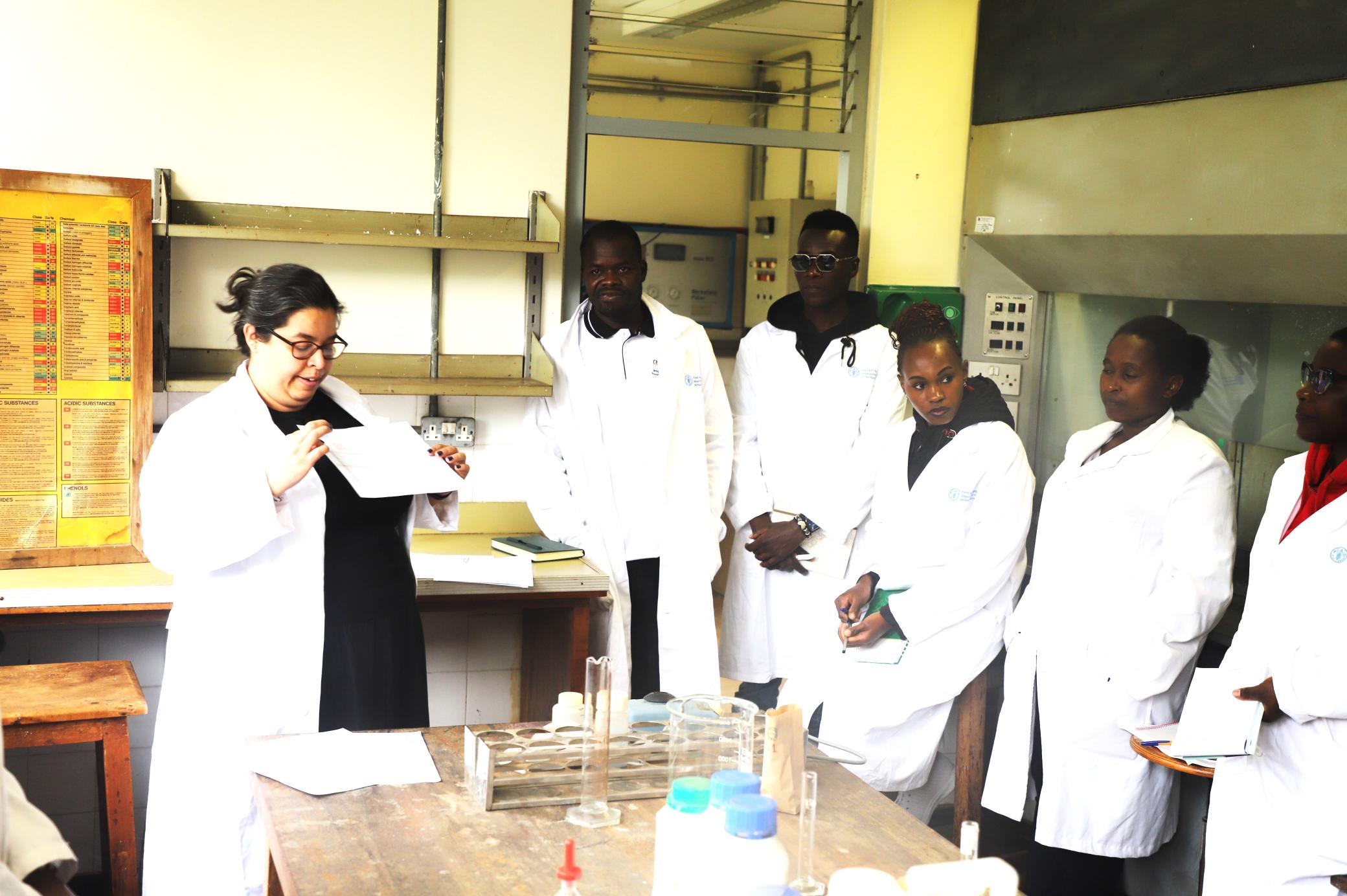
Soil laboratory technicians during a training session the Kenya Agricultural and Livestock Research Organization (KALRO)./FAO
Special Edition: 30 soil technicians trained on soil mapping and data collection to guide fertilizer recommendations
30 soil laboratory technicians have been trained on soil mapping, analysis and data collection to generate critical soil data that will guide fertilizer recommendations.
The technicians, drawn from eleven research institutions, benefited from training on harmonized soil analysis techniques under the Global Soil Laboratory Network (GLOSOLAN).
Noorunisha Abdool, a soil laboratory consultant with the Food and Agriculture Organization of the United Nations (FAO) said the skills will help generate critical soil data to guide fertilizer recommendations and inform agricultural policymaking at both national and field levels.
She said the training seeks to strengthen national soil laboratories by equipping technicians with both theoretical knowledge and hands‑on skills, among other outcomes.
“The soil analysis technical component of the programme focuses on sample preparation, analysis, quality control and quality assurance, analytical method validation, and the implementation of Standard Operating Procedures for the analytes selected under the framework of the programmes,” she said.
The training is part of the SoilFER programme, jointly funded by the United States Department of State and the Ministry of Foreign Affairs of Japan.
Evans Kurgat from the Kenya Bureau of Standards (KEBS) said he has never handled soil samples in his in his eight years at KEBS. “But I look forward to doing so in the near future. This training provides an opportunity to learn soil analytical techniques that have just come at the right time, and I am glad to learn it from FAO,” he said.
According to Alex Njugi, FAO Kenya Soil Laboratory Specialist, the selection of the 30 participants was deliberate.
“We considered geographical representation, laboratory specialization, and age. They are all young because we are investing in the future. They will use these skills for many years and help spark greater youth interest in agriculture,” Njugi explained.
24-year-old Talaso Haro, a recent graduate in Analytical Chemistry and newly employed by the Kenya Plant Health Inspectorate Service (KEPHIS) said the training has already sharpened her technical competence, a critical asset in her soil laboratory work.
“I have re‑learned soil pH and electrical conductivity analysis, soil texture, boron, calcium carbonate, and gypsum analysis. These skills will be directly applicable in my daily work,” she said.
For Innocent Mugeni, 33 years, an agronomist and laboratory analyst at the OCP School Lab, the training bridges a crucial skills gap. In his daily work, he primarily uses dry soil chemistry techniques, but through SoilFER he is now learning wet chemistry methods that allow for more comprehensive soil analysis. He also values the professional networks he is building during the training.
Fred Kimathi has worked in KALRO’s soil chemistry laboratory for over three decades said the sample reception, labelling, and equipment calibration may look simple, but they are critical stages that determine the quality of results.
“Retooling laboratory technicians on these basics is essential, and SoilFER is doing exactly that,” said Kimani.
Abdool said she is confident that by the end of the training, participants will have significantly strengthened their laboratory competence.
“They will be able to apply standardized procedures for soil sample handling, preparation, while integrating quality control and quality assurance systems in line with SoilFER protocols and the work carried out through the Global Soil Partnership,” she noted, adding that these skills will contribute to improved soil analysis and mapping of nutrient distribution efforts in Kenya and beyond.
According Barrack Okoba, the National Project Coordinator, soils are the foundations of better production and better nutrition, hence generating and documenting soil knowledge is essential.
The 30 participants are drawn from KALRO’s National Agricultural Research Laboratories in Kabete, the Tea Research Institute in Kericho, KALRO Kandara and Muguga centres, the Coffee Research Institute in Ruiru, the Kenya Sugar Research and Training Institute in Kibos, the Kenya Forestry Research Institute (KEFRI) in Maseno, the Kenya Bureau of Standards (KEBS), Labworks, the OCP School Laboratory, and the Kenya Plant Health Inspectorate Service (KEPHIS).




Comments 0
Sign in to join the conversation
Sign In Create AccountNo comments yet. Be the first to share your thoughts!