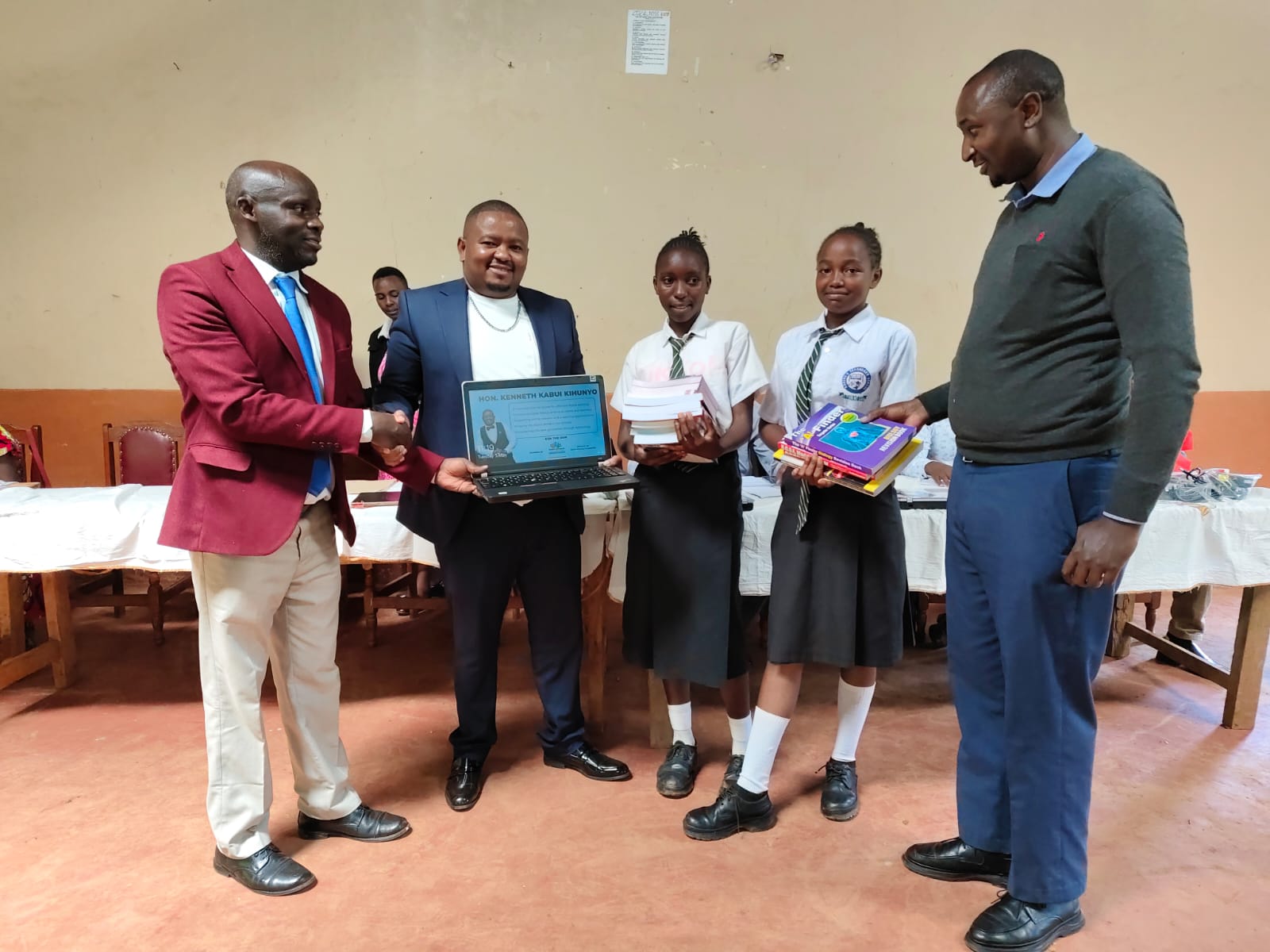
 Kabui Kihunyo Foundation patron Kenneth Kabui (second left) hands over computers to Karung'e Secondary School's fraternity led by principal Richard Wainaina on May 5, 2026 /ALICE WAITHERA
Day secondary schools in Mathioya constituency are set to benefit from a digital literacy initiative aimed at equipping them with computers to support learning and prepare students for opportunities in a technology-driven economy.
The programme, spearheaded by the Kabui Kihunyo Foundation, seeks to provide each day secondary school in the constituency with at least three laptop computers to strengthen ICT laboratories and enhance digital learning among students.
Speaking during the launch of the programme at Karung’e Secondary School, the foundation’s patron, Kenneth Kabui, said the initiative is meant to create a digitally empowered society by exposing learners to practical computer skills before they transition to tertiary institutions.
“We are initiating a project to support all day secondary schools in Mathioya with at least three computers each, so as to boost digital literacy among learners and equip them with skills that will help them in higher education, self-employment, and the digital economy,” he said.
Kabui said digital literacy has become essential in modern education and employment, adding that the programme is intended to ensure learners in rural day schools are not left behind in the fast-growing digital space.
He appealed to development partners and well-wishers to support the foundation so the programme can be rolled out to all day secondary schools in Mathioya within the next five months.
Kabui said the foundation is targeting young people because empowering the youth translates into empowering the wider community, noting that students can use digital skills to explore opportunities such as online marketing, artificial intelligence and talent monetisation beyond conventional employment.
Karung’e Secondary School is among the first beneficiaries of the initiative after receiving three laptop computers, revision books and avocado seedlings from the foundation.
The school’s principal, Richard Wainaina, said the donation will significantly support the institution’s efforts to implement digital learning under the Competency-Based Education (CBE) curriculum.
He said the school recently established an ICT laboratory with 24 computers through support from the board of management, and the additional laptops will raise the number of available machines to 27.
“Digital literacy is one of the key learning areas under CBE, and this support will go a long way in promoting ICT learning in our school despite the many challenges we are facing,” Wainaina said.
He said despite progress made in setting up digital infrastructure, day secondary schools continue to grapple with numerous obstacles in implementing CBE and delivering quality learning.
Among the major challenges, he said, is the shortage of ICT teachers, forcing schools to hire BOM teachers to fill staffing gaps at an extra cost.
Wainaina said although the school’s computer laboratory has a capacity of 43 learners, the institution still lacks enough computers to adequately serve all students during lessons.
He said low student enrolment in day secondary schools remains a major challenge, saying many parents have enrolled their Grade 10 children in boarding schools, leaving day schools with reduced admissions.
According to the principal, the low enrolment directly affects government capitation, limiting schools’ ability to improve infrastructure and hire additional staff.
Karung’e Secondary School currently has about 170 students, down from 250 last year, a drop Wainaina attributed to competition from boarding schools and perceptions about limited facilities in day institutions.
The principal also said the school has already been registered as a double-stream institution but has been unable to split classes due to insufficient teachers deployed by the Teachers Service Commission (TSC).
Magdalene Mueni, the Form 4 parent representative at the school, said the computers will save families the cost of enrolling students in separate institutions for computer lessons after they complete secondary education.
“Our children will now learn computer skills while still in school instead of going elsewhere after Form 4, and this will prepare them better for the digital world,” she said.
She said the avocado seedlings distributed during the event will also support families economically once mature, helping parents generate income to educate their children.