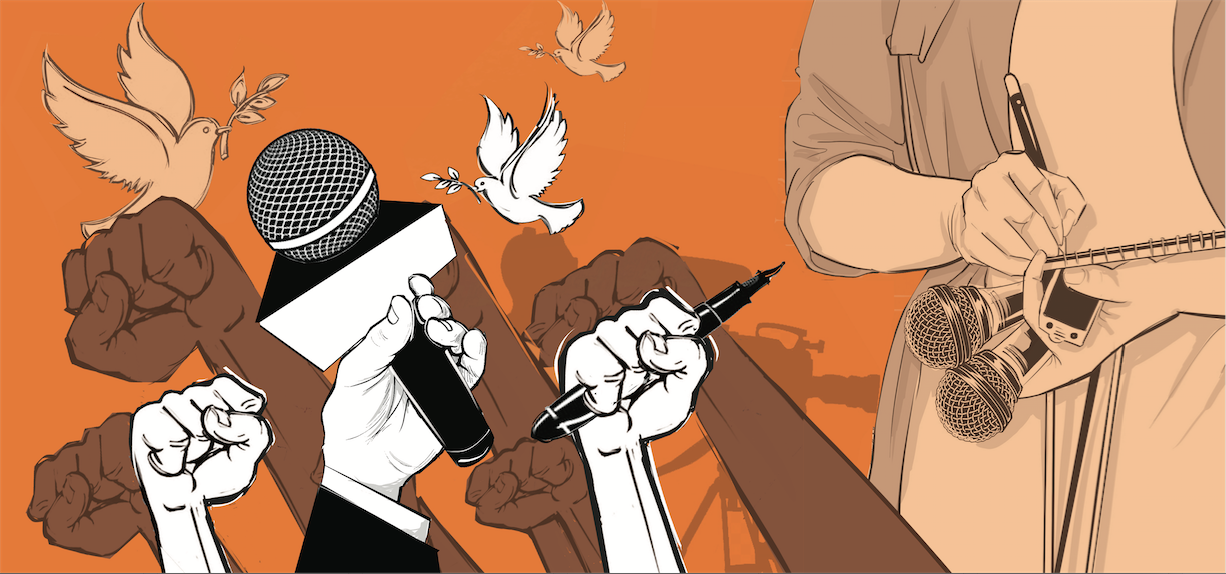
On Monday morning at Strathmore University, Kenyan media professionals and stakeholders gathered together to celebrate World Press Freedom Day.
The day commemorates the Declaration of Windhoek of 1991, when African journalists adopted principles of free press, advocating, among other things, an independent, pluralistic and free press as an essential pillar of development and maintenance of democracy.
Recommended by Unesco and adopted by the UN General Assembly in 1993, the day has become a solemn occasion across the world to reflect on threats and opportunities for an independent, free press.
This year's theme was as bombastic as they come: 'Shaping a future at peace: promoting press freedom for human rights, development and security'. At best, it sounded thoughtful; at worst, it was the quintessential diplomatic word salad.
At the event, the chief guest, Justice Isaac Lenaola, discussed the role of media in Kenya in the context of the upcoming, high-stakes general election. Every headline, every breaking news alert, every panel discussion contributes to shaping public perception, he said.
Journalists have the ability to de-escalate tension simply by how they frame an issue, he added. Accuracy and balance are not enough; context, tone, timing, language and audience matter too, he further submitted.
Justice Lenaola concluded with a call for restraint, where truth is presented in a way that informs without inflaming, where questions are raised without provoking unnecessary hostility and where power is held to account without deepening divisions among citizens.
Justice Lenaola’s call on the media to walk the tightrope of holding power to account while also making peace is not without context. In the aftermath of the 2007 general election, the media was roundly blamed for fanning the tribal divisions that resulted in post-election violence.
A journalist was, in fact, named by the International Criminal Court prosecutor Louis Moreno Ocampo among the persons who allegedly bore the greatest responsibility for the events that transpired in the country.
Since then, the Kenyan media has been co-opted into the national peace project. In the election and national political processes that have followed, Kenyan journalism has erred on the side of caution.
Electoral processes were manipulated, algorithms deployed to manufacture electoral winners, and an “accept and move on” attitude forced on citizens and their institutions.
In 2013, the leading candidates adopted the peace narrative as a political strategy to the detriment of their competitors. Institutions that are expected to offer checks and balances followed suit and walked the tightrope.
Much has been written and said about the 2013 presidential election petition, in comparison to the 2017 one, both staged before the same Supreme Court of Kenya. I will say no more of it.
In the annulled 2017 presidential election, the media only “figured out” the irregularities during the formal hearings of the presidential petition.
To this date, the full story of the 2022 presidential election has never been told, despite some brazen, unconstitutional conduct having been witnessed on live camera.
Much more shocking attempts to overthrow the people's will surfaced at the presidential election petition, none of which have ever been prosecuted in both criminal court and the court of public opinion.
There is palpable apprehension that Kenya's democracy is receding, rather than progressing. And there lies the trouble with so-called pro-peace journalism in the context of the Windhoek Principles. Where is the line supposed to be drawn?
And does it take into consideration the present reality where the information space is now a full-blown theatre of war, with far many more players than journalists playing an active role?
Interest groups spinning deep-fakes, paid gangs and bloggers spreading misinformation, state operatives sponsoring trolls and algorithmic radicalisations taking place, including against the very media, where does that leave the mainstream media?
What happens when these other forces overrun the media to destabilise democracies, weaken trust and credibility in institutions, shake down constitutional order to the core and undermine cohesion?
Just like the early 90s, the wind of change is blowing. The ideas that have held the world together since 1945 are now being shattered in our very face. The world does not need a complacent and timid media at this time. It needs a bold, independent and unfettered press.
Musau, an Advocate of the High Court, is a Senior Project Manager with the Friedrich Naumann Foundation. The views expressed here are his own