
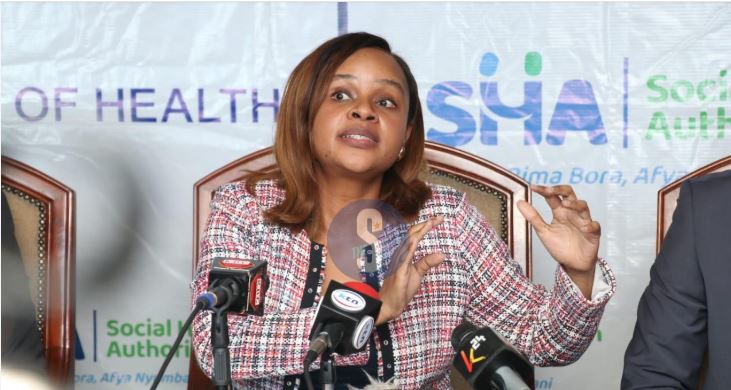
The Social Health Authority (SHA) has strongly defended its Means Testing Instrument (MTI) following scrutiny by Africa Uncensored, insisting the new system is fairer, data-driven, and designed to protect low-income households under the reformed health insurance framework.
In a detailed statement, the Authority welcomed public debate but maintained that the transition from the defunct National Health Insurance Fund (NHIF) was necessary to correct long-standing structural and equity failures.
“We welcome rigorous public discourse on health financing and are committed to addressing these concerns with transparency and strict adherence to our statutory mandate,” SHA said.
According to the Authority, the old NHIF model placed a disproportionate burden on a small segment of the population, with just 20 per cent of Kenyans in formal employment effectively financing healthcare for the rest of the country.
“This was an unsustainable model that promoted inequality and left the vulnerable behind,” the statement noted.
SHA further argued that the NHIF contribution structure was deeply regressive, penalising low-income earners while favouring those with higher incomes.
It cited stark disparities in contribution rates, where poorer households paid a significantly higher proportion of their income.
“It effectively punished low-income households by charging them a disproportionately higher percentage of their earnings,” SHA said.
“Those with the lowest incomes were charged up to 5 per cent, while high-income earners paid as little as 1.12 per cent.”
To illustrate the imbalance, the Authority pointed out that an individual earning Sh1 million monthly contributed just Sh1,700, equivalent to 0.17 per cent, while someone earning Sh10,000 paid Sh500, translating to 5 per cent of their income.
“This is where the system was punishing the poor for being poor,” SHA stated.
The introduction of the Social Health Insurance Act, 2023, marked a shift toward a more equitable contribution structure, anchored on a flat rate of 2.75 per cent of household income, with a minimum monthly payment of Sh300.
“The new statutory flat rate… serves as an equaliser,” SHA explained.
“It abandons the regressive model and ensures that all Kenyans contribute proportionally based solely on their ability to pay.”
The Authority added that the reforms have already yielded benefits, particularly among formally employed contributors, with more than half experiencing reduced premiums.
“Through this equitable recalibration, 54 per cent of formally employed contributors who were previously disadvantaged… have benefited from a reduction in their premium contributions,” it said.
To assess contributions among informal sector households, SHA relies on Proxy Means Testing (PMT), a globally recognised approach used in social protection systems.
“This approach is not unique to Kenya; it is a globally recognised best practice for directing healthcare subsidies and social assistance,” SHA said, citing countries such as Colombia and Indonesia as examples.
The Authority also noted that the MTI was developed through extensive consultations led by the Ministry of Health, involving universities, research institutions, government agencies, and development partners.
“The MTI was not developed in isolation… Reports and technical input from external experts were incorporated into the tool improvement,” SHA stated.
Using nationally representative data, the tool aims to minimise errors by accurately identifying households that require subsidies while avoiding misallocation of resources.
While acknowledging that predictive models are not perfect, SHA insisted that current data shows the system is working largely in favour of low-income earners.
“Currently, 92 per cent of households in the informal sector are assessed at Sh850 or less monthly,” the Authority revealed.
A further breakdown shows that 45 per cent of households fall within the Sh300–500 contribution band, while 47 per cent are in the Sh501–850 range.
Only a small fraction, 7.1 per cent, pay between Sh1,001 and Sh3,499, with just 0.4 per cent assessed above Sh3,500.
“This demonstrates that households are mostly placed in lower contribution bands rather than forced into high payments,” SHA said.
The Authority emphasised that its banding system groups households with similar income levels and assigns the lowest possible contribution within each category to reduce unfairness.
“This approach reduces unfairness and shields low-income households,” it added.
To protect the most vulnerable, SHA integrates data from the State Department for Social Protection to identify indigent households, whose contributions are fully subsidised by the government.
“This ensures their contributions are fully subsidised… protecting them from financial hardship,” the statement read.
Recognising the irregular income patterns common in the informal sector, SHA has also introduced a flexible payment plan dubbed Lipa SHA Pole Pole.
“This premium financing arrangement advances the annual contribution… allowing flexible daily, weekly, or monthly repayments aligned with income cycles,” SHA explained.
At the same time, the Authority acknowledged concerns about accuracy and pledged to strengthen its appeals process for households dissatisfied with their assigned contributions.
“If a member feels the contribution assessed does not reflect their reality, appeals are crucial,” SHA said. “Any member who feels they were assessed unfairly can request a review and receive a prompt response.”
Planned improvements include clearer premium decisions, faster review timelines, and expanded access to appeals through both digital and assisted platforms.
“To strengthen this further, SHA is enhancing the appeals process… and correcting premiums when genuine errors are found,” it added.
Additionally, the Authority is incorporating Alternative Dispute Resolution (ADR) mechanisms to handle disputes more fairly and efficiently.
It also reaffirmed its commitment to refining the system as more data becomes available and strengthening partnerships with key institutions, including county governments and the Kenya National Bureau of Statistics.
“We are committed to continuously refining the means testing tool… engaging openly with civil society, media, and development partners to address legitimate concerns,” the Authority said.
This, while reiterating its pledge to safeguard vulnerable households and ensure affordability mechanisms remain accessible.
“Protecting indigent and vulnerable households from contribution burdens… remains central to our mandate,” SHA stated.


Comments 0
Sign in to join the conversation
Sign In Create AccountNo comments yet. Be the first to share your thoughts!