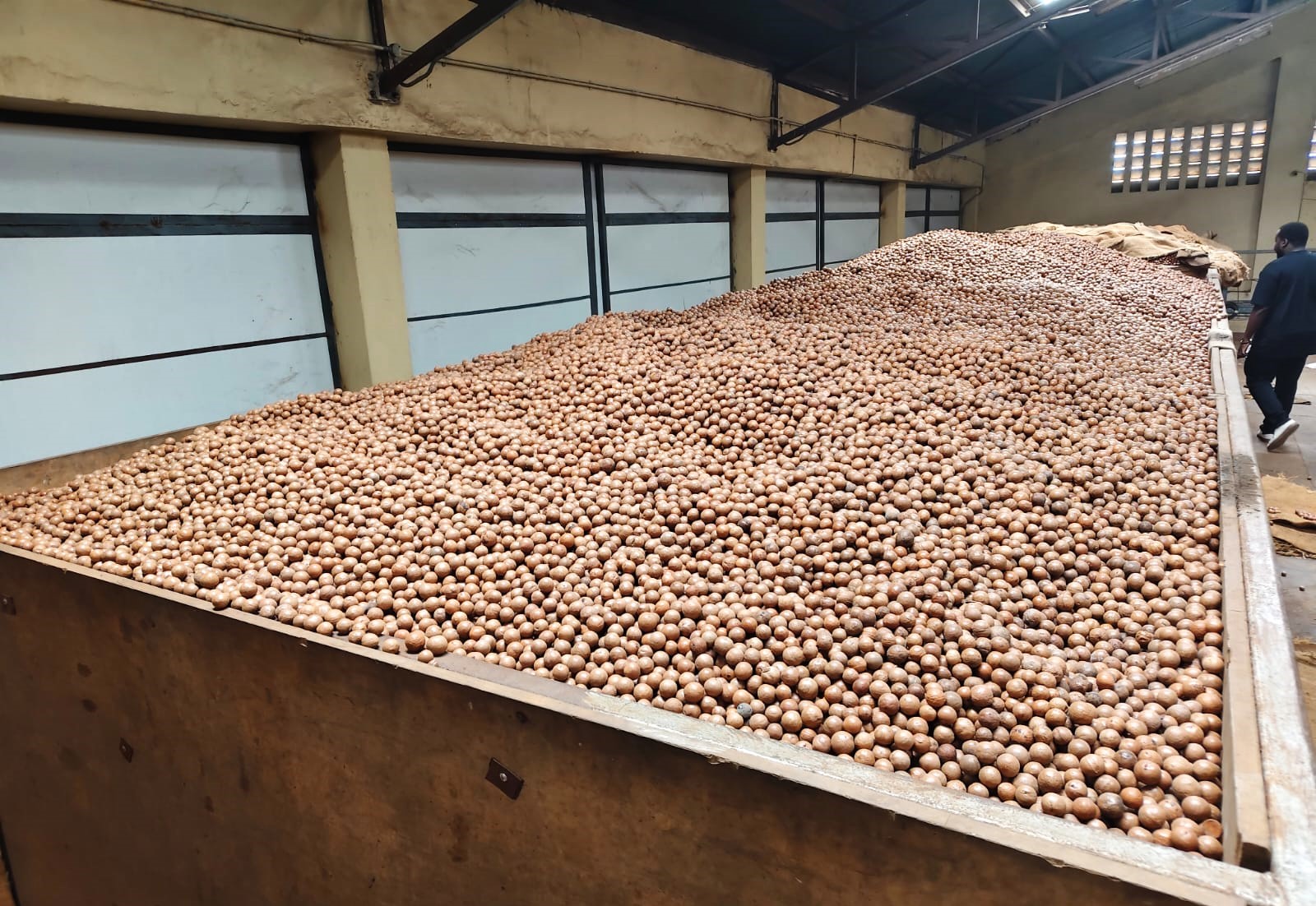
 Macadamia nuts being processed at FairNuts Company's factory in Thika, Kiambu county/ ALICE WAITHERA
Macadamia processors have cautioned farmers against selling their produce to brokers offering prices below the government-set minimum.
The MacNut Association of Kenya (Macnut), which represents processors, said it had received reports from several producing counties of brokers buying macadamia at as low as Sh30 per kilo, despite the Ministry of Agriculture directing that no farmer should be paid below Sh100 per kilo.
Chairperson Pally Muchiri said such practices risk undermining government efforts to stabilise the industry.
“We want to be very clear: farmers deserve fair, transparent and predictable pricing for their macadamia,” he said.
“As an association, we remain fully committed to the set price of Sh100 per kilo. Any price below this is exploitative and does not reflect the value of farmers’ labour and investment.”
The association further said some brokers have been linked to alleged illegal smuggling of nut-in-shell (NIS) macadamia, adding that the illicit trade continues to distort local prices and weaken legitimate processing businesses.
Macnut has urged the government to intensify crackdowns on alleged smuggling cartels and prosecute those involved, arguing that illegal exports of raw nuts are frustrating the implementation of sector regulations and hurting compliant farmers and processors.
The latest warning adds to the long-running dispute between processors under Macnut and traders pushing for liberalisation of raw nut exports.
Processors have consistently argued that continued restrictions on nut-in-shell exports protect local value addition, jobs and farmer returns, while traders maintain that opening export channels would create competition and push farm-gate prices higher.
The Ministry of Agriculture has defended the policy as necessary to support domestic manufacturing and preserve thousands of jobs in processing plants in counties such as Murang’a, Embu, Meru and Kirinyaga.
Traders have, in turn, said the market for in-shell nuts is vast, especially in China, where nuts are consumed as part of the diet, while ready-to-eat nuts, whose markets are in the EU and UK, are more restricted as they are treated as luxury commodities.
But Muchiri said allowing brokers to buy cheaply from farmers for onward smuggling undermines the intent of the government’s protective policies.
He also rejected claims that China offers a reliable market for Kenyan raw macadamia, saying the country is a major producer with sufficient domestic supply for much of the year.
According to Macnut, reliance on raw exports to China would expose Kenyan farmers to price manipulation, abrupt order cancellations and rejected consignments when Chinese domestic output is sufficient.
“When we export nuts in shell, we export jobs and income that should remain in Kenya. Value addition at home strengthens our economy, supports thousands of households and protects farmers from volatile and exploitative markets,” Muchiri said.
Kenya remains one of the world’s leading macadamia producers and Africa’s top exporter of processed macadamia kernels, with the crop emerging as one of the country’s fastest-growing cash crops over the past decade.
The nut is primarily grown in Central Kenya, Eastern Kenya and parts of the Rift Valley, and supports hundreds of thousands of smallholder farmers.
However, the sector has recently faced challenges due to softening global demand, geopolitical instability and rising production costs. Prices have come under pressure due to increased global supply and reduced consumer spending in key markets, complicating efforts to maintain high farm-gate prices.
Last week, Agriculture CS Mutahi Kagwe threatened to lift the ban on the export of raw nuts if processors are unable to absorb all the nuts produced by farmers.
Macnut said geopolitical tensions, including the ongoing Iran conflict and wider global market uncertainties, have disrupted international trade flows and weighed on demand for premium nuts such as macadamia.
The processors also said not all macadamia should attract the same price, noting that farm-gate rates should reflect differences in quality and production methods.
The association said organically certified macadamia and grafted varieties should command premium prices over ordinary ungrafted nuts because they require more investment and produce better-quality yields.
Grafted macadamia is generally preferred by processors due to larger nut size, improved uniformity and better kernel recovery rates.
The association also cautioned farmers against panic-selling immature tetraphylla macadamia, saying the variety has not yet fully matured and will be ready for harvest in the coming weeks.
It said processors remain ready to purchase mature nuts once harvesting conditions are optimal.
To strengthen farmer bargaining power, Macnut said it will support the formation of cooperatives and aggregation centres modelled on tea and coffee marketing structures.
“For three months from May, we will conduct field days in partnership with county and national governments to educate farmers on good agricultural practices and address farmers’ concerns,” Muchiri said.