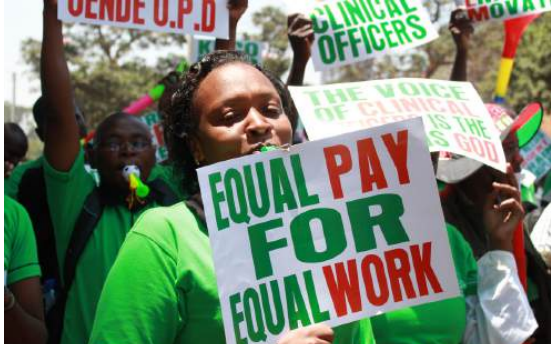
 Clinical Officers during protests /FILE
A Senate committee has laid bare deep-rooted administrative and bureaucratic failures in the management of clinical officers in the country.
In a report tabled in the House, the Health Committee warned that delays in implementing key agreements and staffing decisions are undermining healthcare delivery nationwide.
The panel, in the report tabled by committee chairman Jackson Mandago, found that inefficiencies within the Ministry of Health, the Council of Governors and other agencies have stalled critical reforms affecting thousands of health workers.
“Persistent administrative and bureaucratic failures continue to undermine Kenya’s health workforce management,” the committee said in its report.
The report stems from a petition filed by the Kenya Union of Clinical Officers. It accused the government and the Social Health Authority of discrimination, interference with clinical officers’ practice rights and failure to honour labour agreements.
The committee observed that key labour agreements, including the March 2025 Memorandum of Understanding, the January 2026 Return-to-Work Agreement and a Collective Bargaining Agreement, have faced delays in approval and court registration, slowing implementation.
“These delays have created inconsistencies in salary structures, payment of arrears and operationalisation of allowances,” the report states.
At the same time, a large number of qualified clinical officers remain unposted for internship, delaying their entry into the workforce and worsening staff shortages in health facilities.
“There are interns who were supposed to be posted in December 2022, but this has not happened to date and there is no communication on when all interns will be posted,” the petitioners said.
According to submissions presented to the committee, over 5,400 clinical officer graduates are still awaiting internship placement.
The report further highlights the stalled absorption of thousands of workers recruited under the Universal Health Coverage programme.
Despite government commitments to transition them to permanent and pensionable terms, the process has been slowed by verification delays, payroll disputes and a lack of coordination between national and county governments.
The Public Service Commission told the committee that the transition has been hampered by fiscal constraints and legal complexities in harmonising employment terms.
The committee noted that Sh8.94 billion has been proposed in the 2026–27 budget to facilitate the transition, but warned that without proper safeguards, the funds risk delays or diversion.
The petition also raised concerns over alleged discrimination by the Social Health Authority, particularly the exclusion of clinical officer-run facilities from empanelment under the new health insurance framework.
More than 1,000 facilities previously contracted under the now-defunct National Hospital Insurance Fund were reportedly left out, limiting patient access to care.
The union argued that this has forced patients to pay out of pocket and contributed to low registration under the new scheme.
To address the challenges, the Senate committee issued a raft of recommendations aimed at fast-tracking reforms and restoring order in the sector.
It directed the Ministry of Health, the Council of Governors and county public service boards to develop a time-bound implementation plan for the Return-to-Work Agreement and the CBA within 30 days.
The plan should outline specific actions, responsible officers and timelines for rolling out salary structures, paying arrears and implementing allowances, with quarterly progress reports to the Senate.
The committee also called for the development of a standardised human resource guideline for clinical officers, covering internship placement, recruitment, transfers and career progression.
Further, it urged the national and county governments to expedite the integration of UHC staff into permanent employment and conclude an intergovernmental agreement to guarantee funding of the wage bill.
The committee warned that failure to address the issues could further destabilise the health sector and undermine service delivery.
“The persistent delays and administrative challenges continue to erode confidence in the system and affect the quality of healthcare services,” the report notes.
INSTANT ANALYSIS
The Senate Health Committee has exposed systemic failures in managing clinical officers, citing delays in implementing key agreements and staffing gaps. Chaired by Jackson Ara Mandago, the committee faulted the Ministry of Health and the Council of Governors for bureaucratic inefficiencies. A petition by the Kenya Union of Clinical Officers also alleged discrimination by the Social Health Authority. Over 5,400 interns remain unposted, while UHC staff face delayed absorption, prompting calls for urgent reforms.