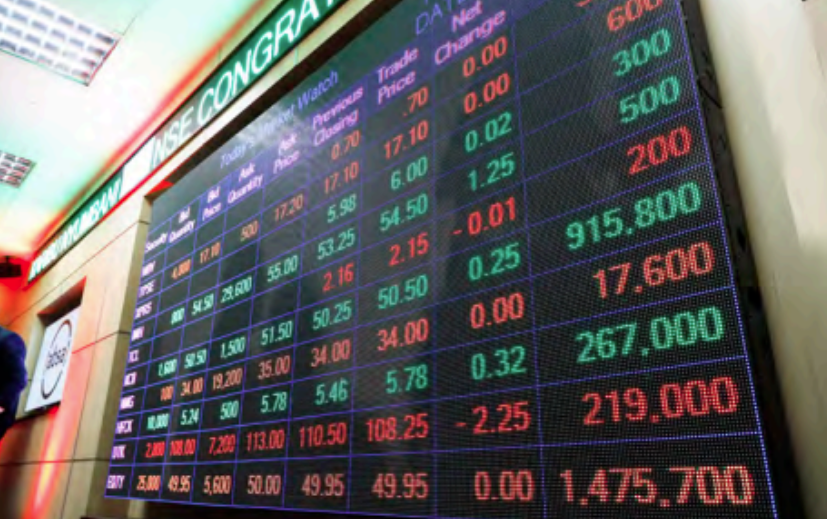
Nairobi Securities Exchange recorded an Sh8.8 billion net foreign investor outflows between January and March 2026, official data shows.
The 90 percent jump compared to the previous quarter comes in the wake of the Middle East crisis, which triggered a sell-off by investors seeking to move to other markets amid uncertainty.
Capital Markets Authority Soundness Report for the third quarter of the 2025-26 financial year (January-March), notes that the trend reflects heightened capital flight and a shift in investor sentiment away from the domestic markets.
The proportion of foreign investor participation in the equities market (buying and selling stocks and shares of companies) declined by 10 per cent , further indicating reduced foreign participation.
“The significant outflows observed during the quarter can largely be attributed to prevailing geopolitical tensions in the Middle East region, which prompted global investors to rebalance their portfolios in favour of safer investment destinations and lower-risk assets,” CMA says in its report.
This, as Kenya, a frontier market, remains susceptible to external shocks and their associated spillover effects, including reduced capital inflows and heightened market volatility.
Despite the substantial foreign investor exit, the equities market demonstrated strong performance during the quarter.
This resilience has been pegged on the growing role of domestic investors in supporting market activity and sustaining liquidity.
Local participation has enhanced market stability and reduced vulnerability to abrupt capital reversals associated with external investor movements.
Despite the ongoing global crisis, the domestic market performed strongly during the quarter.
The four market indices, NSE 20 Index, NSE 25 Index, NASI, and NSE 10 Index closed at 3,431.56, 5,416.72, 194.82, and 2,030.35 basis points, respectively, reflecting gains of 9.31 per cent, 6.28 per cent, 4.42 per cent, and 3.32 per cent.
These are the indices that track the perfomance of companies’ share performances at the bourse.
The number of shares traded increased from 1.49 billion to 1.86 billion during the quarter, indicating improved market activity and liquidity.
“Equity market capitalisation as at March 31, 2026 stood at Sh3.23 trillion, surpassing the three-trillion mark and reflecting growth from Sh2.94 trillion recorded in the previous quarter,” CMA acting directorResearch Policy and Market Development, Samuel Kamunyu Njoroge, noted.
On average, foreign investors accounted for 32.27 per cent of activity in the equity market.
Up to 82.9 per cent of market capitalisation remains concentrated in 10 companies, highlighting a degree of concentration risk within the market.
During the quarter under review, Treasury bonds accounted for 99.99 per cent of total turnover in the fixed income segment, underscoring their dominance in market activity.
Bond issuances comprised exclusively of reopened and switch bonds, with maturities of 15 and 20 years. Through these issuances, the government targeted to raise Sh205 billion from the market.
Investor response was strong, with total bids received amounting to Sh451.41 billion, significantly exceeding the amount on offer. Consequently, the government accepted bids valued at Sh265.68 billion, reflecting robust demand for long-term government securities.
Activity in the corporate bond market segment however remained relatively subdued in the domestic market.
Corporate bond turnover stood at Sh73.6 million , representing a 63.9 per cent decline from Sh203.5 million recorded in the quarter ended December 2026.
This subdued performance is attributed to ongoing investor preference for relatively higher-yielding and more liquid government instruments.
Overall, the quarter was characterized by weak liquidity and minimal participation in the corporate bond segment despite favorable macroeconomic stability.
On Collective Investment Schemes, Money Market Funds remained the most preferred investment option in addition to fixed Income Funds, Equity Funds, Balanced Funds and Special Funds.