The noise is deafening. Across Kenya, politicians are shouting themselves hoarse—promising revolutions, liberation and political rebirths. But beyond the chants and slogans, a quieter force is at play: the steady, clinical logic of numbers.
Kenya’s 2027 election will not be decided by who excites the loudest crowd. It will be decided by who assembles the broadest, most efficient coalition. In short, it is less about passion—and more about arithmetic. And arithmetic, unlike emotion, is scientific. It is predictable, measurable and grounded in verifiable patterns of voter behaviour, turnout and regional distribution. That distinction may ultimately define the outcome.
Three formations are taking shape.
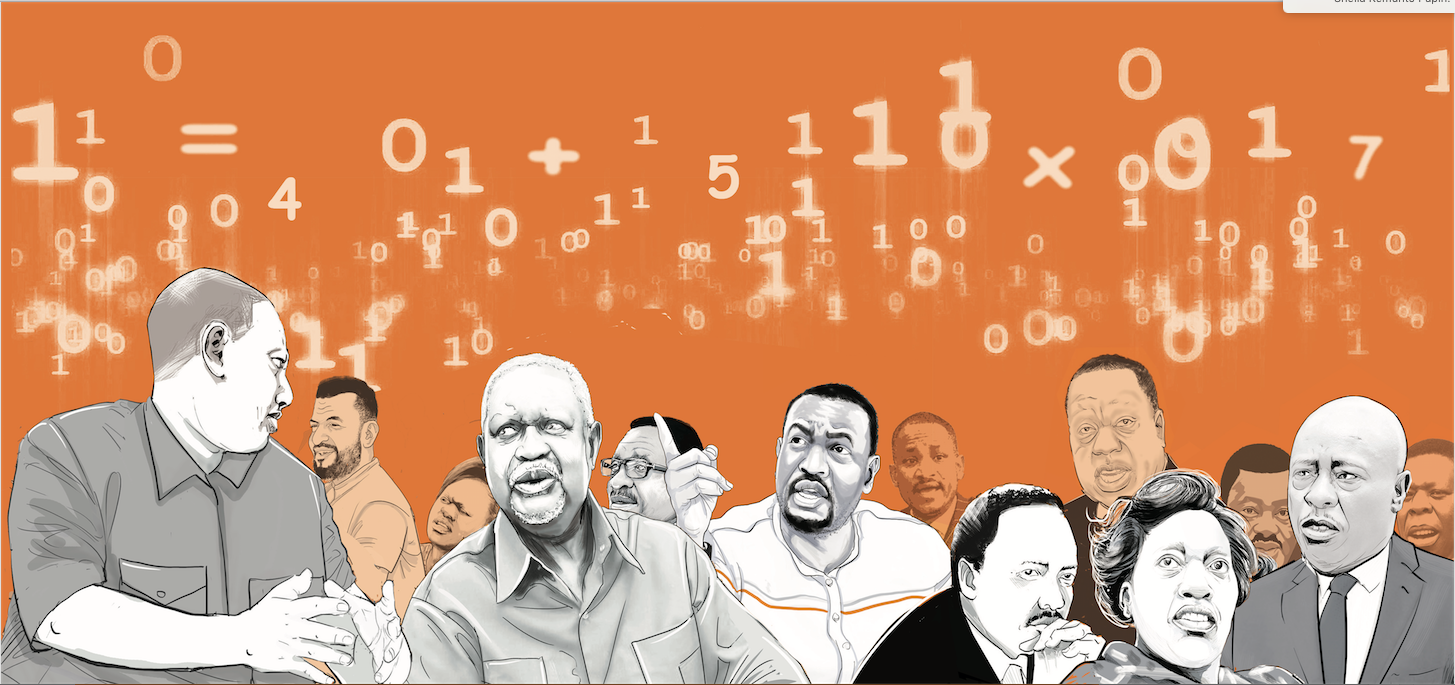
First is President William Ruto’s broad-based government – a strategic convergence between UDA and ODM. Second is the fragmented united opposition, bringing together Kalonzo Musyoka, Martha Karua and Rigathi Gachagua. Third is Linda Wananchi, the insurgent faction within ODM led by James Orengo and Edwin Sifuna, channelling public frustration into political energy.
Each represents a different theory of power.
The united opposition embodies traditional coalition politics, but without cohesion, it is heavily fragmented. Its principals command influence in their respective regions, yet remain unable to consolidate a unified national strategy or rally behind a single presidential candidate.
Their moves, whether managing nominations to avoid internal fallout or celebrating defections, suggest tactical survival rather than strategic expansion. Without coherence, regional strength struggles to translate into national victory. Arithmetic punishes fragmentation; divided vote baskets rarely add up to a winning tally.
Linda Wananchi thrives on momentum. Its rallies are energetic, its messaging sharp and its appeal, particularly among younger voters, undeniable. By articulating popular demands, it taps into public frustration.
Yet political mobilisation is not the same as political organisation. Without a nationwide structure, cross-regional alliances and a tested electoral machine, translating anger into votes across 290 constituencies remains a steep challenge. Anger can fill streets, but elections are won at polling stations, where numbers, not noise, are counted.
Then there is the broad-based government. Its approach is less dramatic, but more methodical. By consolidating political partnerships and maintaining a presence in governance, it is attempting to build a coalition that is both electoral and institutional. Development projects, policy implementation and coalition management all serve a dual purpose: governance and voter consolidation.
Crucially, this formation appears to be operating on a scientific model of politics, one that treats elections as an exercise in data, probability and incremental accumulation. It is about identifying vote-rich regions, minimising losses in opposition strongholds and building just enough cross-ethnic and cross-regional appeal to surpass the constitutional threshold. This is arithmetic in its purest form: addition, subtraction and strategic distribution.
That is why the broad-based faction may ultimately surprise its opponents. While others are consumed by the optics of crowds and the immediacy of political emotion, it is quietly engaged in the slower, less visible work of assembling a winning equation. It understands that elections are not spontaneous events; they are outcomes engineered over time through careful calibration of alliances, resources and voter blocs.
This sets up a fundamental contrast heading into 2027.
On one side is the politics of mobilisation, driven by grievance, urgency and public emotion. On the other hand, there is the politics of accumulation—focused on coalition-building, structure and electoral math. One is loud, reactive and volatile. The other is quiet, deliberate and systematic.
Both have power. But only one, historically, has consistently translated into electoral victory in Kenya’s highly structured voting landscape. The science of numbers tends to outlast the energy of moments.
The real question for voters will not simply be who inspires them, but who can organise, unify and convert support into actual votes on election day. Because inspiration without structure is fleeting, but arithmetic, when done right, is enduring.
In 2027, Kenya will not just choose leaders. It will choose between two political logics: anger or arithmetic.
And in the end, numbers rarely shout—but they almost always decide.
Strategic adviser and expert in leadership and governance