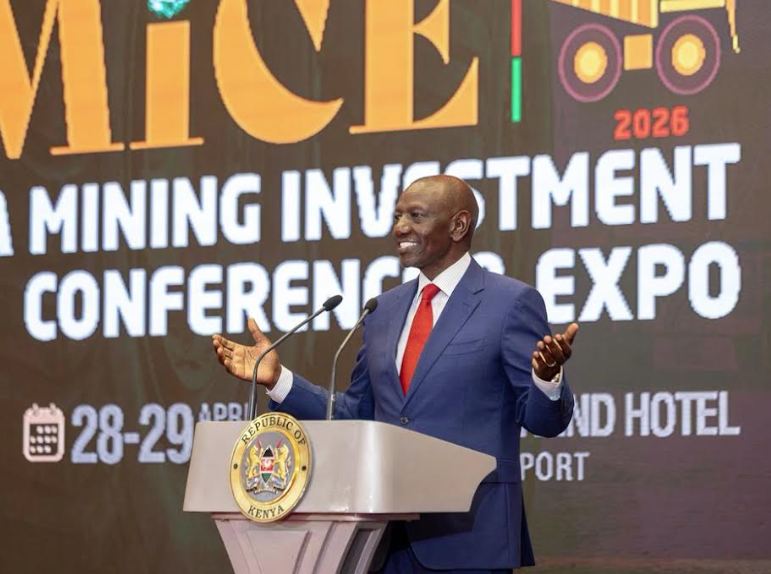
Kenya will no longer be a supplier of raw minerals to fuel industries abroad, President William Ruto has said.
This, as he called on the African continent to ensure processing and value addition is done within the continent, a move that will benefit economies and the people.
Speaking yesterday during the Kenya Mining Investment Conference and Expo 2026 in Nairobi, President Ruto asserted that few African countries can fully account for, or have fully benefitted from their mineral endowments for the past six decades.
“For far too long, the abundant mineral wealth we possess has generated prosperity for others while its true owners, our citizens, have derived only limited benefit,” he said.
Ruto said the Kenyan government has taken a clear and deliberate position on the mining sector to ensure minerals fully benefit the country, with investors having to play by the rules, a decision that he said Africa must make.
“We will process our minerals here on the continent. We will refine them here. We will manufacture them here. The full length of the value chain must, and will, generate value for Africa and for our people,” Ruto said.
His strong call on the continent comes at time when demand for critical minerals such as lithium, cobalt, nickel and graphite is on the rise.
According to the International Energy Agency, demand for these minerals is projected to triple by 2030 and quadruple by 2040, as the world accelerates toward net-zero emissions.
Africa holds about 30 per cent of the world’s critical mineral reserves, which also include manganese, platinum, and rare earth elements essential for batteries, electric vehicles, wind turbines and solar technologies.
Yet despite this endowment, the continent currently captures less than one per cent of the value generated from global clean energy technologies.
“The reason is clear: For too long, we have extracted and exported raw materials at the bottom of the value chain while others have processed, refined, manufactured, and captured the greater share of economic value,” said Ruto.
Kenya is also endowed with significant mineral wealth, the President said, with the recent National Airborne Geophysical Survey identifying over 970 mineral deposits across the country.
They include copper, coltan, rare earth elements, niobium, graphite, lithium, chromium, nickel and uranium, with the government encouraging investments in the sector.
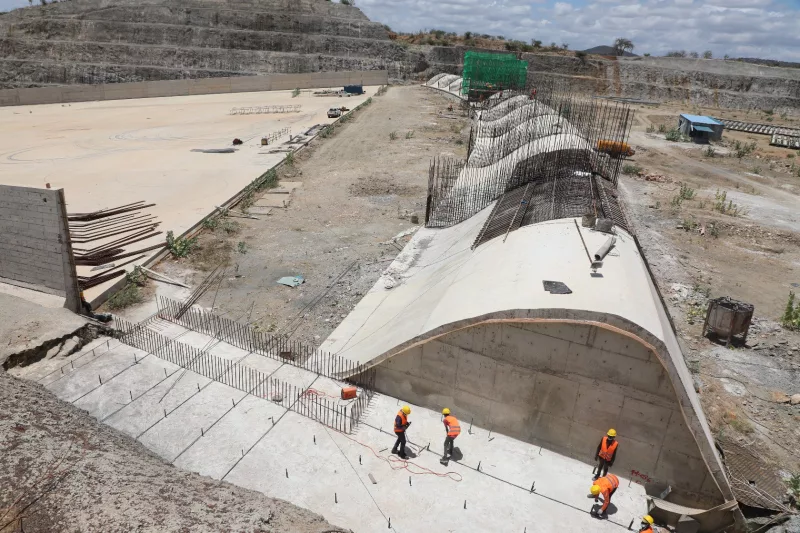
The iron ore palletization plant in Taita Taveta, currently in its final stages of construction, represents an Sh11 billion investment that will create approximately 3,000 jobs for our people, Ruto said.
“Our gold refinery project is also advancing toward completion while the Voi Gemstone Value Addition Centre is already operational, serving artisanal miners and small-scale operators with access to cutting, polishing, grading, and international market linkages,” he said.
Gold stretches across the western belt from Narok through Migori and Kakamega into Turkana and Marsabit counties. Noiobium and rare earth elements are concentrated in Kwale, iron ore in Taita Taveta, and titanium along the Coast.
Gemstones span the central and coastal regions, while copper, chromite and manganese are found across the northern and eastern counties, among many others.
The government has been implementing reforms in the sector to push up mining contribution to the GPD from a paltry one per cent to at least 10 per cent by 2030, with a value of at least Sh1.6 trillion.
This includes the enactment of the Mining Act 2016, described as a progressive, transparent and investor-friendly legal framework that replaced colonial-era 1940 legislation.
Institutional and regulatory capacity continues to be strengthened as the government seeks to provide faster services to investors and more predictable licensing outcomes.
The licensing process has been digitised and through the Online Mining Cadastre, applicants can apply for mineral rights from anywhere in the world.
“In addition, we have established the National Mining Corporation (NAMICO) as the government’s investment arm in the mineral sector,” Ruto said.
The Mining Act provides for a royalty-sharing framework for national government (70%), county government (20%) and local communities 10 per cent.
“In essence, the fundamentals for a viable and competitive minerals sector, one capable of delivering shared value for our people, our economy, and our investors, are firmly in place. Kenya is ready for investment,” Ruto affirmed.