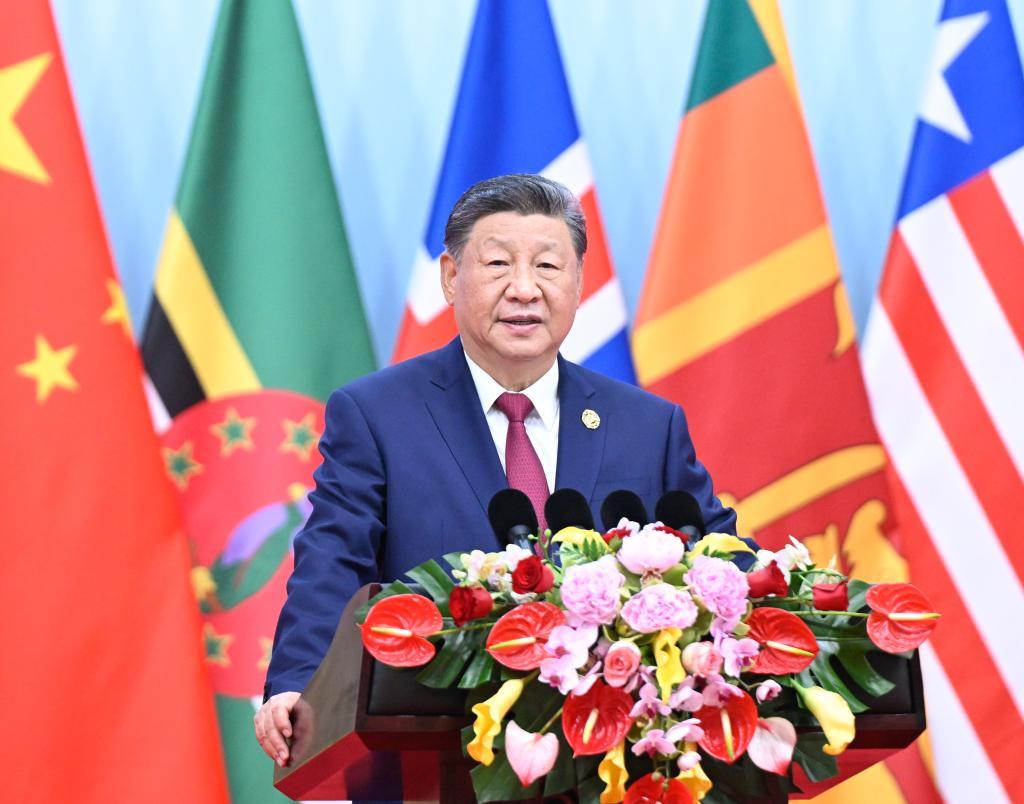
 Chinese President Xi Jinping at the China National Convention Center in Beijing, capital of China, Oct. 13, 2025. (Xinhua)
China has made food security a cornerstone of its national development strategy, viewing agriculture as vital to economic stability, social cohesion, and national security. When President Xi Jinping assumed leadership in 2013, he emphasised that ensuring food for the nation remains a top governance priority.
Drawing on historical experiences of food shortages that defined daily life, Xi has highlighted past crises when citizens relied on rationing (food stamps) and famine caused widespread suffering. These memories inform current policy, reinforcing his key principle that such crises must never be allowed to recur.
With a population exceeding 1.4 billion, China sees food supply as a fundamental constraint on development. As Xi has repeatedly stated, "food is the paramount necessity of the people," underscoring its significance in governance. This perspective elevates agriculture from a traditional economic sector to a strategic pillar of state planning.
It encompasses not only supply assurance but also employment sustenance, rural income stabilisation, and domestic demand support. Currently, agriculture supports over 200 million jobs and sustains more than 500 million rural residents, making it essential for economic performance and social stability.
China's long-term agricultural roadmap illustrates this prioritisation with the country aiming to enhance rural revitalisation in the short term, achieve basic agricultural modernisation by 2035, and become a global agricultural powerhouse by mid-century. This approach integrates food security with broader development goals, linking production, rural transformation, and technological advancement.
Current output stands at approximately 700 million tonnes of grain annually, showcasing significant capacity, with around 95% self-sufficiency in staple crops like rice and wheat. However, increasing demand driven by population growth, urbanisation, and dietary changes continues to exert pressure on the system.
At the heart of China's food security strategy is the principle of self-sufficiency, particularly concerning staple grains. Policymakers assert that reliance on global markets is inherently risky. Given the limited international grain trade volumes relative to China's needs, even aggressive import strategies cannot fully satisfy domestic demand.
As a result, imports are viewed as supplementary rather than foundational. Maintaining sovereign control over food supply is therefore a critical objective, ensuring strategic autonomy during global uncertainties.
Closely tied to this principle is the emphasis on domestic production as the primary supply base. China does not aim for complete self-sufficiency but adopts a balanced approach, importing resource-intensive commodities like soybeans while prioritising domestic staple grain production. This strategy reflects a pragmatic allocation of resources, recognising land and water constraints while safeguarding food sovereignty. The rationale is clear: dependence on external suppliers could expose the nation to geopolitical and market vulnerabilities.
Land policy is another key component of the strategy where China enforces a strict "red line" of at least 120 million hectares of cultivated land, acknowledging farmland as essential for food production. This policy emphasises both the quantity and productivity of arable land.
Converting farmland to non-agricultural uses is tightly regulated, with policymakers stressing that losing high-quality land would jeopardise long-term food security. In practice, cultivated land is protected with the same importance as critical national assets.
Technology is crucial for enhancing productivity and resilience, and China prioritises investments in seed development, irrigation systems, and agricultural innovation, focusing on indigenous capabilities. This push for technological self-reliance aligns with national strategies aimed at reducing dependence on foreign inputs. Improved seed varieties, modern irrigation infrastructure, and data-driven farming practices are expected to boost yields while addressing environmental challenges.
To stabilise supply and prices, China maintains extensive state-managed grain reserves. These reserves act as buffers against shocks, whether climatic, economic, or geopolitical, helping to regulate market fluctuations.
At the same time, the government has refined pricing and subsidy mechanisms to balance the interests of producers and consumers. Farmers benefit from minimum price guarantees and targeted subsidies, while measures are in place to protect low-income consumers from price spikes.
Governance is structured through a dual responsibility system involving both central and local authorities. The "rice bag" accountability framework requires provincial governments to ensure adequate food production, storage, and distribution within their jurisdictions. This decentralised approach prevents over-reliance on national reserves and strengthens local capacities. To encourage compliance, the central government offers financial transfers and rewards to major grain-producing regions, ensuring that high-output areas receive appropriate compensation.
China also adopts a cautious approach to global engagement, where it selectively utilises international markets and overseas agricultural investments to supplement supply while maintaining domestic self-sufficiency.
However, this strategy is managed carefully to avoid excessive dependence or disruptions to domestic production. Policymakers are mindful of geopolitical risks, including price volatility and supply chain disruptions, prioritising stability over expansion.
Another often-overlooked aspect of China's strategy is its focus on reducing food waste. Estimates indicate that wasted food could feed over 200 million people annually, exposing inefficiencies in consumption.
In response, the Chinese government launched campaigns to reduce waste in households, schools, and the hospitality sector. This reflects a broader understanding that food security involves not just increasing supply but also effectively managing demand.
China's model treats food as a strategic asset, comparable to energy or national defence. By integrating domestic production, land protection, technological innovation, market regulation, and behavioural change, the country has established a comprehensive system designed to withstand various risks. While challenges remain, the approach demonstrates how nations can engineer food security through coordinated policy frameworks.
Kipkorir Kesses is a Nairobi-based current affairs commentator