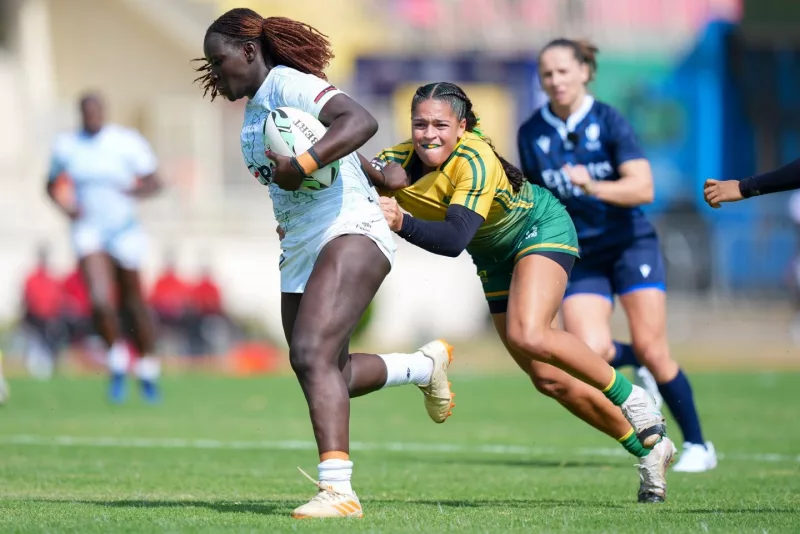
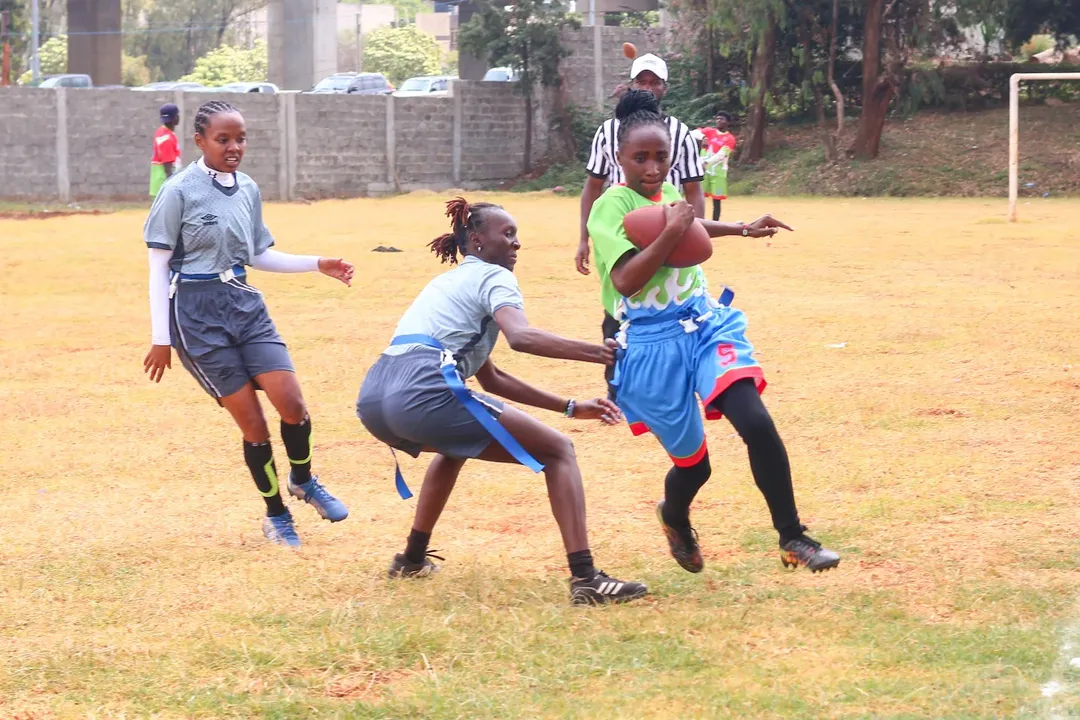
 Players in a previous match/ KFAF
 American football is fast finding its footing on Kenyan soil, surging through universities and capturing the imagination of a new generation of athletes.
What once felt foreign is now gathering pace—a sport of structure, strength and split-second decisions carving its niche.
In today’s Know Your Sport, we break down the mechanics, the rhythm and the raw edge of a game often mistaken for rugby, yet fiercely its own.
At its core, American football is a strategic, high-impact contest played by two teams of 11.
The objective is simple, but the execution is anything but: advance the oval ball into the opponent’s end zone and rack up points.
Every play is scripted, every movement deliberate. It is often described as chess played at full speed—with collisions.
While it shares surface similarities with rugby—the oval ball, the territorial battle, the physicality—the contrasts are stark.
American football is a stop-start spectacle, built around set plays, specialised units, and heavy protective gear.
Rugby, whether 15s or 7s, thrives on continuity—a flowing, relentless contest where play rarely pauses and backward passing is law.
The game unfolds across four quarters, each lasting 15 minutes, though the clock often stretches the drama far beyond that.
Scoring comes in bursts: a touchdown earns six points, a field goal adds three, while extra points or two-point conversions offer the chance to squeeze out more from each visit to the end zone.
The battlefield itself is precise and measured—a 120-yard field, including two 10-yard end zones, laid out with yard lines every five yards.
Protection is non-negotiable. Players armour up in hard-shell helmets, shoulder pads, and a full suite of padding covering the hips, thighs, knees, and tailbone.
Mouthguards are standard, Guardian Caps often feature in training, and cleats provide the grip needed for explosive bursts and sharp cuts.
The heartbeat of the game lies in its possession system.
The attacking team—the offence—is given four chances, known as downs, to advance at least 10 yards.
Make the distance, and they reset for another set of four.
Fall short, and possession flips. Progress comes either through powerful runs or precision passing, each play unfolding in carefully choreographed fashion.
The sport’s origins trace back to November 6, 1869, when Rutgers University faced Princeton University in what is widely recognised as the first college football game.
That early version blurred the lines between soccer and rugby, but the identity of American football soon sharpened, thanks largely to rule innovations driven by Walter Camp in the late 19th century.
Its global push gathered momentum in the 1980s and 1990s, fuelled by the National Football League through initiatives like the American Bowl, planting seeds beyond U.S. borders.
Kenya’s journey with the sport has been a story of stop-start beginnings and renewed ambition.
First introduced in 1997 at the University of Nairobi by Coach Tom Kelly, the early spark fizzled out.
But a revival in 2012 reignited the flame, eventually giving rise to the Kenya Federation of American Football (KFAF).
Today, the sport is gaining real traction. Backed by structured development, flag football programmes in schools, and expanding university leagues, KFAF is building from the grassroots up.
With eyes on the 2028 Olympic horizon, the federation now oversees a growing ecosystem of teams, talent, and opportunity—a clear sign that American football in Kenya is no longer a novelty, but a movement gathering serious momentum.