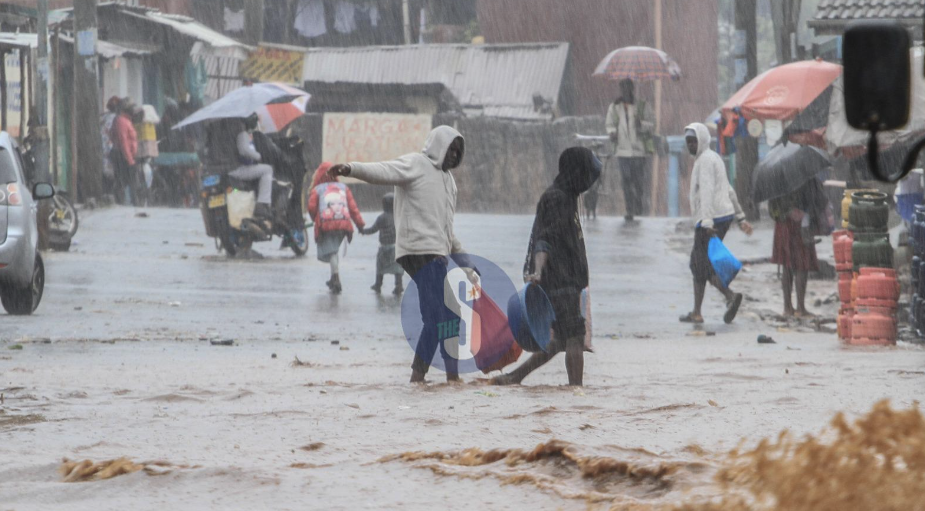
 Nairobi residents wading through water after heavy rains /FILE
Kenya could be headed for another El Niño season later this year, with global and local weather agencies warning that the climate phenomenon may begin developing between May and July 2026 and intensify toward the end of the year.
The World Meteorological Organisation (WMO) says rising sea-surface temperatures in the Equatorial Pacific point to a likely return of El Niño conditions, a weather pattern often associated with above-normal rainfall in the Horn of Africa, including Kenya.
In its latest Global Seasonal Climate Update released on April 24, WMO said climate models are now strongly aligned after a neutral start to the year, increasing confidence that El Niño could emerge from mid-2026 and continue into the final months of the year.
“After a period of neutral conditions at the start of the year, climate models are now strongly aligned, and there is high confidence in the onset of El Niño, followed by further intensification in the months that follow,” Chief of Climate Prediction at WMO, Wilfran Moufouma Okia said.
Okia, however, cautioned that forecasting remains difficult during this period because of what meteorologists call the spring predictability barrier, meaning forecast certainty improves after April.
“Models indicate that this may be a strong event, but the so-called spring predictability barrier is a challenge for the certainty of forecasts at this time of year,” Okia said.
El Niño is the warm phase of the El Niño-Southern Oscillation (ENSO), caused by unusual warming of ocean surface temperatures in the central and eastern Pacific Ocean. It typically occurs every two to seven years and often disrupts normal rainfall patterns across the globe.
For East Africa, and especially Kenya, El Niño is commonly linked to heavier-than-normal short rains between October and December, flash floods, landslides, destruction of roads and displacement of families.
Kenya experienced significant impacts during the 2023–2024 El Niño rains, which led to widespread flooding, damage to infrastructure and loss of lives across several counties. The 1997–98 El Niño rains were also severe, with floods destroying roads, bridges and homes and leaving parts of the country cut off for weeks.
The Kenya Meteorological Department said the latest forecasts do not automatically mean a disaster will occur, but early preparedness is critical as warning signs become clearer.
El Niño conditions are expected to affect global temperatures and rainfall patterns, with WMO noting that the phenomenon typically increases rainfall in the Horn of Africa while bringing drier conditions to Australia, Indonesia and parts of southern Asia.
Even as the country experiences the ongoing long rains season, the Kenya Meteorological Department said rainfall is expected to gradually reduce in the coming days, although risks remain high because soils are already saturated.
“Rainfall is expected to continue in several parts of the country, though rainfall amounts are likely to reduce as the forecast period progresses,” the department said in its latest seven-day forecast.
Acting Deputy Director of Forecasting Services Ezekiel Muigai said intermittent showers and thunderstorms are still expected in several areas, particularly in the afternoons and at night.
“Occasional morning rains are likely to occur over few places. Afternoon showers and thunderstorms expected over few places occasionally spreading to several places,” Muigai said.
The warning comes after weeks of heavy rainfall that have left dozens dead and displaced thousands of households across the country.