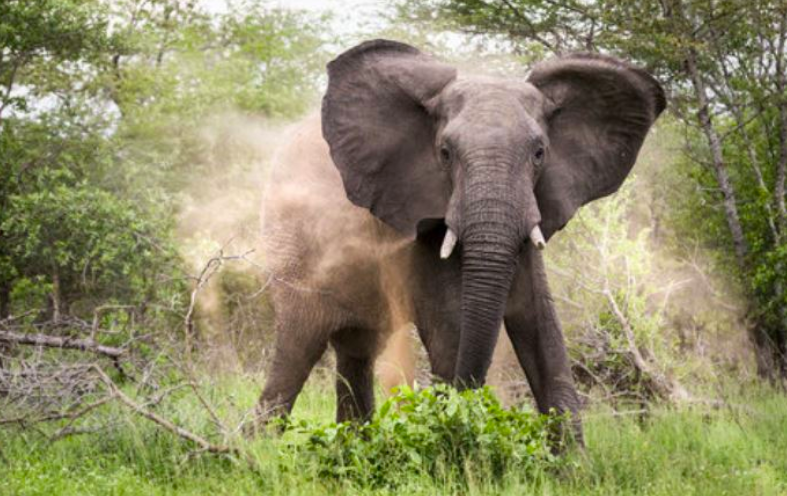
A new study warns that habitat fragmentation driven by human activity is increasingly disrupting elephant populations and weakening their genetic diversity across Africa.
Published on April 16 in Nature Communications, the study titled 'The genomic impact of population connectivity and decline in Africa’s elephants' highlights how rapid human population growth, agricultural expansion and infrastructure development are isolating elephant habitats and affecting their long-term survival.
Researchers analysed 232 high-coverage genomes from 17 African countries, making it the first continent-wide genomic study to treat savanna elephants and forest elephants as separate species. The dataset included 51 forest elephants and 181 savanna elephants.
The findings show protected areas remain critical strongholds for elephant populations, particularly where ecological corridors between reserves are still intact.
Researchers warn that increasing isolation of protected areas is reducing movement between populations, forcing elephants into inbreeding due to limited mating options.
This, they say, leads to a gradual loss of genetic diversity and may undermine the health and resilience of future generations.
The study also identifies evidence of human-induced fragmentation in peripheral populations, despite elephants historically being highly mobile and capable of maintaining gene flow across large landscapes.
A key finding is the divergence between species. Forest elephants were found to have higher genetic diversity and larger historical population sizes, while savanna elephants showed greater levels of inbreeding and genetic load.
Scientists also detected traces of forest elephant ancestry in some savanna populations, pointing to past hybridisation events.
African elephants are listed by the International Union for Conservation of Nature (IUCN) as “endangered” for savanna elephants and “critically endangered” for forest elephants, reflecting continued pressure from poaching and habitat loss.
However, in Kenya, conservation gains offer a contrasting picture.
According to the 2025 Wildlife Research and Training Institute census, elephant numbers rose to 41,952 from 36,280 in 2021, signalling progress in anti-poaching efforts and habitat protection.
The study further shows elephant population trends in protected areas are strongly influenced by conservation funding levels, although researchers stress that effective outcomes depend on evidence-based management strategies.
Between 1960 and 2024, Africa’s human population grew from 283 million to 1.5 billion, the fastest relative increase globally.
This growth has significantly altered land-use patterns, shrinking wildlife habitats and increasing fragmentation.
Scientists estimate that while 62 per cent of Africa is potentially suitable elephant habitat, elephants currently occupy only about 17 per cent of it.
With the human population in sub-Saharan Africa projected to triple by 2100, habitat loss is expected to intensify further.
The researchers conclude that habitat fragmentation poses an urgent threat to elephant genetic health and long-term survival, calling for stronger efforts to maintain connectivity between protected areas and safeguard remaining wildlife corridors.