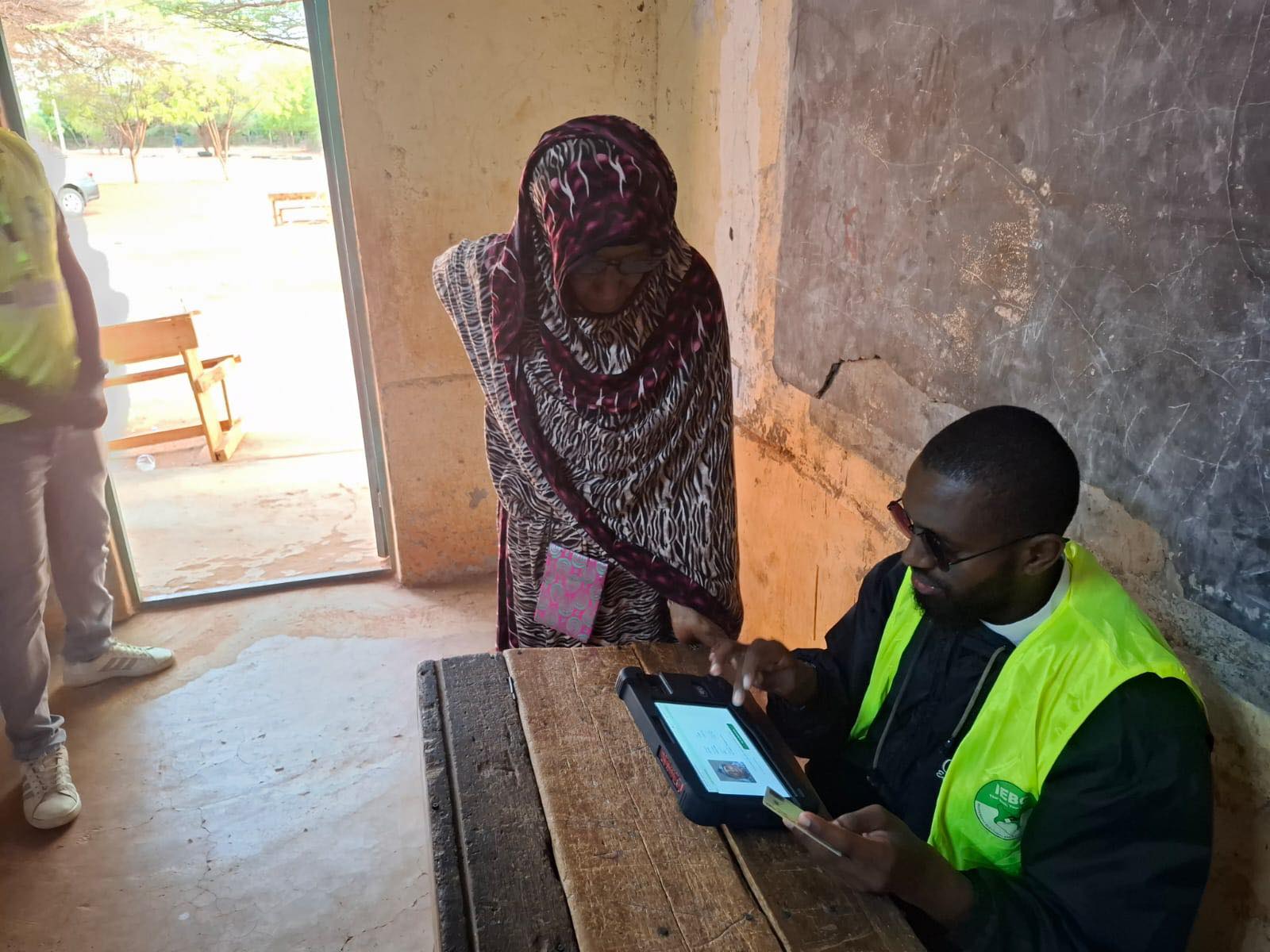
The Independent Electoral and Boundaries Commission is planning a grand overhaul of its results transmission system ahead of the 2027 General Election.
Fresh details show that the electoral commission seeks to introduce an automated network that it hopes will eliminate the failures that have repeatedly cast a shadow over past polls.
IEBC says it is procuring a new satellite to replace Thuraya, which it has been using as a fallback after network failure.
Tender documents released by IEBC reveal a sophisticated architecture designed to keep results flowing from polling stations under virtually any circumstances.
The papers show the electoral agency seeks to introduce a tightly controlled, closed communication environment for election devices.
"The SIM cards shall be configured on a subnet with static, private IP addresses routable over the Standard IEBC APN only and restricted from accessing the global Internet."
IEBC says the aim is to receive results in a timely fashion, even in areas with poor or no mobile network coverage.
The tender document shows a shift in how the Kenya Integrated Election Management System (KIEMS) devices connect to the network.
Each device will be equipped with two SIM cards from different mobile network operators, supported by a satellite link as a last resort.
The system is configured to switch automatically between one network and the other without human intervention.
In practical terms, the design is that if the primary network fails, the KIEMS kit instantly connects to a secondary provider.
If both mobile networks are unavailable, the devices would switch to satellite connectivity, ensuring results transmission can continue uninterrupted.
The approach is a marked departure from previous elections, where presiding officers in some remote or poorly covered areas were forced to physically move KIEMS devices.
Raila Odinga’s presidential election petitions of 2013, 2017 and 2022 had allegations that poll kits were manipulated.
The legal team argued that some Kiems kits were transmitting data from unknown locations for many hours after the close of the election.
Claims were made that the gadgets’ GPRS and geofencing features, designed to lock the kits to specific locations, were deactivated.
In the past elections, IEBC said poll officers are normally forced to move to locations with a network signal.
The situation, however, has been flagged for causing delays and fueling suspicion around the integrity of the results.
There have been audit concerns about missing or untracked kits. An audit for the period to June 30, 2024, revealed that 200 kits were missing.
The machines were not returned to the IEBC’s central warehouse after the 2017 and 2022 general election. The poll agency said it was unable to trace the kits.
Kiems kits, used to identify voters, are loaded with results transmission software and access registered voters’ data.
IEBC seeks to change the scenario through the new technologies, coming against the backdrop of concerns about the cost involved.
A 2022 survey of GPS coordinates for all 46,229 polling stations revealed that only 1,111 stations lacked the minimum required 3G network coverage.
While the internal survey showed that only a small fraction of stations lacked a minimum 3G coverage, the new plan assumes worst-case scenarios.
The commission is now planning for up to 55,000 polling stations in 2027, up from just over 46,000 in 2022. The number of uncovered centres could increase.
According to the tender specifications, all KIEMS SIM cards will operate on a restricted network, using private, static IP addresses routed exclusively through the IEBC’s internal systems.
This means the devices will be effectively cut off from the public Internet, reducing exposure to external interference or cyber threats.
The network will also rely on encryption standards of at least AES-128, and is touted as aligning with widely accepted global standards for secure data transmission.
The new system would also be allocated a dedicated mobile network code – 749, reserved solely for election operations.
The code will not be available for public use, essentially creating a parallel, election-specific telecommunications channel.
“For the 2027 general election, the SIM cards will support a nationwide and diaspora network for voter registration, verification and results transmission,” the document reads.
The cards are to enable KIEMS devices to transmit voter turnout updates to the national tallying centre and also securely transmit final election results, as well as event logs.
IEBC’s intention is to ring-fence election traffic outside the ordinary network, far from risks and cyber-attacks associated with open systems.
“The service provider shall design and implement a robust network solution to connect 337 tally servers (290 constituency and 47 county) to the central system,” the poll agency said.
In a separate measure, the commission seeks to lock the poll devices using a radio frequency identification (RFID) system.
The system is touted as one that will enable IEBC to track Kiems kits from the point of dispatch to their destination.
According to the technical specifications, each KIEMS kit will be fitted with a passive high-frequency tag carrying a unique identity.
To ensure reliability, the IEBC seeks to impose strict performance requirements on telecom providers bidding for the contract.
Operators must guarantee a minimum network uptime of 99.9 per cent across all polling stations, leaving very little room for failure.
Additionally, successful bidders will be required to suspend all routine network maintenance from two days before the election until one week after the final results are transmitted.
The ‘blackout’ period is meant to eliminate avoidable disruptions during the most sensitive phase of the electoral process.
The electoral commission is also demanding unprecedented visibility into network operations during the transmission of election results.
Telecom providers will be required to grant IEBC real-time access to diagnostic tools, enabling officials to monitor performance, track outages and assess traffic flow as results are transmitted.
The tender documents further reveal that the IEBC will not rely on a single service provider.
Instead, the contract will be split among multiple operators, each assigned specific regions based on their network strength and quality of service.
The zoned approach, according to the commission, is intended to reduce the risk of overdependence on a single network.
If one provider experiences difficulties in a particular area, others operating in different zones would not be affected.
The allocation of regions will be informed by data from the Communications Authority of Kenya, which assesses network coverage and bandwidth capacity across the country.
The new system also extends beyond the country’s borders, as the commission moves to embrace diaspora voting on a much bigger scale in 2027.
Bidders must demonstrate partnerships with international carriers to support polling centres in countries such as the United States, the United Kingdom, the United Arab Emirates and South Africa.
IEBC appears keen to ensure votes cast abroad are integrated into the results transmission system in real time.
The tender will cover not only the 2027 General Election but also by-elections, referenda, voter registration exercises and system testing.
Before deployment, the commission plans to conduct joint stress and load testing with the winning bidders to verify that the network can handle peak demand.
The tests would also determine whether IEBC’s servers can process incoming data efficiently, at a time when the commission is under serious public scrutiny.
The opposition has raised concerns about whether the commission’s systems inspire public confidence, with electoral technology already turning out as a flashpoint.
Past elections were marred by instances of transmission glitches and delays, which triggered political disputes and court battles.
If successfully executed, the ‘foolproof’ network could mark a turning point in how the country manages election results.
INSTANT ANALYSIS
By investing in encryption and a closed network, the IEBC appears to be addressing both operational vulnerabilities and credibility concerns. However, questions are likely to persist over implementation, oversight and transparency, particularly given the high-stakes nature of the 2027 election.