
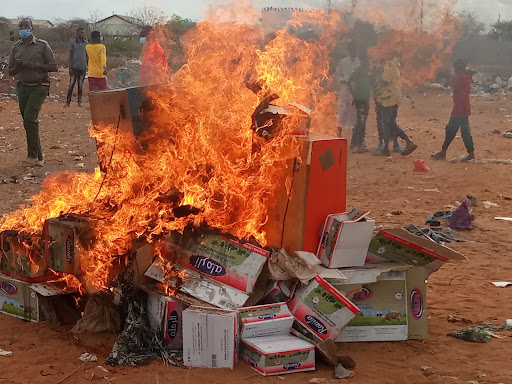
 Kenyan authorities set ablaze contraband products seized near the border with Somalia.
Low and middle-income countries (LMICs) today host an increasingly bizarre marketplace in which fake medicines, diluted baby formula, adulterated flour and sugar, recycled cooking oil, sham sanitary pads, toxic pesticides, counterfeit beer and whiskey, illicit cigarettes, fake fertilisers, and imitation household goods circulate with the confidence of legitimate commodities.
These aren’t isolated defects; they are symptoms of deep structural failures. Substandard and falsified products thrive precisely where markets and institutions malfunction, a phenomenon perfectly aligned with Hsiao’s Abnormal Market Theory, which explains why health-related markets in LMICs routinely defy normal rules of competition, transparency, and quality assurance. In such abnormal markets, the invisible hand doesn’t guide economic activity; it slaps the consumer.
The root causes of this crisis lie at the intersection of governance fragility, institutional gaps, and economic desperation. Institutional economics teaches that markets depend on strong institutions, rules, enforcement, trust and coordination to function efficiently. In many LMICs, however, regulatory bodies remain underfunded, understaffed and under-equipped, creating institutional voids where counterfeiters flourish with entrepreneurial zeal.
In West Africa, Southeast Asia and parts of Latin America, national drug authorities operate with fewer resources than small private pharmacies, while customs departments lack modern scanning equipment or intelligence databases. These gaps, predicted by institutional economics, mean that informal networks, smugglers, and black-market actors step in to “govern” markets where the states have effectively retreated.
But institutional weakness alone does not explain the persistence of counterfeit economies. Regulatory Capture Theory offers further insight; regulators in several LMICs often become beholden to the very industries they are meant to police. Whether through bribery, political pressure, or collusion, oversight agencies, especially those monitoring pharmaceuticals, food imports and consumables, can be co-opted by powerful interest groups.
This capture transforms regulators from watchdogs into doormats, enabling counterfeit products to move through borders with embarrassing ease. When smuggling cartels and illicit manufacturers can influence regulatory decisions, enforcement becomes selective, inspections become symbolic, and consumers become collateral damage.
Economically, poverty exacerbates the counterfeit crisis. Households faced with minimal disposable income make decisions that follow Rational Choice Theory even as they violate public health logic. Cheap powdered milk mixed with starch, knock-off condoms, or cut-price antibiotics sold in informal markets appear rational purchases when survival trumps safety.
These choices are made within skewed market environments distorted by information asymmetry, consumers cannot distinguish genuine from fake, which aligns with Akerlof’s Market for Lemons Theory, ‘bad products drive out good ones until only the worst remain dominant’.
The counterfeit wave has created a public health landscape shaped by what scholars call the Political Economy of Health. Health outcomes are not merely biological; they are political, economic and institutional products. Where elites tolerate counterfeit markets, where regulators are weak, and where consumers lack economic power, disease proliferates.
Substandard antimalarials in parts of Southeast Asia have fueled treatment failure and drug resistance, fake antibiotics in West African markets contribute to rising antimicrobial resistance, adulterated cooking oil and pesticide residues in South Asia have led to chronic cardiovascular and metabolic diseases, and illicit alcohol in Eastern Europe and West Africa has caused mass poisonings, blindness and death. These outcomes mirror the predictions of health production models: when the inputs (food, medicines, consumer goods) are systematically compromised, the outputs (population health and life expectancy) collapse.
Counterfeit markets also behave like Complex Adaptive Systems, where individual actions (smuggling, bribery, informal trading) accumulate into systemic patterns that are difficult to reverse. These markets self-organise, learn, adapt and mutate. When governments crack down on fake medicines, counterfeiters shift to contraband baby formula.
When alcohol raids increase, production sites move deeper into rural or cross-border zones. The actors (smugglers, corrupt officials, informal traders) interact dynamically, forming resilient networks that respond to policy pressure the way bacteria respond to antibiotics, ‘by evolving’. This complexity means traditional enforcement (raids, seizures, press conferences) rarely produces lasting change.
Economically, the impacts are brutal and predictable. Market Failure Theory helps explain why legitimate producers collapse when forced to compete with untaxed, unregulated counterfeit goods. Soap makers in West Africa, textile manufacturers in South Asia, dairy cooperatives in Latin America and household-goods producers across the Caribbean routinely lose market share to inferior, cheaper imports.
Governments, too, bleed revenue as tax evasion and smuggling gut national budgets, a reality consistent with Public Finance Theory, which highlights how weakened revenue collection undermines public service provision. Meanwhile, exploding health expenditures resulting from poisoning, chronic toxicity, organ failure and drug-resistant infections tighten the chokehold on already overstretched health systems, deepening Poverty Trap dynamics for households and nations alike.
Socially, the crisis corrodes trust in ways predicted by Social Capital Theory. When mothers cannot trust baby formula, when patients cannot trust antibiotics, when families cannot trust the cooking oil or sugar they buy, the social contract frays. Inequality widens as wealthier households insulate themselves with imported premium goods while low-income families are left to navigate dangerous informal markets.
As counterfeit trade intersects with organised crime networks seen in parts of Latin America and West Africa, the state’s authority erodes further, validating predictions from Shadow Economy Theory and criminological models linking weak governance to illicit enterprise.
Leadership failures stand as the common denominator. LMICs rarely lack policies; they lack implementation. If political leaders fought counterfeit goods with the same enthusiasm they reserve for election campaigns, the problem would shrink dramatically.
But governance in many settings fits the pattern described by New Public Management critiques, ‘leaders prioritise visibility over substance, launching anti-counterfeit task forces that appear energetic on television but vanish off-camera’. Without genuine accountability (legal, administrative and political) such initiatives remain cosmetic.
Yet solutions exist and align with well-established frameworks. Strengthening regulatory agencies through funding, autonomy and digital surveillance reflects the prescriptions of Institutional Strengthening Models.
Modernising borders through risk-based screening and regional cooperation matches Collaborative Governance Theory, acknowledging that counterfeit trade is transnational. Empowering consumers with knowledge aligns with Human Capital and Behaviour Change Theories. Supporting local manufacturing through coordinated industrial policy addresses structural gaps identified in Industrial Economics. And establishing uncompromising accountability through prosecution, deterrence and transparency directly confronts the rent-seeking behaviours identified by political economy models.
The plague of substandard medicines, contraband foods, fake alcohol, counterfeit household goods, and toxic tobacco is not an economic accident; it is a leadership failure. Substandard and falsified goods cost LMICs their health, their industries, their public revenues and their future. They distort markets, collapse industries, poison populations, shrink life expectancy, empower criminal networks and erode the legitimacy of the state.
The counterfeit economy survives because institutions tolerate it. After all, poverty sustains it, and because leadership has yet to declare it an existential threat. Until that changes, counterfeit products will remain the reigning monarchs of LMIC markets, crowned not by merit, but by the vacuum left where effective governance should be. If leaders act boldly, this tide can be reversed. If not, the counterfeit economy will continue to flourish, efficient, innovative, and devastatingly lethal, while citizens pay the ultimate cost for bargains they never truly chose. In the end, nothing is more expensive than a substandard or falsified product.
Dr Mugambi is a healthcare leadership scholar at the University of Oxford’s Saïd Business School and the Nuffield Department of Primary Care Health Sciences.




![Africa CDC Director General Dr Jean Kaseya at a past event. [Photo: Arthur Mbuguah, WHM]](https://cdn.radioafrica.digital/image/2026/10/8ced213c-affb-4dff-97ca-1b6bac1f958e.webp)