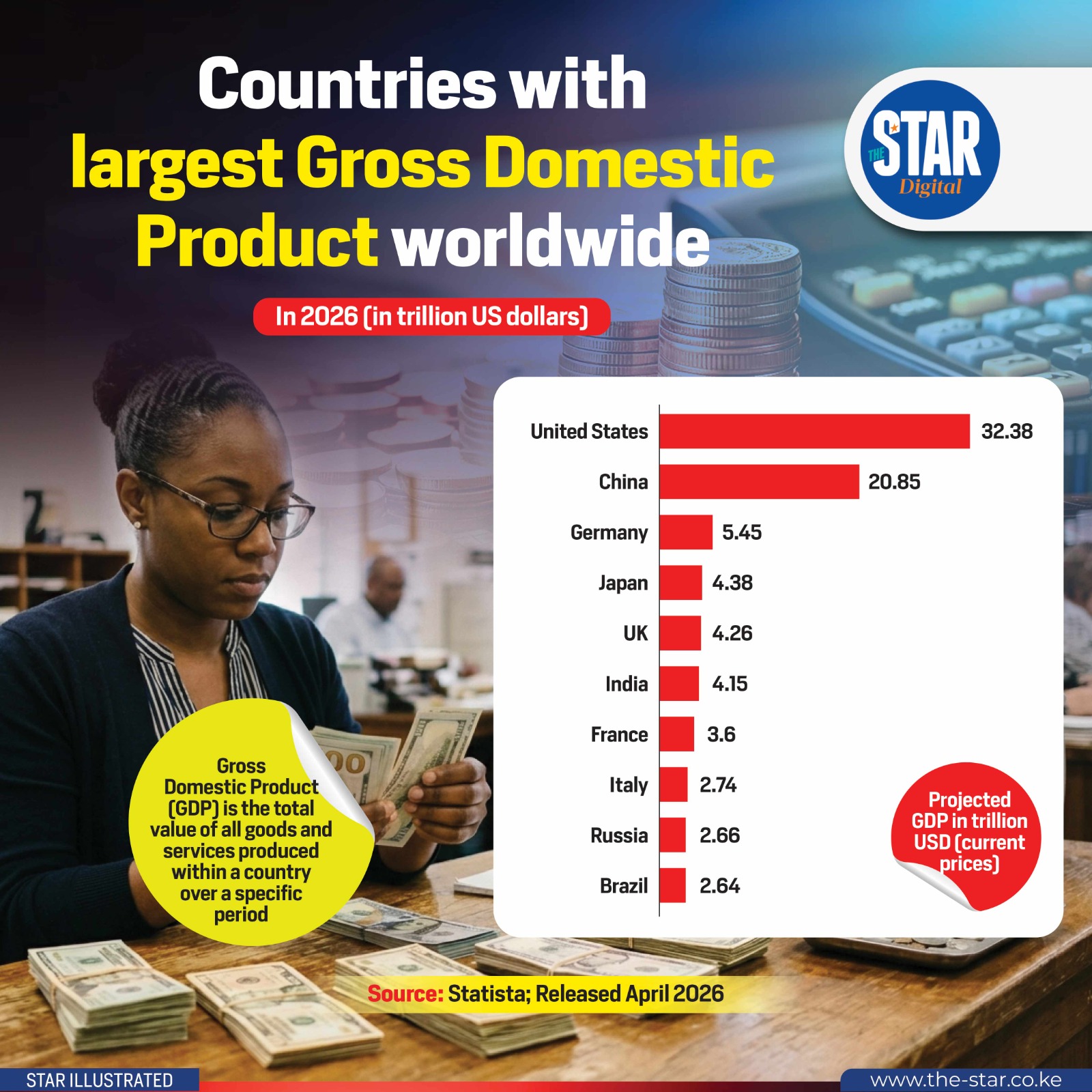
The landscape of global economic dominance in 2026 continues to be defined by a massive gap between the world’s two largest economies and the rest of the international community.
Projections for the year place the United States firmly at the summit of global wealth, with a Gross Domestic Product reaching 32.38 trillion dollars. This figure represents the total value of all goods and services produced within the country at current prices, maintaining its position as the primary engine of the global economy.
China holds its position as the world's second-largest economy with a projected GDP of 20.85 trillion dollars, roughly two-thirds the size of the American economy but significantly ahead of its closest European and Asian competitors.
The data highlights a stark drop-off following these two superpowers. Germany follows as the third-largest economy at 5.45 trillion dollars, narrowly leading Japan at 4.38 trillion dollars and the United Kingdom at 4.26 trillion dollars.
The middle tier of the top ten economies shows a highly competitive landscape. India’s economy is projected at 4.15 trillion dollars, placing it within striking distance of the UK and Japan.
France maintains its standing with 3.6 trillion dollars, while Italy, Russia, and Brazil round out the global top ten. Italy sits at 2.74 trillion dollars, followed by Russia at 2.66 trillion dollars and Brazil at 2.64 trillion dollars. These figures underscore a world where economic influence is heavily concentrated, with the US and China operating on a scale that dwarfs the combined output of several other top-ten nations.





Comments 0
Sign in to join the conversation
Sign In Create AccountNo comments yet. Be the first to share your thoughts!