
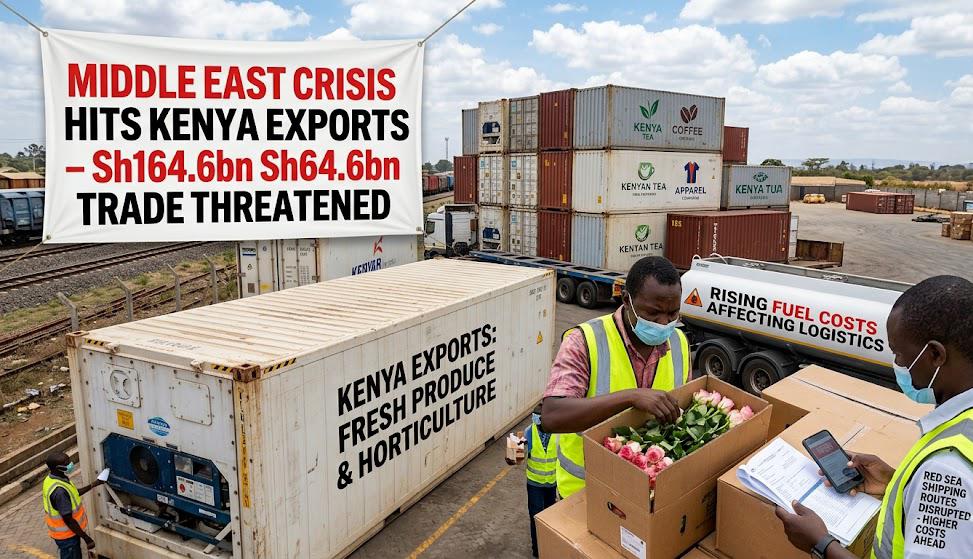
 Kenyan port /AI ILLUSTRATED
 Kenya has warned of mounting pressure on its export sector as the ongoing Middle East crisis disrupts global trade routes, raising costs and threatening key markets for Kenyan goods.
In a statement on Tuesday, the Ministry of Investments, Trade and Industry said the geopolitical tensions could affect exports worth about Sh164.6 billion annually to the Middle East, a region described as one of Kenya’s fastest-growing and most strategic markets.
The ministry said Kenya’s exports hit a record Sh1.1 trillion in 2024, driven by strong performance in horticulture, tea, apparel and emerging manufacturing.
However, the current crisis is now undermining these gains, particularly for high-value and time-sensitive products.
“The ongoing crisis in the Middle East continues to exert significant pressure on global trade systems, with direct implications for Kenya’s export sector,” the cabinet secretary said in the statement.
Beyond direct exports, the Middle East plays a central role in global logistics as a major transshipment hub.
Disruptions in the region are therefore affecting not only trade with Gulf countries but also Kenya’s access to markets in Europe, Asia and North America.
Shipping and air transport have been particularly hit, with key routes through the Red Sea and Gulf corridors facing restrictions and suspensions.
As a result, transit times have increased by between 10 and 20 days, while freight costs have risen sharply.
Air cargo delays of up to 48 hours are also being reported, posing a major risk to perishable exports such as flowers and fresh produce, which rely on timely delivery to maintain quality.
The ministry said the disruptions are already being felt across several sectors.
Floriculture exporters are incurring weekly losses due to spoilage and delayed shipments, while meat exports in some cases have dropped to less than 5 per cent of normal volumes.
Dairy and other agricultural sectors are also experiencing reduced export flows.
Tea exports, which account for up to 35 per cent of shipments to the Middle East, are facing declining prices and reduced market access.
At the same time, rising global oil prices linked to the crisis are increasing production and transport costs.
Fuel accounts for up to half of logistics expenses, further eroding the competitiveness of Kenyan exports in international markets.
The government also warned of potential impacts on diaspora remittances, noting that more than 400,000 Kenyans work in Gulf countries in sectors such as hospitality, construction and domestic services.
To cushion the economy, the government has rolled out a series of measures, including a temporary reduction of VAT on petroleum products from 16 per cent to 8 per cent to ease fuel costs.
It has also activated a multi-agency framework to monitor fuel prices, freight costs and supply chain stability, with a focus on protecting key sectors such as horticulture, tea, coffee, livestock and manufacturing.
Authorities are working with Kenya Airways, international carriers and logistics partners to secure alternative cargo routes and minimise disruptions.
Efforts are also underway to improve efficiency at major entry and exit points, including the Port of Mombasa and Lamu Port, to reduce delays and maintain the flow of goods.
In the longer term, the government is pushing to diversify export markets and reduce reliance on single transit corridors, while strengthening regional and continental trade frameworks.
Kenya remains committed to supporting farmers, manufacturers and exporters as it navigates the challenges posed by the evolving global environment.







