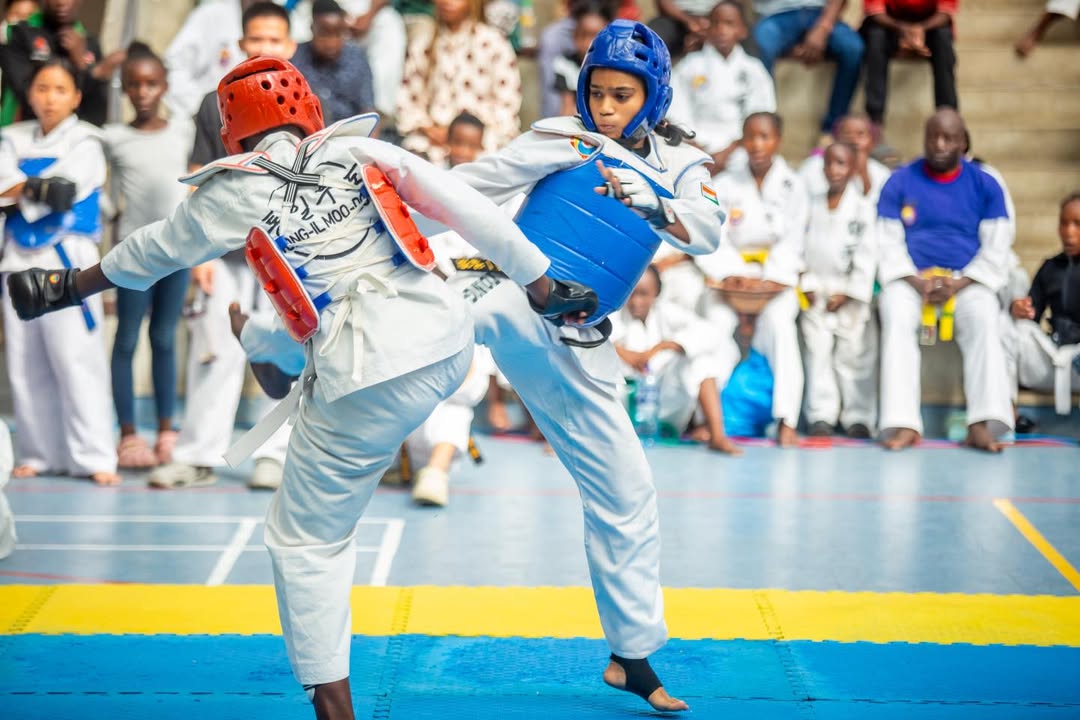
 Action during the Mombasa Open Championship/ KENYA TONG-IL MOO-DO FEDERATION
Kenya has quietly emerged as a driving force behind the global rise of Tong-Il Moo-Do.
Over the years, Kenya has evolved into a key hub for the discipline in Africa, serving as a launchpad for its spread across the continent and cementing its place on the international map.
Central to that growth has been the annual Mombasa Open International Championship, a flagship event that has, for more than a decade, drawn competitors from across the world and significantly boosted the sport’s global profile.
Tong-Il Moo-Do is a Korean unified martial art that fuses techniques from Karate, Taekwondo, Aikido, Judo and Tai Chi into one fluid and dynamic system.
It is as much about philosophy as it is about combat, built on the principles of harmony and righteousness, while placing strong emphasis on character development, self-defence and discipline.
At the core of the sport lies the “Unification Principle,” a concept that blends hard, linear movements with soft, circular techniques to create a balanced and adaptable fighting style.
In competition, Tong-Il Moo-Do is played as a full-contact sport that combines striking and grappling, allowing athletes to showcase a wide range of techniques including kicks, punches, throws, joint locks and ground fighting.
Matches are typically structured across three key segments: sparring, forms and special techniques.
Sparring involves controlled but intense exchanges, where fighters score through clean, effective strikes and, in certain formats, grappling manoeuvres that assert dominance.
Forms, also known as kata or poomsae, are choreographed sequences that test an athlete’s precision, balance, rhythm and technical execution, while special techniques often involve board-breaking demonstrations that highlight power, accuracy and control.
Competitors step onto the mat equipped with protective gear such as chest guards, headgear, gloves and shin guards, ensuring safety while maintaining the sport’s competitive edge.
Scoring varies across different segments but is rooted in clarity and execution; in sparring, points are awarded for clean hits to legal target areas and for techniques that clearly outmatch an opponent, while in forms, judges evaluate performance based on technical accuracy, strength, speed and overall presentation.
Ultimately, victory is decided by the total points accumulated, rewarding athletes who combine skill, discipline and tactical awareness.
Tong-Il Moo-Do was officially founded on April 15, 1979, by Dr Joon Ho Seuk, marking the birth of a unified martial art that would grow far beyond its origins.
Its early development included a notable training exhibition at the Belvedere Training Centre in the United States, setting the tone for its structured global expansion.
Today, the sport is governed internationally by the World Tong-Il Moo-Do Federation, with national bodies such as the Kenya Tong-Il Moo-Do Federation overseeing technical standards, belt grading systems and staging of competitions at the local level.
The pinnacle of Tong-Il Moo-Do competition remains the Mombasa Open Tong-Il Moo-Do International Martial Arts Championship—an event that has grown into the sport’s most prestigious global gathering.
Since attaining World Championship status in 2013, it has attracted hundreds of athletes from more than 20 countries across Africa, Asia and other regions, turning Kenya into the beating heart of the discipline.